HOW TO HIRE · ELECTRICAL · CHECKED OCTOBER 2026
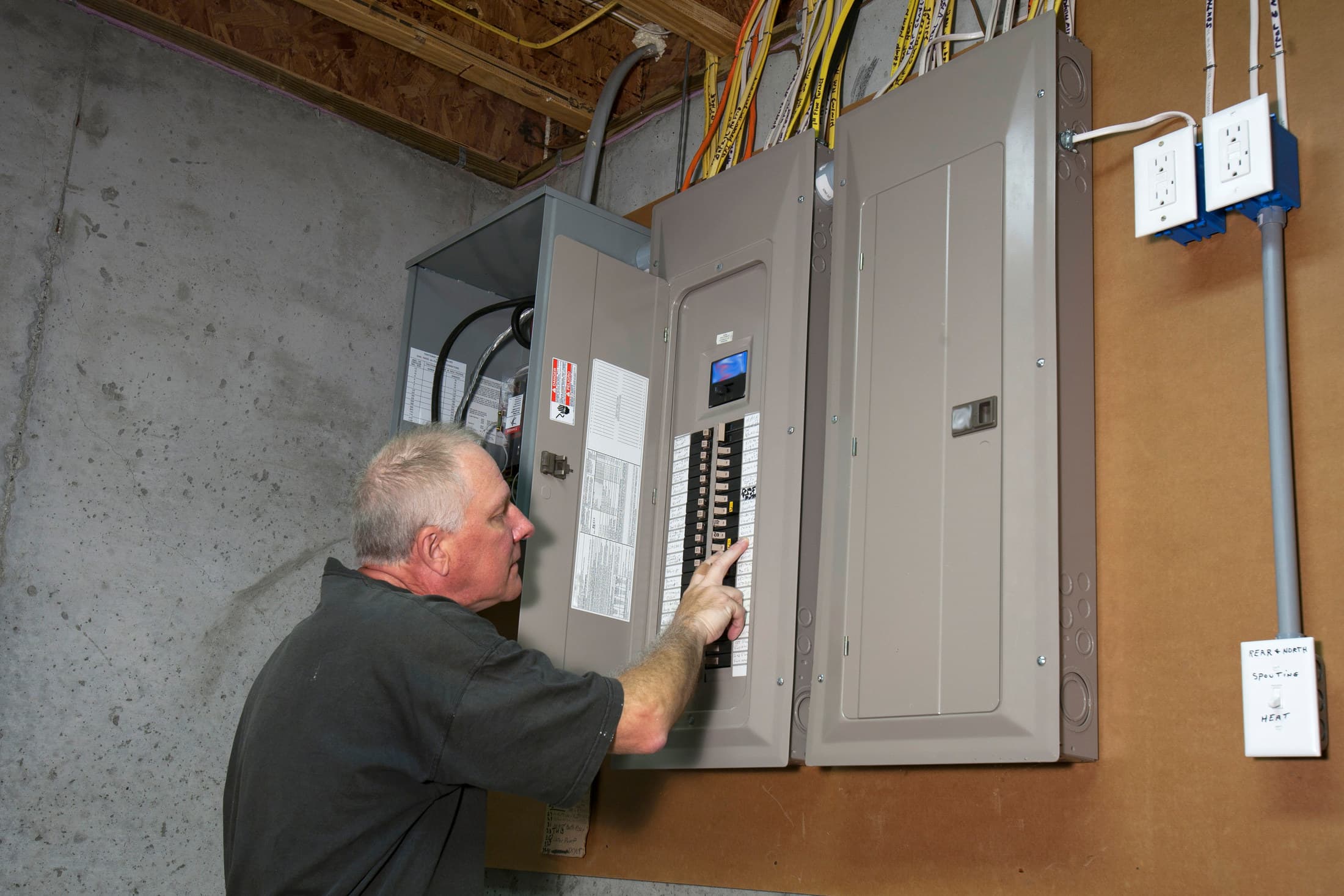
How to hire a consumer unit installer in the UK
The checks, the questions and the paperwork.
Swapping a consumer unit is always notifiable in England and Wales. How to check the electrician, what to ask, and the two certificates you should get.
- Search and compare — no account needed
- Nearest to you first
- One score from Google, Trustpilot and Locufy reviews
THE 60-SECOND VERSION
Hiring a consumer unit installer in five steps
- Check the register firstIn England and Wales, a consumer unit swap is notifiable: search the business on the Registered Competent Person Electrical register.
- Send a photo of the old boardA clear picture of the fuse box, the meter tails and the earthing, so the quote reflects what is actually there.
- Compare like for likeSame board type, the same RCBO or RCD layout, surge protection in or out, and VAT shown.
- Plan the day without powerA board change usually takes a working day with the power off; fridge, freezer and working from home need planning.
- Get both certificatesThe Electrical Installation Certificate on the day, and the Building Regulations compliance certificate from the scheme afterwards.
BEFORE YOU BOOK
Check before you book
Registered Competent Person Electrical
In England and Wales, a new or replacement consumer unit is notifiable building work every time, whatever the room. So the consumer unit upgrade is either self-certified under the Building Regulations by an electrician on a government-authorised competent person scheme, such as NICEIC or NAPIT, or notified to building control before it starts, and you pay for that inspection. Public liability insurance is the norm for the consumer unit upgrade; ask who the insurer is and the cover limit. Your Consumer Rights Act 2015 protections for the consumer unit upgrade apply because you are dealing with a trader, and if you agree the consumer unit upgrade at home or online the Consumer Contracts Regulations 2013 usually give you 14 days to cancel — but you pay for any work you asked to start within those days, and goods made to your own specification are outside the right.
Search the business name on the register before you agree the consumer unit upgrade. Request the current insurance schedule before the consumer unit upgrade, and look at the profile badges for trader status and ID. electricalcompetentperson.co.uk →
Electrical Installation Certificate
When the consumer unit upgrade is finished, every circuit connected to the new board is tested and recorded on an Electrical Installation Certificate to BS 7671. Because the consumer unit upgrade is notifiable, the scheme also issues a Building Regulations compliance certificate: gov.uk says within 8 weeks in England, and the Welsh Government says the electrician should arrange it within 30 days.
Get the certificate and its schedule of results on the day the consumer unit upgrade is completed. gov.wales →
Building warrant (Scotland) and Northern Ireland
Scotland has no competent person register for electricians: the consumer unit upgrade must meet building standard 4.5 (wiring to BS 7671), and whether a warrant is needed depends on the building, so ask the council's building standards service if it is part of wider work. Northern Ireland has no Part P-style notification rule for home wiring, which covers the consumer unit upgrade too.
Scottish homeowners should ask whether the consumer unit upgrade needs a warrant before work starts, and who will certify it. gov.scot →
Landlord electrical safety report
If you let the property, the new board is a good moment for the five-yearly inspection: private landlords in England (2020 Regulations) and Northern Ireland (from 1 April 2025) must have the installation inspected and tested at least every 5 years and give tenants the report; Wales sets the same five-year limit through its fitness for habitation rules.
Ask the electrician whether the consumer unit upgrade can be followed by an EICR on the same visit. legislation.gov.uk →
VAT
VAT on replacing a consumer unit is charged at the standard 20%, and any business turning over more than £90,000 a year in taxable sales has to register, add it to the price and set it out on its own line.
Ask for the VAT number, and look for VAT as its own line on the board-change quote. gov.uk →
A good answer: A named scheme and an entry on the Registered Competent Person Electrical register you can see yourself. 'I'll get it signed off by a mate' is the end of the conversation.
A good answer: A look at the existing circuits, the earthing and the meter tails. Faults on old circuits often show up only when a modern board with RCD protection goes in, and a good electrician warns you.
A good answer: An honest explanation of the difference — one fault tripping one circuit rather than half the house — and the price of each.
A good answer: A clear yes or no, priced as its own line so the quotes can be compared.
A good answer: An agreed plan: the fault is explained, priced and fixed with your consent, or the circuit is left safely disconnected and recorded.
A good answer: A time estimate for the consumer unit upgrade, usually a working day, and a plan for anything that cannot go off — a freezer, a stairlift, a home office.
A good answer: The scheme, after the electrician notifies the work; gov.uk says within 8 weeks in England, and the Welsh Government says within 30 days.
Getting the quote right
- The make and type of consumer unit, and how many RCBOs or RCDs it has
- Surge protection, meter-tail upgrades and earthing or bonding work as separate lines
- Testing, the Electrical Installation Certificate and the scheme notification included
- What happens, and at what rate, if an existing circuit fails its tests
- Who actually attends — the registered electrician doing the board change, employed or subcontracted — and the business's VAT number, with VAT at 20% shown as its own line
- A written date and a time estimate for the day without power
Walk away if
- No competent person scheme and no plan to notify building control for the consumer unit upgrade
- A quote given over the phone without seeing the old board
- No Electrical Installation Certificate, or 'the certificate costs extra'
- Pressure to replace the whole board when one breaker is the problem, without testing to show why
- Cash only, or full payment before the board is fitted
What a consumer unit installer costs: £350–£750 per unit
A consumer unit upgrade is quoted as a fixed price for the board, its fitting and testing; surge protection, extra RCBOs and repairs to faulty circuits are usually added lines. Consumer Unit / Fuse Board Upgrade price guide →
Guide prices compiled by the Locufy team from published Irish and UK provider price lists and 2026/27 cost guides. Updated 2026.
KNOW WHAT TO LOOK FOR? NOW FIND ONE
Consumer unit installers near you, with the badges that matter shown
ID checked, trader status and one score from every review — on the card, before you message anyone. Nearest first. No account needed to look.
Or post the job free and let them come to you.
- SurveyThe electrician looks at the old board, the meter tails and the main earth before quoting, and tests the existing circuits if anything looks doubtful.
- IsolateThe supply is switched off at the main switch; work on the supplier's fuse or meter is for the network operator, which the electrician arranges.
- Change the boardThe old unit comes out, the new one goes in, and each circuit is connected to its own protective device.
- Test every circuitContinuity, insulation resistance, earth fault loop impedance and RCD trip times are measured before the power is restored.
- Certify and notifyYou receive the Electrical Installation Certificate; the electrician notifies the work through the scheme, which sends the compliance certificate.
- Consumer unit
- The fuse box where the supply is split into circuits.
- RCBO
- A breaker and RCD in one, protecting a single circuit.
- Split-load board
- A board where groups of circuits share an RCD; one fault trips the whole group.
- SPD
- Surge protection device: guards the installation against voltage spikes.
- Meter tails
- The heavy cables between the meter and the consumer unit.
- Compliance certificate
- The scheme's certificate that the notifiable work meets the Building Regulations.
AFTER
When the job is done
Hiring a consumer unit installer: questions people ask
In England and Wales it is notifiable work: either a scheme-registered electrician self-certifies it, or building control is notified before the work starts and inspects it, for a fee.
An Electrical Installation Certificate from the electrician on the day, and a Building Regulations compliance certificate from the scheme afterwards — within 8 weeks in England, according to gov.uk.
£350–£750 a unit, typically around £525. Surge protection, RCBOs and any fault found on the old circuits move the price. See the Consumer Unit / Fuse Board Upgrade price guide for the detail, then search your postcode above to compare consumer unit installers nearby.
Modern RCD protection reacts to faults the old fuses ignored. The electrician should have found them in testing; if not, ask them back to trace the fault.
Scotland has no competent person register: the board must meet building standard 4.5 (BS 7671), and the council's building standards service can say whether wider work needs a warrant. Northern Ireland has no Part P-style notification scheme for home wiring.
Yes, but plan for a day without power. A good electrician will tell you roughly when it goes off and when it comes back.
MORE GUIDES
More hiring guides in electrical
Consumer unit installers near you
Sources — checked October 2026
- gov.uk — Approved Document P: electrical safety in dwellings (England)
- Registered Competent Person Electrical register
- gov.uk — building work, replacements and repairs to your home (England)
- gov.wales — building regulations: electrics
- gov.scot — Building Standards Technical Handbook 2022 (domestic), standard 4.5 electrical safety
- gov.uk — building regulations: use a competent person scheme
- Electrical Safety Standards in the Private Rented Sector (England) Regulations 2020
- Electrical Safety Standards for Private Tenancies Regulations (Northern Ireland) 2024
- Renting Homes (Fitness for Human Habitation) (Wales) Regulations 2022, regulation 6 — electrical safety
- Consumer Rights Act 2015, section 49 — reasonable care and skill
- Consumer Rights Act 2015, section 54 — what you can ask for when a service falls short
- Consumer Contracts Regulations 2013, regulation 30 — the 14-day cancellation period
- Consumer Contracts Regulations 2013, regulation 28 — contracts the cancellation right does not cover
- Consumer Contracts Regulations 2013, regulation 36 — services started within the cancellation period
- Civil Procedure Rules Part 26 — the small claims track limit (England and Wales)
- Scottish Courts and Tribunals — making a claim under simple procedure
- nidirect — the small claims process (Northern Ireland)
- Buildings and construction (VAT Notice 708) — 2.1 Construction services: work to an existing building is normally standard-rated
- GOV.UK — VAT rates
- GOV.UK — Register for VAT: when to register