DIY GUIDE · VEHICLES & TRANSPORT · CHECKED OCTOBER 2026
How to valet a car yourself
A morning. €67–€120 for a starter kit of shampoo, buckets, mitts, towels and cleaners.
Wheels first, two buckets, roof down, dry it before it spots, then the inside from the top down.
- Every step, start to finish
- Checked October 2026 — sources at the end
- Honest about when to call a pro
FIRST, THE HONEST ANSWER
Do it yourself, or get a cleaner?
Do it yourself if…
- You have a driveway, a yard or a lawn where you can wash the car without the water running into a road gully
- You have a hose with a trigger nozzle, or a pressure washer, and a vacuum that reaches into the car
- The paint is in reasonable condition and you want it clean and protected rather than restored
- You can work out of strong sun, or early or late in the day when the panels are cool
- You are happy to spend a few hours bent over wheels and footwells
Get a pro if…
- The interior has mould, a spilled liquid that has soaked into the foam, or a smell that has lasted weeks
- There are pet hairs worked deep into the carpet and seats and you have no strong vacuum
- You have nowhere to wash the car without the run-off going down a surface water drain
- The paint has swirl marks, scratches or a dull, chalky look; that is a detailing job, covered in its own guide
- The car is being sold or handed back on a lease, and the finish has to be inspection-ready
Safety first
- Read the label of every product before use and keep each one in its original container. The safety regulator's guidance on household chemicals, including car cleaning products, is to follow the instructions and never mix products.
- Wear gloves for wheel cleaners and tar removers, and eye protection when spraying above shoulder height. Strong wheel cleaners can burn skin and eyes.
- Keep products away from children and pets, and never decant them into drinks bottles.
- Keep a pressure washer's jet off people, pets, tyres' sidewalls and electrical connections, and keep its cable and plug dry and away from standing water.
- Do not let wash water or chemicals run into a road gully. In Irish towns the surface water drain usually carries rainwater straight to a river, and releasing polluting matter to drains, including across hard surfaces, counts as water pollution.
- Ventilate the car when using interior cleaners, and do not run the engine to warm it up in a closed garage.
| MATERIAL | COVERAGE | FOR THIS JOB |
|---|---|---|
| Car shampoo | The dose on the bottle; the one we read uses 2 capfuls to 10 litres | One bucket for most cars |
| Wheel cleaner | To suit your wheel finish | Enough for four wheels, one at a time |
| Tyre dressing | Water-based for a satin finish | A thin coat on four tyres |
| Glass cleaner | Ammonia-free if you have tinted film | All glass, inside and out |
| Interior shampoo and leather cleaner | One for fabric and plastics, one for leather | As the stains need |
| Spray wax or sealant | Applied to clean, dry paint | One light coat |
How much shampoo for your bucket
36 m² of wall → 7.2 L for 2 coats. Buy about 7.5 L.
Shampoo dose = bucket volume ÷ the volume on the label × the dose on the label. For a shampoo dosed at 2 capfuls per 10 litres, a 20-litre bucket filled to 15 litres needs 15 ÷ 10 × 2 = 3 capfuls.
Fill the rinse bucket with plain water only. If the shampoo bucket goes grey before the car is done, empty it and mix a fresh one.
Washing-up liquid is made to strip grease, and that includes the wax or sealant protecting your paint. A car shampoo lifts dirt without stripping protection. The one we read is used at 2 capfuls to 10 litres of water, which shows how little you need; more foam does not mean more cleaning.
One bucket holds the shampoo, the other plain water for rinsing the mitt. A grit guard is a plastic grid at the bottom of the rinse bucket that lets dirt settle out of reach. Together they stop you rubbing grit from the bottom of the car over the bonnet.
A deep-pile microfibre wash mitt holds dirt away from the paint far better than a sponge. A large microfibre drying towel dries a car in one pass without water spots. Keep separate cloths for glass, for the interior and for wheels, and never use a wheel cloth on paint.
Wheel cleaners range from gentle, pH-neutral sprays to strong acidic ones. The strong acidic cleaner we read is for standard painted or lacquered wheels only, not for chrome, polished or specialist finishes. If you do not know what your wheels are, use a pH-neutral cleaner.
An interior shampoo cleans fabric and hard plastics; a separate leather cleaner suits leather seats. Screens and touch controls need only a barely damp microfibre cloth, as the interior cleaner we read is not for infotainment screens. Glass needs its own cleaner and a clean, dry cloth.
A spray wax or spray sealant applied after drying adds gloss and makes the next wash easier. It is not the same as the polish or long-life coating in our detailing and ceramic coating guides; it is maintenance.
THE PART THAT DECIDES THE FINISH
Preparing the car — by what you start with
How dirty the car is and where it lives decide what you do before the mitt touches the paint. Find your car below and do its list first.
A car in regular use, lightly dirty
Road film, dust and the odd bird dropping.
- Park in the shade, or wait until early morning or evening when the panels are cool to touch
- Empty the car: mats, child seats, rubbish and everything in the door pockets
- Soak any bird droppings with a wet cloth for a few minutes before washing; never scrub them dry
- Check where the water will run, and move the car onto grass or gravel if it would reach a gully
A car caked in mud or salt
After a winter, a farm lane or a beach.
- Rinse the wheel arches, sills and lower panels with plenty of water before anything else
- Let a pre-wash foam or traffic film remover sit on the lower half if the dirt is heavy, then rinse
- Never touch the paint with a mitt until the loose grit is gone
- Plan on refilling the rinse bucket more than once
Interior with pet hair or sand
Dogs, beaches and football boots.
- Take the mats out and beat them against a wall before vacuuming
- Use a rubber glove or a pet-hair brush on the seats and carpet to bundle hair before vacuuming
- Slide the front seats fully forward and back to reach the runners
- Work sand out of the carpet with a stiff brush before the vacuum
Interior with stains or spills
Coffee, milk, mud, grease or ink.
- Vacuum first; shampooing over grit grinds it in
- Test any cleaner on a hidden patch of the same fabric
- Blot fresh spills with a dry cloth rather than rubbing
- Treat grease or ink with a solvent cleaner sparingly on a cloth, then clean the whole panel so it dries evenly
Leather seats
Smooth or perforated leather.
- Vacuum the seams and perforations with a soft brush tool
- Use a cleaner made for leather, applied to a cloth, not sprayed onto the seat
- Keep water out of perforations and seat heater elements
- Have a separate dry cloth ready to wipe off cleaner straight away
THE JOB
How to valet a car
Set up and empty the car
15 minutesPark somewhere shaded, on grass or gravel if you can, with the windows shut. Fill one bucket with shampoo and water at the dose on the bottle and the other with plain water, with the grit guard in the rinse bucket. Take everything out of the car, including the mats. Then go to the section above and do the list for how your car starts.
- Lay out mitts, cloths and towels on a clean surface, not the ground
- Keep the products' caps on so nothing tips into the buckets
- Shake out the mats and lean them against a wall to dry later
Mistake to avoid: Starting in full sun. Shampoo and wheel cleaner dry on hot panels and leave marks that take longer to remove than the wash took.
Clean the wheels and tyres first
20 minutesWork on one wheel at a time, cool to the touch. Spray the wheel cleaner from the bottom up so it does not run in streaks, and let it work for the time on the label; the cleaner we read asks for 2-4 minutes and must not be left to dry. Brush the faces and between the spokes with the soft wheel brush, scrub the tyre wall with the stiffer brush, then rinse the wheel, the tyre and the arch thoroughly before the next.
- Never use the wheel brush or cloth anywhere on the paint
- Rinse the ground under the wheel straight after, as the cleaner we read asks
- Leave tyre dressing until the end
Mistake to avoid: Washing the body first and the wheels last. Brake dust and grime splash up onto clean paint.
Rinse the whole car from the top down
10 minutesRinse the roof, glass, bonnet, sides and then the lower panels with plenty of water, letting it carry loose dirt off. With a pressure washer, keep the lance moving, on a wide fan, and well back from the paint; go gently near badges, rubber seals and any chipped edges. The aim is to remove grit before anything touches the paint.
- Spend longest on the lower third, where the grit is
- Rinse door shuts and the fuel flap gently
- Do not aim a jet straight at window seals or into the engine bay
Mistake to avoid: Skipping the rinse. Every bit of grit left on the car becomes a fine scratch under the mitt.
Wash with two buckets, roof first
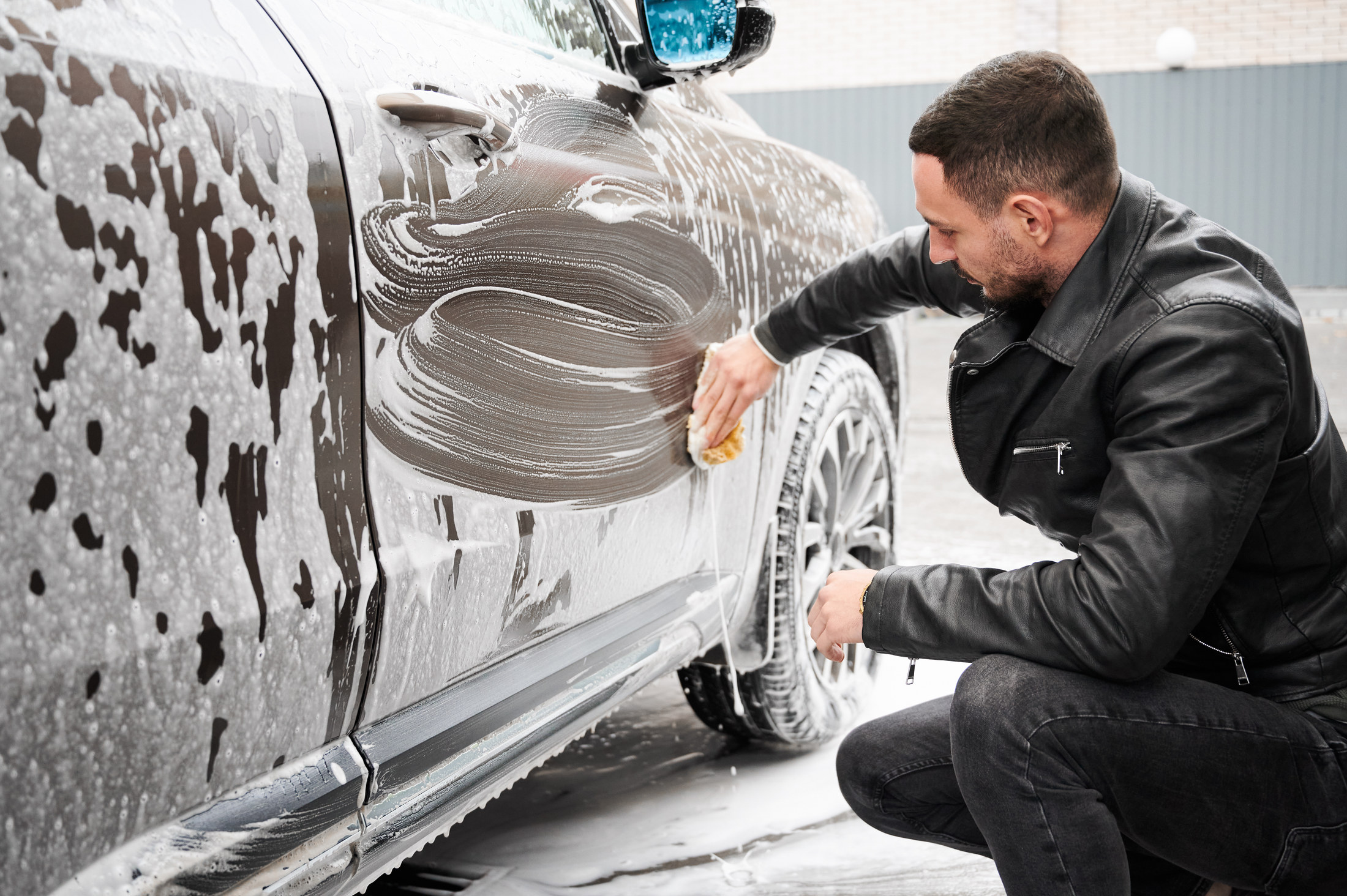
25 minutesDip the mitt in the shampoo bucket and wash the roof in straight lines, not circles, with light pressure. After each panel, rinse the mitt in the plain water bucket, rubbing it against the grit guard, then reload it with shampoo. Work down: roof, glass, bonnet and boot, upper sides, then the dirty lower panels last. Rinse each section before the shampoo dries.
- Let the mitt glide; pressing harder only drags grit
- If you drop the mitt, rinse it thoroughly or swap it for a clean one
- Wash the lower panels with a second mitt if they are heavily soiled
Mistake to avoid: Working in circles. Any fine scratches you make show up as swirls in sunlight; straight lines hide them.
Final rinse and dry
15 minutesRinse the whole car from the roof down, letting the water sheet off. Dry straight away with a large microfibre drying towel: lay it flat on a panel and draw it towards you, then fold it to a dry side. Open the doors, boot and fuel flap and wipe the shuts and sills. Water left to dry in Irish hard-water areas leaves white spots.
- Dry the glass first, then the roof, then work down
- Use a smaller towel for mirrors and badges, where water hides
- Wring the towel out when it gets heavy
Mistake to avoid: Letting the car air-dry. Hard water leaves limescale spots that need polishing out.
Glass and quick protection
15 minutesClean the outside glass with glass cleaner on one cloth and buff with a second dry cloth. Then apply a light spray wax or sealant to the dry paint, one panel at a time, following its label, and buff it off with a clean microfibre cloth. Finish with a thin coat of tyre dressing on an applicator pad, kept off the tread and off the paint.
- Wipe glass in one direction outside and the other direction inside, so you can tell which side a streak is on
- Use less spray wax than you think; excess smears
- Keep tyre dressing on the sidewall only, never the tread
Mistake to avoid: Getting tyre dressing on the tread. It makes the tyre slippery for the first few corners.
Vacuum the interior, top to bottom
30 minutesStart at the top: headlining edges, then the dashboard and vents with a soft brush tool, then the seats, then the carpet. Slide each front seat fully forward and back to reach underneath. Use the crevice tool along seat seams and the console sides. Vacuum the boot last, and lift its floor panel if there is a spare-wheel well.
- Brush air vents and seams while vacuuming so the dust goes straight into the vacuum
- Work in the same order every time so nothing is missed
- Check under the seats for coins and pens that will snag the vacuum
Mistake to avoid: Vacuuming the carpet first. Dust you knock off the dashboard falls onto it again.
Clean hard surfaces and screens
20 minutesSpray interior cleaner onto a microfibre cloth, not onto the dashboard, and wipe the dashboard, door cards, console, steering wheel and gear lever. Use a soft brush for switches and seams. Wipe screens and touch controls with a barely damp clean cloth only; the interior cleaner we read is not for infotainment screens. Clean the inside glass last.
- Spraying the cloth keeps cleaner off electronics and the glass
- Wipe the steering wheel and gear lever twice; they carry the most grime
- Do the inside of the windscreen with the back of your hand on the cloth to reach the bottom edge
Mistake to avoid: Spraying cleaner straight onto the dashboard. It runs into switches and onto the inside of the windscreen, which then smears in low sun.
Shampoo fabric and clean leather
30 minutesOn fabric seats and carpet, spray interior shampoo lightly, work it in with a firm sponge or brush, then lift the dirt with a clean, damp microfibre cloth, rinsing it often. Treat a whole panel at a time so it dries evenly. On leather, apply leather cleaner to a cloth, wipe a section, and dry it off straight away. Leave the doors open to let the fabric dry.
- Keep fabric damp, never soaked; water that reaches the foam smells for weeks
- Clean a whole seat panel, not just the stain, to avoid tide marks
- Do not use a hot surface; the shampoo we read is not for hot surfaces
Mistake to avoid: Soaking the seat. Water in the foam takes days to dry, and in an Irish winter it often turns to mildew.
Mats, final check and tidy up
15 minutesVacuum and shampoo the mats outside the car, and put them back only when they are dry. Walk round the car in daylight and look for missed spots. Empty the buckets onto grass or gravel, rinse the mitts and cloths in clean water and leave them to dry.
- Rubber mats can be scrubbed with shampoo water and rinsed
- Leave a window open a little on a dry day to help the interior dry
- Store products upright, capped, out of the reach of children
Mistake to avoid: Putting wet mats back in. Moisture trapped under them soaks into the carpet and fogs the windows.
The mistakes that show
- Using washing-up liquid, which strips the paint's protection
- Washing in strong sun so shampoo and cleaner dry in streaks
- One bucket and a sponge, which grind grit into the paint
- Letting the car air-dry into water spots
- Soaking fabric seats so they smell for weeks
- Letting dirty water run into a road gully
Stop here and get a car valeter
- There is mould in the seats or carpet, or a smell that cleaning has not shifted
- A liquid has soaked into the seat foam or under the carpet
- You have nowhere to wash the car without the water reaching a road drain
- The paint needs polishing or correction rather than washing
| WHAT YOU SEE | WHY, AND THE FIX |
|---|---|
| White spots all over the paint after washing | Water dried on the paint and left its minerals behind. Wash the panel again and dry it immediately. Spots that stay need a light polish. |
| Swirl marks visible in sunlight | Grit dragged across the paint by a sponge, a dirty mitt or circular washing. Change to two buckets, a grit guard and straight-line washing. Swirls already there need polishing, which is in the detailing guide. |
| Streaks on the inside of the windscreen | Residue from interior cleaner or a dirty cloth. Clean it with glass cleaner and two clean, dry microfibre cloths, one to clean and one to buff. |
| Tide marks on the seats after shampooing | Only the stain was cleaned, so the edge dried differently. Clean the whole seat panel evenly with a damp cloth and let it dry with the doors open. |
| A damp, musty smell after cleaning | Fabric or carpet was too wet, or mats went back damp. Dry the car with the heater on and the windows slightly open, and take the mats out until they are fully dry. |
| Smears or haze where spray wax was used | Too much product, or it was applied on a warm or damp panel. Buff it again with a clean, dry microfibre cloth; a fresh wipe with a little detailing spray lifts the rest. |
| Wheel cleaner left marks on the alloys | It dried on, or the wheels were warm, or it was the wrong cleaner for the finish. Rinse thoroughly. Stains on polished or chrome wheels may need a specialist cleaner. |
| The tyres look greasy and fling dressing onto the paint | Too much dressing. Wipe the excess off with a cloth and let the rest dry before driving. |
WHAT YOU SAVE
What it costs to do it yourself
| Car shampoo | €8.96–€26.40 |
|---|---|
| Valeting bucket and grit guard | €9.60–€16.80 |
| Wash mitt and microfibre cloths | €3.59–€17.99 |
| Wheel cleaner and tyre dressing | €17.95–€28.55 |
| Glass cleaner and interior shampoo | €26.74–€29.75 |
| Total | €67–€120 |
| DIY total | €67–€120 |
Guide prices compiled by the Locufy team from published Irish and UK provider price lists and 2026/27 cost guides. Updated 2026.
Prices from an Irish motor retailer's car-cleaning ranges for October 2026; most bottles last several washes, so the cost per valet after the first is small. The professional valet price, from the price guide, is shown alongside.
RATHER NOT?
Car valeters near you, with prices shown
The ones who cover your area, nearest first, with one score from every review. No account needed to look.
Or post the job free and let them come to you.
Tip leftover wash water onto grass or gravel, never into a road gully. Empty, rinsed plastic bottles go in the recycling; part-used tar removers, solvent cleaners and aerosols are household hazardous waste and go to a civic amenity site that accepts them, which the mywaste.ie locator shows.
Rinse the mitts and towels, wash them separately from other laundry without fabric softener, and air-dry them. Softener clogs microfibre and it stops absorbing.
Keep everything upright, capped and in its original container, out of the reach of children and away from frost.
A wash every two or three weeks with the same method keeps the car easy to clean; leaving it for months lets grime bond to the paint and trim.
Valeting a car: questions people ask
Yes. A full valet needs no special skill, only a careful order: wheels first, a thorough rinse, two buckets, roof down, dry straight away, then the interior from the top down.
Better not. It strips wax and sealant from the paint and leaves it unprotected. A car shampoo is made to clean without stripping protection.
One holds shampoo, the other plain water to rinse the mitt between panels. With a grit guard in the rinse bucket, the dirt stays at the bottom instead of going back onto the paint.
Washing your own car is not banned, but letting dirty water and chemicals run into a road gully is a problem: the surface water drain usually carries rainwater to a river, and polluting matter released to drains counts as water pollution. Wash on grass or gravel where you can.
A wash every two or three weeks and a full interior clean every couple of months suits most family cars.
The Locufy price guide for Ireland puts car valeting at €40–€150 per valet, with €80 typical, depending on the size of the car and how much is included.
MORE GUIDES
More DIY guides
Sources — checked October 2026
- Autoglym — Bodywork Shampoo Conditioner: 2 capfuls to 10 litres; work on a cool surface from the roof down; do not let it dry; dry with a microfibre towel
- Autoglym — Advanced All Wheel Cleaner: cool, dry wheel; apply from the bottom up; dwell 2-4 minutes; do not let it dry; rinse the driveway; standard lacquered or painted wheels only
- Autoglym — Interior Shampoo: vacuum first; spray lightly and agitate fabric; not on hot surfaces; not for infotainment screens
- HSA — Use Chemicals Safely at Home and in the Garden (car cleaning products; read the label; original containers; do not mix)
- MyWaste — chemicals: household hazardous waste, not in household bins, civic amenity sites
- MyWaste — aerosols: hazardous waste, to the civic amenity site
- Limerick City and County Council — water pollution: releasing polluting matter to drains, including via hard surfaces, is water pollution
- Dublin City Council — misconnection programme: the surface water drain carries rainwater to local rivers and streams
- Halfords Ireland — car shampoo price check, October 2026: €8.96–€26.40
- Halfords Ireland — sponges, brushes and buckets price check, October 2026: bucket €9.60, grit guard €7.20, wash mitt €3.59
- Halfords Ireland — car cleaning materials price check, October 2026: microfibre cloths €17.99
- Halfords Ireland — tyre and wheel cleaning price check, October 2026: wheel cleaner €11.72–€18.00, tyre dressing €6.23–€10.55
- Halfords Ireland — interior cleaning price check, October 2026: glass cleaner €11.39–€14.40, interior shampoo €15.35