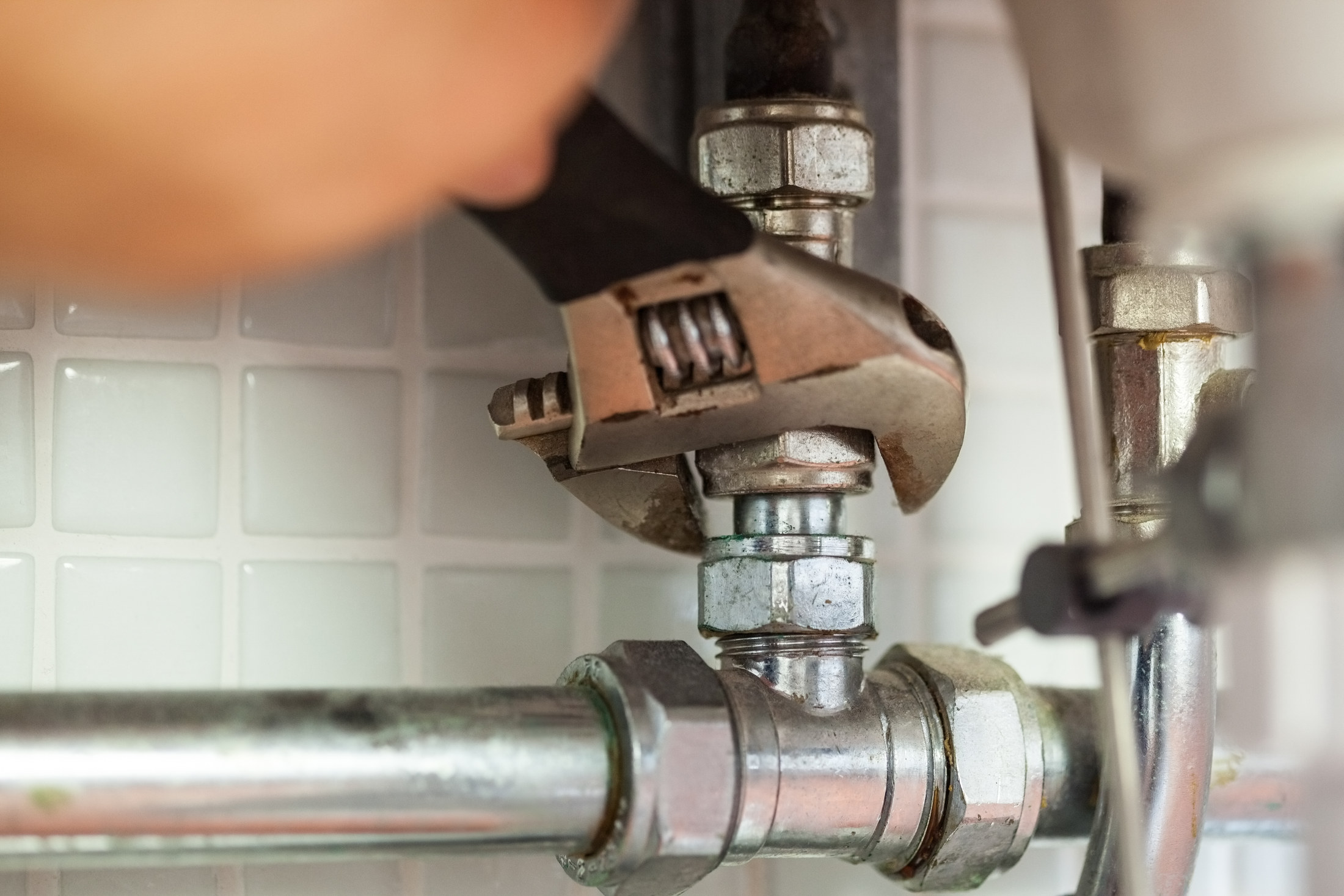
DIY GUIDE · PLUMBING & HEATING · CHECKED OCTOBER 2026
How to do the small plumbing jobs yourself
A morning. €10–€26 for a vent key, tap washers and a plunger, if you have none.
Bleed, top up the pressure, change a washer, clear a trap. Know where your stop valve is, and stop at the boiler case, the cylinder and the mains.
- Every step, start to finish
- Checked October 2026 — sources at the end
- Honest about when to call a pro
FIRST, THE HONEST ANSWER
Do it yourself, or get a plumber?
Do it yourself if…
- Your radiators are cold at the top, or the heating pressure gauge has dropped below its usual reading
- A tap drips and you can isolate it, or turn off the stop valve
- A basin or sink is slow and the blockage is in its trap or just beyond
- You know where your stop valve is and it turns
Get a pro if…
- The heating pressure drops again within days of topping up, or the relief pipe outside drips
- The boiler shows a fault code, makes unusual noises or you smell gas or fumes
- Water is coming through a ceiling or you cannot find where a leak starts
- Several drains back up at once, or the blockage is outside beyond your own chamber
Safety first
- Let the heating cool before you bleed or top up. The boiler maker we read says to add water only when the system is cold.
- Never take the cover off a gas boiler or touch its gas pipe or controls inside. If you smell gas, open the windows, leave the house and call the gas emergency line from outside.
- Bleed water is dirty and stains. Hold a cloth and container under the valve and keep it off carpets and walls.
- Kneeling at radiators and under sinks strains back and knees. The HSA's manual handling guidance counts posture and twisting as risks as well as weight; use a pad and take breaks.
- Keep water away from the boiler's electrics, sockets and any controls on the wall when you bleed or open a trap.
Stop here: Stop here: the gas side, pressurised cylinders and the mains
Bleeding radiators and using the filling loop are householder jobs, but anything inside a gas boiler's case, on its gas pipe or its flue is gas work, which Irish law restricts to a Registered Gas Installer; the CRU runs the scheme and prosecutes unregistered gas work. An unvented cylinder stores hot water under pressure and its safety valves are a danger in untrained hands. The supply pipe in the ground and the meter are not small jobs: leaks inside the house are the owner's to fix, as the CRU explains, and a leak on the external supply pipe may be repaired under Uisce Éireann's First Fix Free scheme. How to hire a plumber →
| MATERIAL | COVERAGE | FOR THIS JOB |
|---|---|---|
| Tap washers | The right size for your tap, usually half-inch | A small pack |
| Trap seals | Spare washers for the basin or sink trap if the old ones are flat | One set |
| Corrosion inhibitor | Only if your heating installer or the boiler manual says to add it after topping up | As the label says |
Is the pressure loss normal
Daily loss = (pressure after topping up − pressure one day later, both cold). If you top up to 1.0 bar and it reads 0.9 bar the next morning, the loss is 0.1 bar a day, which needs a plumber.
A sealed system should hold its pressure for weeks. A small drop after bleeding is normal; a steady drop every day is a leak somewhere.
Air collects at the top of radiators, especially upstairs and after any draining. The fix is bleeding with a vent key. The oil boiler maker we read says to vent a radiator if the top is cool and the bottom is hot, and warns that too much venting lowers the system pressure.
If your boiler or hot press has a pressure gauge, your system is sealed and has a filling loop. The same maker gives a normal cold pressure of between 0.5 and 1.0 bar for its sealed systems, rising a little when hot. Check the figure in your own boiler's manual. Many older Irish systems are open-vented instead, fed from a small tank in the attic, with no gauge; those never need topping up by hand.
A tap that turns several times to open has a rubber washer; a quarter-turn tap has ceramic discs; a single lever has a cartridge. A washer is the easiest small job of all. Discs and cartridges are matched by make and size.
Hair and soap in the bathroom, fat and food in the kitchen. A plunger and a cleaned trap clear most of them. Chemicals are a last resort.
If any of these keeps coming back — a system that needs topping up every week, a tap that drips again within days, a drain that blocks every month — there is an underlying fault. That is the point to call a plumber.
THE PART THAT DECIDES THE FINISH
Before you start — what kind of system you have
Find your boiler and your hot press, and match what you see to one of these.
Sealed system with a gauge
A boiler or a unit in the hot press with a pressure gauge and a filling loop: two valves joined by a short braided hose.
- Note the pressure on the gauge with the heating cold
- Find the filling loop and both of its valves; do not open them yet
- Find the boiler's user manual for its normal cold pressure
- Check the small relief pipe outside the house for drips
Open-vented system with an attic tank
No pressure gauge, a cylinder in the hot press, and a small tank for the heating in the attic beside the main cold tank.
- There is nothing to top up by hand; the small tank refills itself
- Look at the small tank occasionally to check its float valve works
- Bleed radiators as below when they are cold at the top
- If the small tank is empty or overflowing, call a plumber
Taps and traps
The tap that drips and the basin or sink that drains slowly.
- Find the isolating valve under the basin or sink, or the stop valve
- Check whether the tap turns several times, a quarter turn, or is a lever
- Empty the cupboard under the sink and lay towels
- Have a bucket ready for the trap
Heating that runs on gas
A gas boiler, usually with a flue through the wall and a gas meter.
- You can bleed radiators and use the filling loop, which are outside the boiler case
- Do not remove the boiler's cover or touch its gas pipe or controls inside
- If you smell gas, leave the house and call the gas emergency line from outside
- Know who services the boiler and when it was last done
THE JOB
How to do the four jobs
Set up: heating off and cool
30 minTurn the heating off at the programmer and let the radiators and the boiler cool. Bleeding hot radiators sprays hot water and, on a sealed system, a cold reading is the only one that means anything. Gather the vent key, cloths, a small container, the plunger, spanners and the bucket.
- Do the tap and trap first while the heating cools
- Note the pressure on the gauge before you start
- Open a window if you will use any cleaning chemical
Mistake to avoid: Bleeding radiators with the heating on. Hot water spits out round the key and scalds your hand.
Do the prep for your system
15 minThis is the prep from the cards above. Read the gauge, find the filling loop, check the relief pipe outside, find the isolating valves under the sink, and empty the cupboard. Know where the stop valve is before you open anything.
- Take a photo of the filling loop valves in their closed position
- Mark the normal pressure on the gauge glass with a dot of tape if it has no red marker
- Turn the stop valve once to make sure it moves
Mistake to avoid: Opening a filling loop you have not traced. You may be opening the wrong valve, or one that drains instead of fills.
Bleed the radiators
30 minStart at the radiator furthest from the boiler on the lowest floor, as the oil boiler maker we read suggests, then work up. Hold a cloth under the bleed valve at the top corner and turn the key slowly anticlockwise a quarter turn. You will hear air hiss. As soon as water comes out steadily, close it. Do every radiator that was cold at the top.
- Keep the container under the cloth; the water can stain carpets
- Close the valve firmly but do not overtighten; the seat is small
- If no air or water comes, the valve may be blocked; leave it for a plumber
Mistake to avoid: Opening the bleed valve fully and walking away. On a sealed system the pressure drops fast; on any system the water ends up on the floor.
Re-pressurise a sealed system
15 minCheck the gauge. If it has dropped below the normal cold pressure in your manual, top it up through the filling loop. With the system cold, open the two filling loop valves slowly and watch the gauge rise. Close both when it reaches the normal cold pressure. The maker we read is clear: only add water when the system is cold.
- Open the valves slowly, a little at a time
- Close both valves fully when done; a loop left open overfills the system
- If the loop is a removable hose, take it off afterwards and catch the drips
Mistake to avoid: Overfilling. Above the safe pressure the relief valve opens and discharges outside, and then the system has to be drained back.
Run the heating and check again
20 minTurn the heating back on and let it run for twenty minutes. Feel each radiator: it should be warm top to bottom. Check the gauge, which should rise a little when hot. Bleed again any radiator still cool at the top once the system is cold.
- A gauge that rises a lot when hot can mean the expansion vessel needs checking
- Check the relief pipe outside while the heating runs
- Note the hot reading next to the cold one
Mistake to avoid: Bleeding a second time while hot. Let it cool again; hot bleeding is a scald risk and gives false readings.
Change a tap washer
20 minIsolate the tap and open it to empty it. Prise off the handle cap, remove the screw and the handle, and unscrew the tap head with a spanner while you hold the tap body still. Replace the washer on the jumper at the bottom, wipe the seat clean and reassemble. Turn the water on and test.
- Put the plug in the basin so screws cannot vanish
- Hold the tap body still so it cannot twist in the basin
- Take the old washer to compare if you are not sure of the size
Mistake to avoid: Turning the tap head without holding the body. The tap twists and loosens its fixing under the basin.
Clear a slow basin or sink
20 minBlock the overflow with a damp cloth, leave a little water in the bowl and plunge firmly a dozen times. If it is still slow, put the bucket under the trap, undo it by hand, clean it out and look into the pipe beyond it. Refit with the seals square, run water and check for drips.
- The upstroke of the plunger does as much as the downstroke
- Replace flattened trap seals while it is apart
- Run the tap at full flow for a minute to test
Mistake to avoid: Pouring drain chemical in first and then plunging. The chemical splashes back into your eyes.
Look at the header tank on an open-vented system
20 minIf your heating has no gauge, it is fed from a small tank in the attic beside the main cold tank. With the heating cold, go up with a torch and look at it. The water should sit a short way up the tank, with the float valve shut. If it is bone dry, the float valve has stuck and the radiators will soon fill with air. If it is brimming into its overflow, the valve is not shutting off. Free a sticking float gently by hand; anything more is for a plumber.
- Stand only on boards or joists in the attic
- A bucket of water in the small tank is not a fix; the valve must work
- Look at the overflow pipe outside for drips while you are up there
Mistake to avoid: Pouring water into a dry header tank and leaving it. The valve that failed will fail again, and the next time the radiators may be full of air in a cold snap.
Check everything once more
15 minLook at each radiator bleed valve for drips, the filling loop for weeps, the tap for a drip and the trap for leaks. Read the heating gauge again cold the next morning and write both readings down.
- Leave dry kitchen paper under the trap overnight
- Compare the gauge the next morning with your cold reading
- If the pressure has dropped, do not keep topping up; call a plumber
Mistake to avoid: Topping up every few days and calling it fine. A sealed system that keeps losing pressure is leaking.
The mistakes that show
- Bleeding radiators while the heating is hot
- Overfilling a sealed system through the filling loop
- Leaving the filling loop valves open
- Topping up every week instead of finding the leak
- Removing the boiler cover to look inside
- Plunging a sink that has drain chemical in it
Stop here and get a plumber
- The sealed system keeps losing pressure, or the relief pipe keeps dripping
- The boiler needs its cover off, shows a lasting fault, or you smell gas or fumes
- You have an unvented hot-water cylinder that needs any attention
- A leak is hidden, or a drain blockage is beyond your own property
| WHAT YOU SEE | WHY, AND THE FIX |
|---|---|
| Radiator still cold at the top after bleeding | More air has come up, or the radiator valve is partly closed. Bleed again once cold; check both valves at the bottom are open. |
| Radiator cold at the bottom, warm at the top | Sludge in the radiator. Bleeding will not help; a plumber can flush it. |
| Pressure drops back within days | A leak on the sealed system, or the expansion vessel has lost its air charge. Call a plumber or the boiler engineer. |
| Water from the pipe outside after topping up | The system was overfilled and the relief valve opened. Bleed a radiator to bring the pressure down to normal; if it keeps dripping, call a plumber. |
| Bleed valve will not close | The valve seat is damaged. Close it as far as it goes, put a container under it and call a plumber. |
| Tap still drips after a new washer | The seat in the tap is worn. A plumber can recut it, or fit a new tap or a ceramic conversion. |
| Sink still slow after the trap | The blockage is further along the waste pipe or in the drain. Use a waste cleaner, or rod from the chamber outside. |
| Boiler shows a fault code after topping up | Read the manual; low pressure faults clear once topped up, others need the boiler engineer. |
WHAT YOU SAVE
What it costs to do it yourself
| Radiator vent key | €3.79 |
|---|---|
| Pack of assorted washers | €5.99 |
| Rubber plunger | €5.95 |
| Radiator vent and plug kit | €10.69 |
| Total | €10–€26 |
| DIY total | €10–€26 |
Guide prices compiled by the Locufy team from published Irish and UK provider price lists and 2026/27 cost guides. Updated 2026.
Most homes already have some of this. Against a plumber's hourly guide rate, the kit pays for itself the first time you use it.
RATHER NOT?
Plumbers near you, with prices shown
The ones who cover your area, nearest first, with one score from every review. No account needed to look.
Or post the job free and let them come to you.
Keep a note of the cold pressure after topping up and the date. If you need to top up again soon, you have the evidence a plumber needs.
The oil boiler maker we read asks for an annual service by a competent person, including a check of the expansion vessel. A gas boiler's service must be done by a Registered Gas Installer.
Old washers go in your general waste bin. Leftover inhibitor or drain chemicals should not go down the sink; mywaste.ie explains that household chemicals go to a civic amenity site that takes hazardous waste.
Put the vent key, spare washers, trap seals and the plunger in one box under the sink. Next time each job takes ten minutes.
Doing the small plumbing jobs yourself: questions people ask
Yes. With the heating cold, open the bleed valve a quarter turn with a vent key, let the air out and close it as soon as water appears. Start downstairs and work up.
Check your boiler's manual. One oil boiler maker gives 0.5 to 1.0 bar cold for its sealed systems, rising slightly when hot. Systems with an attic header tank have no gauge and need no topping up.
With the system cold, open both filling loop valves slowly, watch the gauge rise to the normal cold pressure in the manual, and close both valves fully.
A leak somewhere in the sealed system, a dripping relief valve or a failing expansion vessel. Topping up only hides it; a plumber or boiler engineer should find the cause.
No. You can bleed radiators and use the filling loop, but anything inside the boiler's case or on its gas pipe is restricted to a Registered Gas Installer.
Locufy's Irish price guide puts a plumber at €60–€120 per hour, typically €80. Small jobs done yourself save the call-out entirely.
MORE GUIDES
More DIY guides
Sources — checked October 2026
- Grant — Vortex boiler user instructions: sealed system pressure, topping up, venting radiators
- HSA — guide to the manual handling of loads (General Application Regulations 2007)
- CRU — RGI and Safe Electric schemes: gas work is restricted to a Registered Gas Installer
- CRU — water leaks in the home and the First Fix Free scheme
- MyWaste.ie — chemicals
- Woodie's — plumbing tools and accessories (price check)
- Woodie's — washers and sealants (price check)
- Ganly's — plumbers' tools: plunger (price check)