DIY GUIDE · PLUMBING & HEATING · CHECKED OCTOBER 2026
How to handle a plumbing emergency yourself until help arrives
Ten minutes to stop it; an hour to make it safe. €8–€49 for a stop valve key, a pipe clamp and a repair patch to keep ready.
Stop the water, stop the heat, protect the electrics, drain down, contain it. Then a holding repair if you can, and the call.
- Every step, start to finish
- Checked October 2026 — sources at the end
- Honest about when to call a pro
FIRST, THE HONEST ANSWER
Do it yourself, or get a plumber?
Do it yourself if…
- You know where the inside stop valve is, or you can find it quickly under the kitchen sink
- The water is coming from a pipe, a tap, a toilet or a tank you can see or reach
- You can switch off the electrics at the board from a dry place if water is near them
- You will call a plumber for the permanent repair
Get a pro if…
- The stop valve will not close, or there is none, and the water will not stop
- Water is coming from a gas boiler, the hot cylinder or anything near the gas supply
- Sewage is backing up into the house
- Water has reached the electrics and the board is wet or will not switch off
Safety first
- Electricity first: switch off at the board only if you and the switch are dry. A wet board or switch is left alone, and Safe Electric advises that a safety switch that keeps tripping should be checked by a Registered Electrical Contractor.
- A ceiling full of water can collapse. Keep everyone out from under it and put a bucket at its lowest point.
- In the attic, stand only on boards or joists. The HSA's ladder guidance asks for three points of contact on the ladder and a ladder that extends about a metre above the landing point, or another handhold, where you step off it.
- Water from a heating system or the hot cylinder can be scalding. Switch the heat off and let it cool before you go near it.
- If you smell gas, do not use switches, phones or flames inside. Leave the house first, then call the gas emergency number.
Stop here: Stop here: the mains, the gas side and pressurised systems
Your part of an emergency ends at stopping the water and making it safe. Any work on a gas boiler or gas pipe is restricted by Irish law to a Registered Gas Installer, and the CRU prosecutes unregistered gas work. An unvented cylinder or a sealed heating system holds water under pressure, which is a danger to anyone who opens it without training. If water has reached the wiring, any repair is restricted electrical work for a Registered Electrical Contractor. The meter, the outside stop valve on the public side and the main are Uisce Éireann's; the owner is responsible for leaks inside the house, as the CRU explains. How to hire an emergency plumber →
| MATERIAL | COVERAGE | FOR THIS JOB |
|---|---|---|
| Self-amalgamating tape or a repair patch | Bonds to itself when stretched; wraps a split pipe | One roll or patch |
| Large plastic sheet | To protect furniture under a dripping ceiling | One |
| Bin bags | For wet insulation, towels and debris | A few |
How much water is coming through
Flow = water collected ÷ time. If a bucket under the drip collects 2 litres in five minutes, that is 24 litres an hour, enough to soak a ceiling and the room below overnight.
Time it once while you wait for the plumber. It tells them how urgent it is and tells you how often to empty the bucket.
Close the stop valve and the attic tank outlet first, then think. Uisce Éireann's burst advice runs in a clear order: water off, cold taps open and toilets flushed to empty the pipes, heating and immersion off, and the hot taps opened last.
This is the most dangerous emergency. Switch off the mains at the board only if you and the switch are dry. A wet board or switch must be left alone, and the people in the house kept away from the area until an electrician has seen it.
Stop flushing. Close the isolating valve on the pipe into the cistern, or lift the float in the cistern to stop it refilling. If the bowl is rising because the drain is blocked, the problem is downstream; see the drain guide.
Check with a neighbour first. If they have none either, the problem is on the public supply; Uisce Éireann's supply page and its customer line give outage updates. If only you have none and it is freezing, a pipe may be frozen.
If water is pouring from a radiator or a heating pipe, switch the heating and the boiler off at the controls and let it cool. On a sealed system the pressure falls quickly and the boiler stops itself; on any system the water is hot and dirty. Contain it and call a plumber.
THE PART THAT DECIDES THE FINISH
Before it happens — know your house
The best time to prepare for an emergency is a quiet afternoon. Find each of these now.
The inside stop valve
Usually under the kitchen sink, sometimes where the supply enters the house.
- Find it and label it with a tag
- Turn it clockwise to close and back to open, once, to make sure it moves
- Clear the cupboard in front of it so you can reach it in the dark
- If it is seized, get it replaced before you need it
The attic tank and its outlet valve
Most Irish homes still have a cold tank in the attic that feeds the hot cylinder and some taps.
- Find the tank and the valve on the pipe leaving it, if there is one
- Check the route across the attic is on boards or joists
- Put a torch near the hatch
- Note that closing the stop valve does not empty the tank; that is why its outlet matters
The board and the water heating
The electrical board, the immersion switch and the boiler controls.
- Find the main switch on the board and check you can reach it from a dry place
- Find the immersion switch, usually in the hot press
- Find how to switch off the boiler at its controls
- If you use a solid-fuel stove with a back boiler, know how to let it die down
An apartment or shared supply
Several homes on one supply, with a stop valve where it enters the building.
- Find out from the management company where the building's stop valve is
- Check your own flat's stop valve, often in the kitchen or the hot press
- Know who to call out of hours
- Remember that closing the building valve cuts off your neighbours
THE JOB
What to do, in order
Stop the water at the stop valve
2 minGo straight to the inside stop valve and turn it clockwise until it stops. If it is stiff, use the key or a cloth for grip, but do not force it so hard it breaks. If water is still coming after a minute, it is coming from the attic tank or from a heating system, which the stop valve does not control.
- Shout to everyone in the house to stop using water
- Leave the stop valve closed until the plumber says otherwise
- If it will not move at all, go to the next step anyway
Mistake to avoid: Hunting for the leak before you close the stop valve. Every minute spent looking is a minute more water through the ceiling.
Make the electrics safe
3 minIf water is near sockets, lights, an appliance or the board, switch off the main switch at the board, but only if you and the switch are dry. If the board or the floor round it is wet, do not touch it; keep everyone out of the area and tell the electrician when you call. Unplug nothing that is wet.
- Use a torch, not the lights, once the power is off
- Never stand in water to reach a switch
- Leave the power off until an electrician has checked
Mistake to avoid: Switching on a light to see a leak in a ceiling. Water inside the fitting can make it live.
Close the tank outlet and stop the heat
5 minGo to the attic and close the valve on the pipe leaving the cold tank, if there is one. Switch off the immersion and the boiler, and let any solid-fuel stove die down, as Uisce Éireann advises. Then open all the cold taps and flush the toilets to drain the pipes. When the water heating is off, open the hot taps too.
- Close the tank outlet before you go back down; climbing twice in the dark is worse
- Leave the taps open until the plumber arrives
- If you cannot close the tank outlet, draining the taps still empties it, slowly
Mistake to avoid: Leaving the immersion on while the system drains. The cylinder empties around a live element, which burns out.
Contain the water
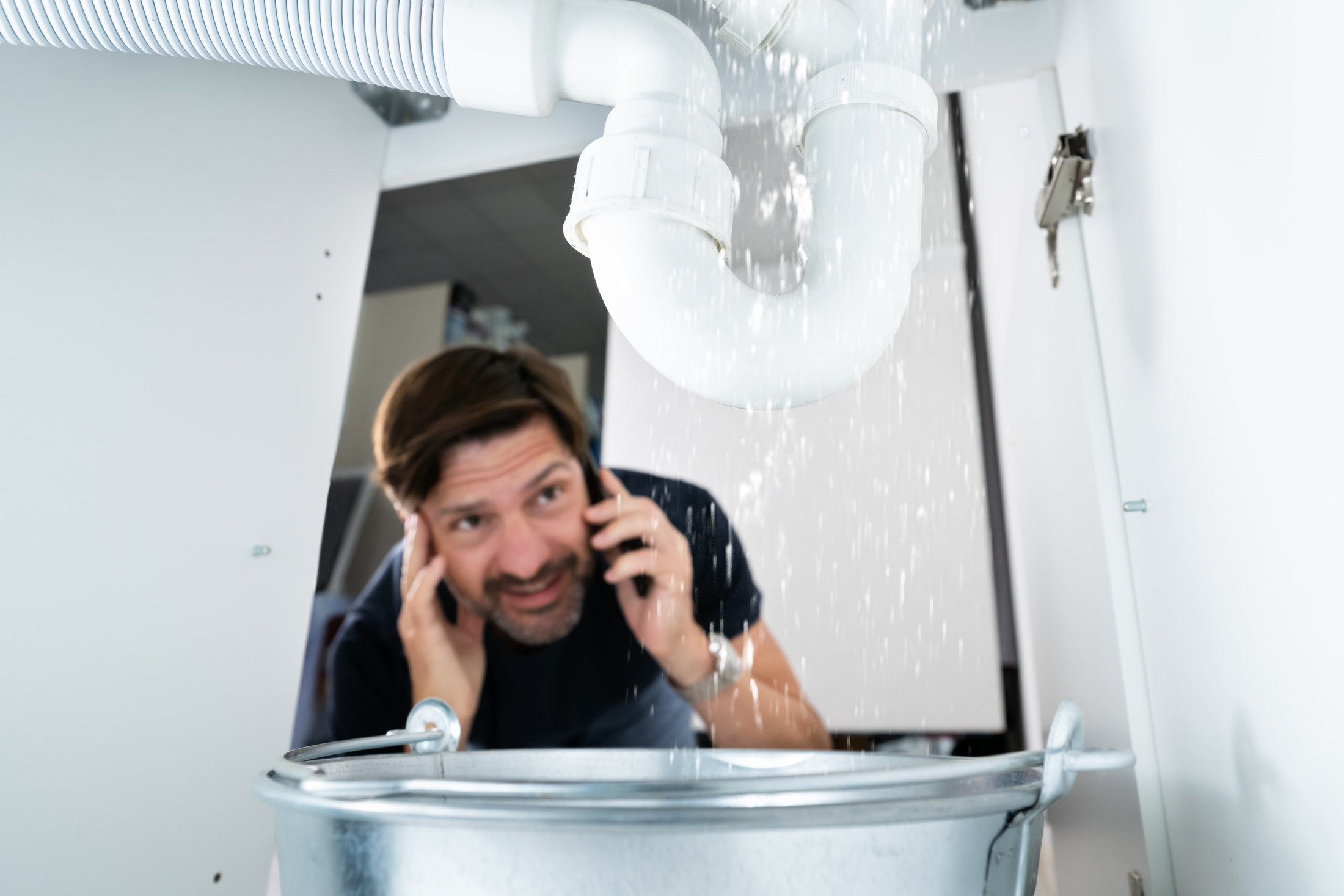
15 minPut buckets under every drip. Move furniture, rugs and electrical items out of the way, or cover them with plastic. Mop up standing water. If a ceiling is bulging with water, put a bucket under the lowest point and keep people well away from underneath it.
- Lift rugs and roll back carpet edges to save them
- Take photographs of the damage for your insurer now
- Use towels along door thresholds to stop water spreading
Mistake to avoid: Standing under a bulging ceiling. A saturated board can drop without warning and it is heavy.
Find where it is coming from
10 minNow look. A burst pipe in a cupboard or the attic shows itself; a ceiling leak is usually below a bathroom, a tank or the hot press. Note what you find for the plumber: which pipe, what material, how big the split.
- Dry the pipe and watch for where water appears first
- Check the attic tank and its pipes if the leak is upstairs
- Look under the bath panel if the ceiling below the bathroom is wet
Mistake to avoid: Pulling down boxing or ceiling board to look. You make more damage and may disturb cables; leave that to the plumber.
Make a holding repair if you can
15 minIf the split is on a pipe you can see and reach, and the water is off, dry it and wrap it tightly with self-amalgamating tape or a repair patch, well past the split on each side. An emergency pipe clamp can be fitted on plastic pipe. Uisce Éireann's advice is that this is temporary and the pipe needs a permanent repair by a qualified plumber.
- Stretch the tape as you wrap so it bonds
- Overlap each turn by half its width
- Do not turn the water back on to test it unless the plumber asks you to
Mistake to avoid: Calling the holding repair a fix and turning the water back on overnight. It can let go while you sleep.
Deal with an overflowing toilet
10 minStop flushing. Close the isolating valve on the cistern supply with a screwdriver, or lift the float arm and hold it up while someone closes the stop valve. If the bowl is full because the drain is blocked, put on gloves and use a flanged plunger once the water has dropped a little.
- Lay towels round the pan before you plunge
- Lift the cistern lid gently and set it on a towel on the floor
- If other drains are rising too, the blockage is further down
Mistake to avoid: Flushing again to see if it clears. It sends another full cistern over the rim.
Make the call with the facts
10 minRing your plumber, or an emergency plumber, and tell them clearly: what has happened, that the water is off, what pipe or fitting it is, and whether the electrics are off. If water reached the wiring, also ring an electrician. If you suspect the leak is on the supply pipe outside, contact Uisce Éireann.
- Have your photographs ready to send
- Ask for a call-out price and an hourly rate before they come
- Tell your insurer the same day
Mistake to avoid: Ringing without knowing what to say. Clear facts get a faster, better-prepared visit and a fairer bill.
Keep it safe until they arrive
30 minKeep the stop valve closed and the power off where it needs to be. Empty buckets before they overflow. Keep children and pets away from wet areas and any bulging ceiling. If it is freezing, keep the heating off if it was involved, and keep the house warm with portable heaters only away from water.
- Put a sign on the stop valve so nobody opens it
- Bottled water or a filled kettle covers drinks until the supply is back
- Note the time you turned things off for the plumber
Mistake to avoid: Turning the water back on to see if it has stopped. It has not, and you start again.
The mistakes that show
- Not knowing where the stop valve is
- Forgetting that the attic tank keeps feeding a leak after the stop valve is closed
- Touching a wet board or switch
- Leaving the immersion on while the system drains
- Standing under a bulging ceiling
- Turning the water back on to check a temporary repair
Stop here and get an emergency plumber
- The water will not stop, or the stop valve is seized or missing
- The leak is on the gas boiler, the hot cylinder or a sealed heating system
- Water has reached the electrics
- Sewage is backing up into the house
| WHAT YOU SEE | WHY, AND THE FIX |
|---|---|
| The stop valve will not turn | Use the attic tank outlet and drain the taps to reduce the flow. Call a plumber urgently; if the outside valve is yours to use, the key can close it. |
| Water keeps coming with the stop valve closed | It is coming from the attic tank or the heating. Close the tank outlet, drain the taps, and switch the heating off. |
| No water and the neighbours have none | The problem is on the public supply. Check Uisce Éireann's supply updates or ring its customer line. |
| No water only in your house in frost | A frozen pipe. Close the stop valve, open the nearest cold tap and thaw the pipe gently with a hairdryer. |
| The board trips when you switch back on | Water has reached wiring. Leave it off and call a Registered Electrical Contractor. |
| Hot water coming from a radiator or pipe | Switch the heating and boiler off at the controls and let it cool before you go near it. Call a plumber. |
| Sewage coming up through a floor gully or toilet | The drain is blocked downstream. Stop using water and call a drain specialist; do not try to clear it from inside. |
| Smell of gas | Open the windows, do not use switches or flames, leave the house and call the gas emergency number from outside. |
WHAT YOU SAVE
What it costs to do it yourself
| Rapid repair patch, small | €8.19 |
|---|---|
| Emergency pipe clamp | €16.79 |
| Water key for an under-sink stop valve | €24.19 |
| Total | €8–€49 |
| DIY total | €8–€49 |
Guide prices compiled by the Locufy team from published Irish and UK provider price lists and 2026/27 cost guides. Updated 2026.
This is the cost of a kit kept ready, not of the repair. It is a small fraction of one emergency call-out, and it cuts the damage you pay for afterwards.
RATHER NOT?
Emergency plumbers near you, with prices shown
The ones who cover your area, nearest first, with one score from every review. No account needed to look.
Or post the job free and let them come to you.
Let the plumber reopen the stop valve and the tank outlet once the repair is made. Refill the hot cylinder before the immersion or boiler goes back on, as Uisce Éireann advises.
Open windows and run the heating once it is safe. Leave wet ceilings and walls to dry fully before you redecorate.
Wet ceiling board and plaster are construction waste and do not go in household bins; mywaste.ie shows which civic amenity site near you accepts plasterboard. Bag wet insulation the same way.
Keep a stop valve key, a torch, a repair patch, a roll of self-amalgamating tape and a list of numbers in one box under the sink.
Handling a plumbing emergency until help arrives: questions people ask
Close the inside stop valve, usually under the kitchen sink. Then make the electrics safe, close the attic tank outlet, switch off the immersion and boiler, and drain the taps.
The attic tank feeds the hot cylinder and some taps, and the heating has its own water. Close the tank outlet and open the taps to drain it.
If water is near sockets, lights or the board, yes, at the main switch, but only if you and the switch are dry. A wet board is left alone.
The meter and the public side are Uisce Éireann's. Report it to them; do not open the boundary box yourself.
Only if the plumber asks you to and only to test it. A patch or tape is a holding repair until the pipe is properly fixed.
Locufy's Irish price guide puts an emergency plumber at €120–€280 per job, typically €160. Night and weekend calls are at the top.
MORE GUIDES
More DIY guides
Sources — checked October 2026
- Grant — Vortex boiler user instructions: frost protection and failure of the electricity supply
- HSA — using ladders safely information sheet
- Uisce Éireann — frozen or burst pipes
- Uisce Éireann — no water or low pressure
- CRU — water leaks in the home
- CRU — RGI and Safe Electric schemes
- Safe Electric — home safety: RCDs and when to call a Registered Electrical Contractor
- MyWaste.ie — plasterboard
- Woodie's — plumbing tools and accessories, page 1 (price check)
- Woodie's — plumbing tools and accessories, page 2 (price check)