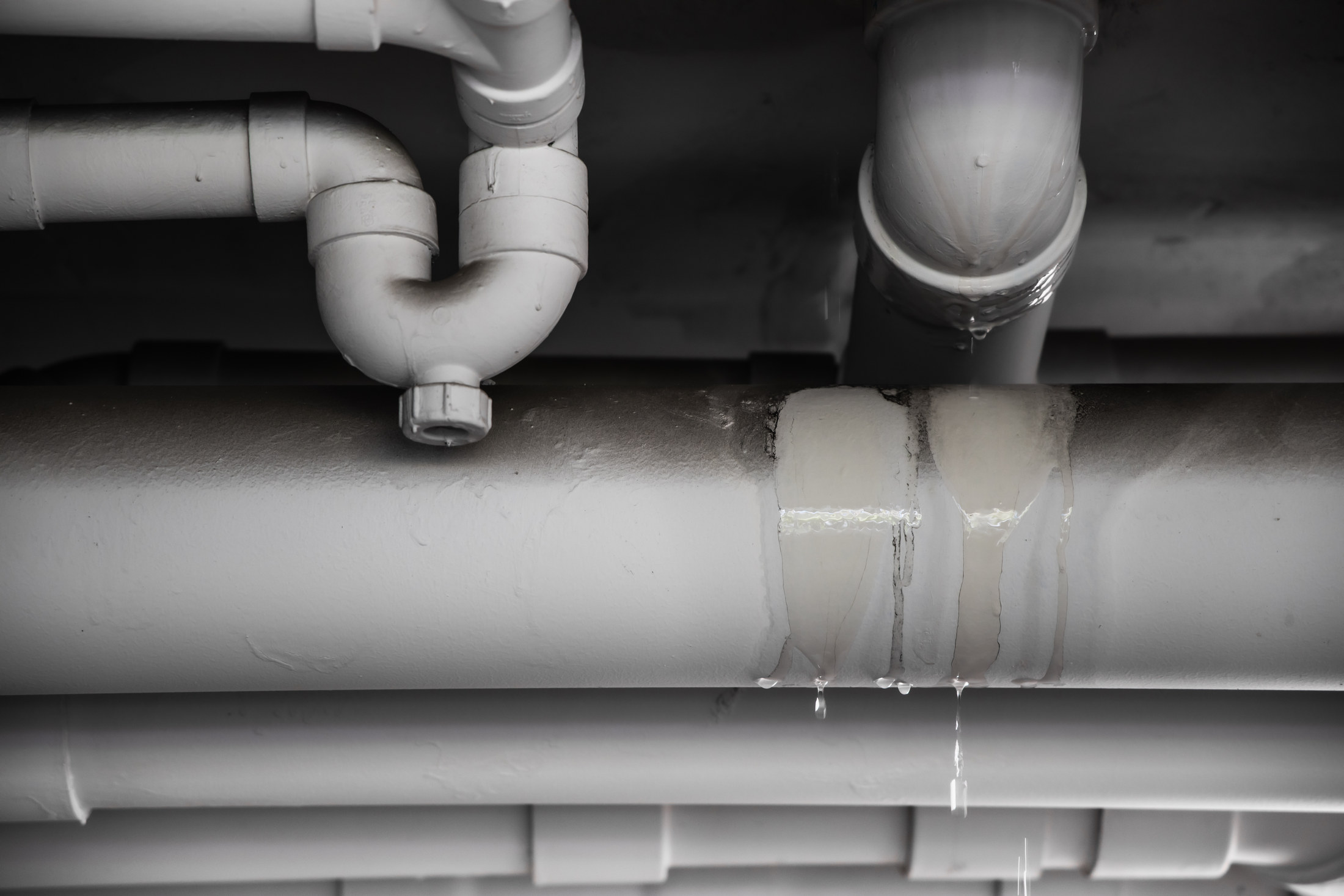
DIY GUIDE · PLUMBING & HEATING · CHECKED OCTOBER 2026
How to stop a burst pipe and repair it yourself
An hour or two once the water is off. €8–€51 for a repair patch, a repair kit or couplings, a pipe cutter and lagging.
Stop the water first: inside stop valve, tank outlet, drain, electrics. Then, if the split is on a pipe you can see, cut out the damage and join it with a repair coupling.
- Every step, start to finish
- Checked October 2026 — sources at the end
- Honest about when to call a pro
FIRST, THE HONEST ANSWER
Do it yourself, or get a repairer?
Do it yourself if…
- The split or failed joint is on a length of pipe you can see and reach, in a cupboard, the attic or along a skirting
- The pipe is standard copper or plastic in a common size, and the damaged section is short
- You can close the inside stop valve and the attic tank outlet, and they hold
- No water has reached the wiring, or the board has been switched off and stays off
Get a pro if…
- The burst is under a floor, inside a wall or ceiling, or you cannot see where the water starts
- The pipe is outside in the ground, between the boundary and the house
- The burst is on an unvented hot-water cylinder, a sealed heating system or anything near the boiler
- Water has reached sockets, lights or the board
Safety first
- Water near electrics is the main danger. If water reaches sockets, switches or lights, switch off at the board only if you and the switch are dry. Leave a wet switch alone and call a qualified electrician, as Uisce Éireann's burst advice says.
- In the attic, stand only on boards or joists. The HSA's ladder guidance asks for three points of contact on the ladder and no standing on the top steps of a stepladder.
- A ceiling heavy with water can collapse. Keep people out from under it, put buckets down, and if it bulges, a small hole at the lowest point drains it into a bucket under control.
- Never thaw pipes with a flame, a heat gun or the immersion. Use a hairdryer on low and keep the cold tap open.
- Water from the attic tank is not for drinking. Wear gloves when handling wet insulation and wash afterwards.
Stop here: Stop here: anything buried, the public side, pressurised systems and the electrics
Uisce Éireann's guidance is to have a burst permanently repaired by a qualified, registered plumber, and anything hidden or excavated needs one. The external supply pipe between your boundary and the house is yours under Irish law, but a leak on it can be investigated and repaired under the First Fix Free scheme; the main and the meter are Uisce Éireann's. An unvented cylinder or sealed heating system holds water under pressure and is a danger to open without training. If water has reached the wiring, any repair is restricted electrical work for a Registered Electrical Contractor, and gas work near the boiler is for a Registered Gas Installer. How to hire a burst pipe plumber →
| MATERIAL | COVERAGE | FOR THIS JOB |
|---|---|---|
| Burst-pipe repair kit | Half-inch or three-quarter-inch to match the pipe | One |
| Push-fit or compression couplings | To match the pipe size and type | Two, with a short length of pipe |
| Pipe support sleeves | For plastic pipe in push-fit fittings | One per plastic pipe end |
| Pipe lagging | Sized to the pipe | Enough for the exposed run |
How much pipe to cut out
Cut length = length of the split + a margin of sound pipe each side. A 40 mm split with 25 mm of margin each end means cutting out 90 mm, and the repair must bridge that gap.
A split pipe is often bulged or thinned either side of the visible crack. Cut back until the pipe is perfectly round and smooth, then measure.
Uisce Éireann's advice for a burst is to bind it tightly with cloth or tape as a stop-gap and have it repaired properly as soon as you can. A self-amalgamating repair patch or tape does the same job better. It is a holding repair: plan the permanent fix the same day or the next.
Sold in half-inch and three-quarter-inch sizes, these are a short flexible hose with a connector at each end. You cut out the split section and the kit bridges the gap, so there is no need to measure a pipe exactly. They suit a split on a straight run where there is room for the kit.
Push-fit fittings join copper or plastic pipe without tools once the pipe is cut. The maker we read insists on a square cut, a burr-free end and, on plastic pipe, a support sleeve pushed into the pipe end, then a tug to check it has locked. With a short length of new pipe and two couplings you can replace the damaged section.
Brass couplings with nuts and olives make a permanent, tool-tightened joint on copper. They are compact and suit tight spots, but need the pipe ends straight and round, and two spanners to tighten without twisting the pipe.
Most bursts in Ireland are frozen pipes in an attic, an outhouse or an outside wall. Uisce Éireann's winter advice is to insulate exposed pipes and tanks. Fit lagging to the repaired pipe and its neighbours before you close the hatch.
THE PART THAT DECIDES THE FINISH
Before you start — where the burst is
Once the water is stopped, look at where the damage is. Each place has its own prep before the repair.
Under a sink or in a cupboard
A pipe or joint you can see clearly, with room to work.
- Empty the cupboard and lay towels and a bucket
- Check the board under it for swelling and the wall behind for wet plaster
- Make sure any appliance in the cupboard is unplugged
- Look at both sides of the split for bulging before you buy parts
In the attic
A pipe to or from the tank, or the tank's own connections. The usual place for a frozen burst.
- Get up safely with a torch and stand only on boards or joists
- Close the outlet valve from the tank if there is one, as well as the stop valve
- Put a board under the pipe to spread your weight while you work
- Lift wet insulation off the ceiling so it can dry, and bag it
Along a skirting or in a hot press
Pipe runs that are partly boxed in.
- Remove only the boxing you need to see the whole damaged section
- Check the pipe is not near a cable behind the boxing before you cut
- In the hot press, switch off the immersion and let the cylinder cool
- If the burst is on the cylinder itself, stop: that is not a pipe repair
A frozen pipe that has not split
No flow from a tap in freezing weather, but no water escaping.
- Close the stop valve and the tank outlet anyway, in case it splits as it thaws
- Find the frozen section: an uninsulated pipe, a cold spot, a draughty run
- Move anything that could be damaged if it bursts as it thaws
- Open the nearest cold tap to relieve pressure, as Uisce Éireann advises, but never the hot
THE JOB
How to stop and repair the burst
Stop the water and make it safe
10 minClose the inside stop valve, usually under the kitchen sink. Close the valve on the pipe leaving the attic tank if you have one. Switch off the immersion and the boiler, and let a solid-fuel stove die down. Open all the cold taps and flush the toilets to drain the system; once the water heating is off, open the hot taps too. If water is near sockets or lights, switch off the mains at the board, but only if the switch and you are dry.
- Know where the stop valve is before you ever need it
- Put buckets under the burst and towels round them
- If you live in an apartment, find the building's stop valve, usually where the supply enters
Mistake to avoid: Leaving the immersion or boiler on while the system drains. A heater running with no water in the cylinder or system can be badly damaged.
Prepare the area
20 minThis is the prep from the cards above. Clear the space, get light on it and dry the pipe so you can see the damage. Mop up and lay towels. Move furniture and anything electrical away from the water. Lift wet insulation in the attic off the ceiling.
- Photograph the damage for your insurer before you touch it
- Keep a bucket under the burst; the pipe keeps draining for a while
- Wear gloves; water from a tank is not drinking water
Mistake to avoid: Starting the repair in poor light. You miss a second, smaller split beside the first, and it leaks the moment the water goes back on.
Thaw a frozen pipe if needed
30 minIf the pipe is frozen but not split, warm it gently with a hairdryer on its lowest setting, starting at the tap end and working back towards the frozen section, as Uisce Éireann describes. Keep the nearest cold tap open so meltwater can escape. Check constantly for a split as it thaws.
- Wrap a warm towel round the pipe between passes
- Thaw from the open tap end so pressure has somewhere to go
- Stop at once if you see a drip
Mistake to avoid: Thawing with a blowlamp, a heat gun or the central heating. A flame can start a fire in the attic, and fast heating splits the pipe.
Fit a temporary patch if you must wait
10 minIf you cannot do the permanent repair straight away, dry the pipe and wrap a repair patch or self-amalgamating tape tightly round the split, well beyond it on each side. This lets you restore water to the rest of the house if the split is on a branch you can isolate. Treat it as temporary.
- Stretch self-amalgamating tape as you wrap so it bonds to itself
- Overlap each turn by half its width
- Check the patch every few hours
Mistake to avoid: Leaving the patch as the repair. It holds for a while and then lets go, often at night.
Cut out the damaged section
15 minWith the water off and the pipe drained, cut the pipe square either side of the split, back to sound, round pipe. Use a rotary cutter on copper, turning it a little at a time, and a proper cutter on plastic. Clean and deburr both cut ends inside and out.
- Leave room each side for the coupling to slide on
- Catch the water left in the pipe in a bucket
- Check the pipe is still clipped firmly each side of the cut
Mistake to avoid: Cutting with a hacksaw. The end is angled and ragged, and no push-fit or compression fitting seals on it properly.
Fit the repair
30 minFor a repair kit, push or tighten its ends onto each cut end as its instructions show. For push-fit couplings, mark the insertion depth on each pipe end, fit a support sleeve into plastic pipe, then push each end fully home and tug to check it has locked, as the fitting maker requires. For compression couplings, slide on nut and olive, push the pipe fully home, tighten by hand and then with two spanners.
- A pen mark at the insertion depth shows at a glance whether the pipe is fully in
- On copper, a push-fit fitting needs no support sleeve; on plastic it always does
- Support the pipe so the repair is not hanging under its own weight
Mistake to avoid: Pushing a pipe only partly into a push-fit fitting. It holds at low pressure and then blows out when the mains comes back on.
Restore the water slowly
20 minClose all the taps you opened. Open the stop valve a little at a time and let the pipes refill. Then open the tank outlet valve. Check the repair constantly as the pressure rises. Run each tap until the air clears and the flow is steady.
- Have someone watch the repair while you open the valve
- Expect spluttering taps as air clears
- If an airlock stops the hot taps, see the problems below
Mistake to avoid: Opening the stop valve fully in one go. The surge of water and air hammers the pipes and tests a new joint harder than it needs to be.
Refill hot water before heating
15 minCheck that the hot cylinder has refilled, by running a hot tap until it flows steadily, before you switch the immersion or the boiler back on. Uisce Éireann's advice is plain: refill the hot water system before switching the heating back on. Then turn them on and check the repair again once it is warm.
- Feel the top of the cylinder pipework for water, not air
- Look at the repair again an hour after the heating comes on
- Check the overflow outside is not running
Mistake to avoid: Switching the immersion on with the cylinder empty. The element burns out in minutes.
Lag and protect the pipe
20 minFit pipe lagging along the repaired pipe and any other exposed pipes nearby, with the joints taped. In the attic, make sure the tank and pipes are insulated but the area under the tank is not, so a little heat from the house reaches it.
- Lag outside taps and pipes in outhouses as well
- Close draughts that blow across pipes
- Leave heating on low during a freeze when you are away
Mistake to avoid: Lagging over a damp pipe or a weeping joint. The moisture stays trapped and you will not see the drip until the ceiling shows it.
The mistakes that show
- Not knowing where the stop valve is until water is pouring through
- Thawing a frozen pipe with a flame or a heat gun
- Cutting pipe with a hacksaw instead of a pipe cutter
- Switching the immersion back on before the cylinder has refilled
- Leaving a temporary patch as the permanent repair
- Re-lagging over a joint that is still weeping
Stop here and get a plumber
- The burst is inside a wall or floor, or outside in the ground
- It is on the hot cylinder, an unvented system or the sealed heating circuit
- The stop valve does not hold and the water cannot be fully stopped
- Water has reached the electrics
| WHAT YOU SEE | WHY, AND THE FIX |
|---|---|
| Repair weeps after the water goes back on | A pipe end is not fully home, is scored or is not square. Isolate, remake the joint with a fresh, square cut. |
| No hot water after refilling | An airlock in the hot pipes. Uisce Éireann's airlock advice uses the mains cold to push air back up to the tank; if that does not clear it, a plumber can. |
| Taps spit and splutter | Air left in the pipes after draining. Run each tap in turn until the flow is steady. |
| Stop valve will not close fully | The valve washer is worn or seized. Use the tank outlet valve and drain; have the stop valve replaced. |
| Water still coming from a ceiling | There is a second leak, or water stored in the ceiling is still draining. Keep the water off and watch; if it continues, call a plumber. |
| Electrics trip when switched back on | Water has reached wiring. Leave it off and have a Registered Electrical Contractor check the installation. |
| Pipe frozen again | The run is still exposed to cold air. Lag it fully, stop draughts and keep the heating on low in a freeze. |
| Repair kit hose bulges | The kit is the wrong size or rating for the pipe, or it is twisted. Replace it with the correct size, laid straight. |
WHAT YOU SAVE
What it costs to do it yourself
| Rapid repair patch, small | €8.19 |
|---|---|
| Burst pipe repair kit, half-inch or three-quarter-inch | €14.29–€20.99 |
| Plastic pipe cutter | €22.99 |
| Reflective pipe insulation | €6.39 |
| Total | €8–€51 |
| DIY total | €8–€51 |
Guide prices compiled by the Locufy team from published Irish and UK provider price lists and 2026/27 cost guides. Updated 2026.
The low figure is a patch to hold until a plumber can come. The high figure is a kit and a cutter to do the permanent repair yourself.
RATHER NOT?
Burst pipe plumbers near you, with prices shown
The ones who cover your area, nearest first, with one score from every review. No account needed to look.
Or post the job free and let them come to you.
Leave wet areas to dry with the heating on and a window open. A stain-blocking primer stops the mark showing through when you redecorate.
Uisce Éireann's winter list is short: insulate exposed pipes and tanks, find your stop valve, fix drips, stop draughts and keep the heating on low when away. Do it before the next cold snap.
Old copper pipe is metal and goes to the metal skip at your local civic amenity site. Wet ceiling board is construction waste; mywaste.ie shows which civic amenity site near you takes plasterboard.
If the burst caused damage, report it with your photographs. Keep the receipts for parts and any professional repair.
Stopping a burst pipe and repairing an exposed section: questions people ask
Close the inside stop valve, close the outlet from the attic tank, switch off the immersion and boiler, and open the taps to drain the system. If water is near the electrics, switch off at the board only if you are dry.
Close the water off first, open the nearest cold tap, then warm the pipe gently with a hairdryer on its lowest setting, starting at the tap end. Never use a flame or a heat gun.
If the split is on a pipe you can see and reach, yes, with a repair kit or couplings. A burst under a floor, inside a wall, in the ground or on a pressurised system is a plumber's job.
The external supply pipe between the boundary and the house is the owner's, but a leak on it may be repaired free under Uisce Éireann's First Fix Free scheme. Anything at the meter or on the main is Uisce Éireann's.
Yes, on a low setting, as Uisce Éireann advises, so warm air keeps circulating. For a long absence, consider turning the water off at the stop valve.
Locufy's Irish price guide puts burst pipe repair at €120–€450 per job, typically €200. Out-of-hours calls and hidden pipes cost more.
MORE GUIDES
More DIY guides
Sources — checked October 2026
- Wavin — Hep2O push-fit plumbing instructions: square cut, support sleeve, tug test
- HSA — using ladders safely information sheet
- Uisce Éireann — frozen or burst pipes
- Uisce Éireann — winterproofing your home
- Uisce Éireann — internal airlocks
- CRU — water leaks in the home and the First Fix Free scheme
- MyWaste.ie — plasterboard
- MyWaste.ie — DIY equipment: metal items at civic amenity sites
- Woodie's — plumbing tools and accessories, page 1 (price check)
- Woodie's — plumbing tools and accessories, page 2 (price check)
- Woodie's — cold weather essentials (price check)