DIY GUIDE · CLEANING · CHECKED OCTOBER 2026
How to clean a mattress yourself
A morning, then the day to dry. €11–€21 in stain removers and a protector.
Strip, vacuum seams, blot stains with little liquid, deodorise dry, and air it fully.
- Every step, start to finish
- Checked October 2026 — sources at the end
- Honest about when to call a pro
FIRST, THE HONEST ANSWER
Do it yourself, or get a cleaner?
Do it yourself if…
- The marks are sweat, drink, a nosebleed or a recent accident
- You can work in the morning and leave the mattress uncovered until evening
- The bedroom has a window you can open, or a fan
- You can lift and turn the mattress, or have someone to help
Get a pro if…
- There has been a large urine or vomit accident that has soaked deep into the filling
- You can see mould on the mattress or a musty smell will not go
- The mattress has a dry-clean-only or no-liquid label
- You suspect bed bugs — that is pest control first, then cleaning
Safety first
- Wear gloves for urine, blood and vomit. The HSA's cleaning guidance treats human waste as a biological hazard and stresses gloves and good hand hygiene.
- Never mix cleaning products: vinegar is an acid, and the HSA warns that bleach mixed with certain other cleaners gives off a harmful gas. Use one product, rinse, then the next.
- Read the label of every stain remover for its hazard pictograms and test it on a hidden spot first.
- Get help to lift and turn a mattress; they are heavy and floppy, and twisting while you hold one is how backs go.
- If anyone in the house has asthma, open the window and keep them out of the room while you vacuum and treat the mattress.
| MATERIAL | COVERAGE | FOR THIS JOB |
|---|---|---|
| Mild detergent or upholstery stain remover | A few drops of detergent in warm water; cold water for blood | A small bowl |
| White vinegar | Equal parts with water for urine | A small spray bottle |
| Bicarbonate of soda | A generous dusting over the whole surface | About a cup for a double |
| Waterproof mattress protector | Breathable, fitted, to the mattress size | One |
When to start so it is dry by bedtime
Start time = bedtime − (work time + drying time). Work time is about an hour for a double. Drying time after spot cleaning is several hours; allow at least six to be safe in an Irish winter. Example: bedtime at 11 p.m. minus one hour of work and six of drying means starting by 4 p.m. — start in the morning and you have plenty in hand.
If any patch still feels cool or damp to the back of your hand at bedtime, sleep elsewhere for the night. A damp mattress under bedding is how mould starts.
The mattress maker's label or care leaflet decides what is safe. Two makers we checked both warn that memory foam and latex should never be saturated. A sprung mattress with a quilted top is more forgiving but still only takes a little liquid at a time. If there is no label, treat it as the most delicate case.
Dust, skin flakes and dust mites live in the surface and the seams. The HSE suggests a vacuum fitted with a high-efficiency particulate filter for anyone with a dust mite allergy, and allergy-proof covers for mattresses. A thorough vacuum with the upholstery tool, slowly, seams and piping included, does more than any spray.
One mattress maker uses warm water with a mild detergent on a cloth for general stains, and cold water for blood. Apply the solution to the cloth, not the mattress, and blot. A bottled upholstery stain remover is the step up for stubborn marks; test it on the side panel first.
Speed matters most. Blot up as much as you can at once. The same maker then mists the patch with white vinegar diluted half and half with water, then blots once more, followed by bicarbonate of soda left for a few hours to draw out moisture and smell. A pet stain and odour spray does the same job for pet accidents.
Sprinkled over a dry mattress it absorbs moisture and neutralises odour. One maker suggests at least 15–30 minutes and longer if needed; the other leaves it several hours. Vacuum every grain off — leftover crystals are uncomfortable under a sheet.
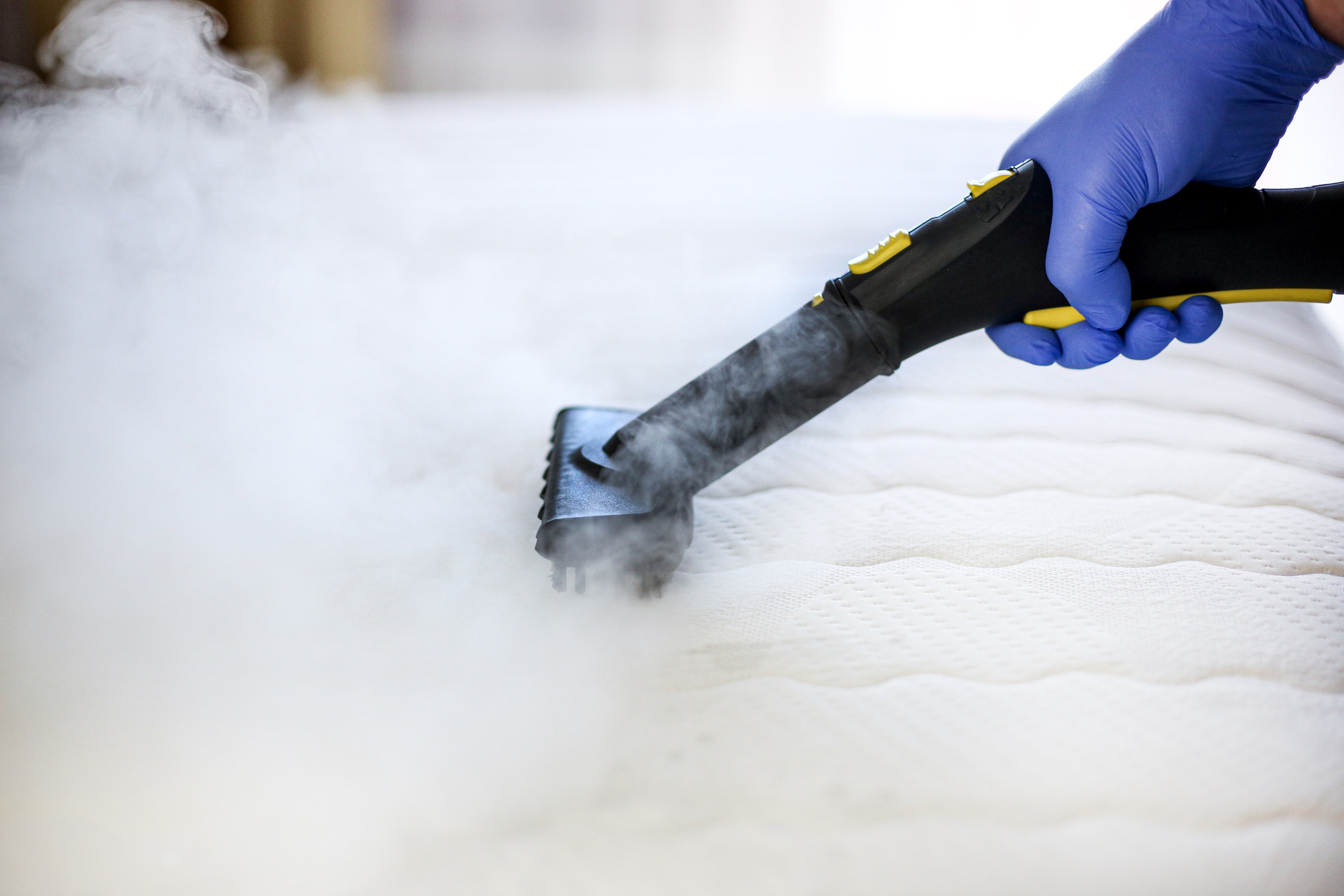
Steam is only for mattresses whose maker allows it. The carpet washers hired out by DIY chains are not for memory foam mattresses: the hire shop lists them among the things the machine should not clean. More water is the opposite of what a mattress needs.
THE PART THAT DECIDES THE FINISH
Preparing the mattress — by what kind it is
Find your mattress below and do its preparation before you start. Many mattresses are a mix, such as springs with a foam topper, so read both.
Open-coil or pocket-sprung mattress
Springs inside, a quilted or tufted top, often two usable sides.
- Strip the bed completely, including the protector, and wash the bedding to its care labels
- Check the label to see whether it is two-sided and meant to be turned
- Have the upholstery tool and crevice tool on the vacuum
- Open the window before you start so the room is already airing
Memory foam or latex
Dense foam with no springs; usually one-sided, often a zipped cover.
- Read the care label; most say no soaking and some say no liquids on the foam at all
- Check whether the cover unzips and whether its own label allows washing
- Use a soft brush attachment for vacuuming
- Plan on blotting only, with the barest amount of mild solution
A child's mattress with accidents
Cot, cot-bed or single mattresses with repeated wetting.
- Strip it and blot any fresh wetness straight away
- Mix equal parts white vinegar and water in a spray bottle
- Have bicarbonate of soda and plenty of kitchen roll ready
- Plan on fitting a waterproof protector before it goes back into use
A mattress with a musty smell
Often in a spare room, a damp house or a mattress stored against a wall.
- Look closely for grey, green or black spots, especially on the underside
- If you see spots of mould, stop and read the mould guide; a mattress with mould through it is usually replaced
- If there are no spots, plan on a long airing in a dry room with the window open
- Check the bed base and the wall behind the bed for damp too
A mattress you are moving into
A furnished rental or a second-hand bed.
- Check the seams and piping with a torch for tiny dark spots or bugs before you sleep on it
- Vacuum it thoroughly and empty the vacuum outside straight afterwards
- Treat stains as below and air it fully
- Fit a fresh protector before your own bedding goes on
THE JOB
How to clean a mattress, in order
Strip the bed and open the window
10 minTake off everything — sheets, pillowcases, the protector and any topper — and put them in the wash at the temperature their labels allow. Open the window wide. Use the surfaces section above to identify your mattress, and read its label. If the room is cold and damp, put a fan or a dehumidifier in it now so the air is drier by the time the mattress needs to dry.
- Check the label for a turn or no-turn instruction
- Lean the mattress on its side briefly to look at the underside
- Wash the protector too; it holds most of what the mattress would
Mistake to avoid: Cleaning the mattress and putting the same unwashed protector back on. The dust and sweat are straight back on the clean surface.
Vacuum slowly, seams first
20 minFit the upholstery tool and go over the whole top surface in slow, overlapping strokes. Then switch to the crevice tool and run it along every seam, the piping round the edge and into each tufting button, where dust gathers most. Do the sides and, if it is two-sided, turn it and do the other face. Empty the vacuum outside afterwards.
- Slow strokes pick up more than fast ones
- Use the soft brush attachment on memory foam
- Vacuum the bed base and under the bed while the mattress is off
Mistake to avoid: Racing over the top in two minutes. The seams and edges, where most of the dust sits, never get touched.
Treat general stains with a mild solution
15 minMix a few drops of mild detergent into warm water. Dip a cloth, wring it out until it is only damp and press it onto the stain. Leave it a few minutes, then work it gently in small circles with a soft brush or sponge and blot again with a dry cloth. Spray a light mist of clean cold water to rinse and blot dry once more.
- Work from the edge of the stain towards the middle
- Turn the cloth so you always press with a clean part
- Sweat marks are gradual; expect them to fade, not vanish
Mistake to avoid: Pouring the solution straight on. It sinks into the filling, takes hours to dry and leaves a bigger ring than the stain.
Deal with blood in cold water
15 minBlood sets with heat, so use cold water only. Blot a fresh stain with a cold, damp cloth, pressing rather than rubbing. Apply a little mild detergent in cold water on the cloth, leave it a few minutes, then blot. Repeat until no more colour lifts. An upholstery stain remover is the next step for an old mark; test it on the side panel first.
- Never use hot water or a steamer on blood
- Keep blotting with fresh kitchen roll until it comes away clean
- Rinse with a cold mist and blot dry
Mistake to avoid: Using hot water to shift it faster. Heat fixes the protein in the fibres and the stain becomes permanent.
Tackle urine and accidents
20 minGlove up. Blot as much liquid as you possibly can with kitchen roll, pressing hard and changing it often; this matters more than anything that follows. Spray the area with equal parts white vinegar and water, wait a few minutes and blot again. For a pet accident, a pet stain and odour remover used as its label says does the same job. Then cover the patch with bicarbonate of soda and leave it.
- Stand on a folded towel pressed onto the wet patch to draw more out
- Work outwards from the middle so the patch does not grow
- Wash your hands well afterwards, even with gloves on
Mistake to avoid: Scrubbing the wet patch. It pushes the urine deeper into the filling, where the smell will come back every time the room warms.
Deodorise the whole surface
As long as you canWhen the treated areas are no longer wet, dust bicarbonate of soda evenly over the whole top of the mattress. One mattress maker suggests leaving it at least 15–30 minutes and longer if needed; on urine patches, leave it a few hours. Keep the window open while it sits. It absorbs moisture and smell as long as it is there.
- Use a sieve to spread it evenly
- Keep pets off the mattress while it sits
- Never put it on a patch that is still wet; it forms a paste
Mistake to avoid: Sprinkling it on a damp mattress. It clogs into a crust in the fabric that is hard to vacuum off.
Vacuum it off completely
15 minGo over the whole mattress again with the upholstery tool, slowly, then the seams with the crevice tool, until no white powder is left. Run your palm over it to feel for grit. Empty the vacuum and clean or tap out its filter, because fine powder clogs it quickly.
- Go across and then along so you lift it from every angle
- Check the tufting buttons; powder collects round them
- Wipe the vacuum head afterwards
Mistake to avoid: Leaving traces behind. They feel like sand through a sheet and attract moisture back into the fabric.
Air and dry it fully
Several hoursLeave the mattress uncovered with the window open and a fan running across it. A dehumidifier helps a great deal in a damp room. Drying takes several hours, which is why both makers suggest starting in the morning. Turn or tilt it partway through so the underside airs too. Do not make the bed until every patch is dry to the touch.
- Feel the treated spots with the back of your hand; cool means still damp
- Keep it away from a radiator; uneven drying leaves rings
- If it is still damp at night, sleep elsewhere
Mistake to avoid: Making the bed over a damp patch. Moisture trapped under bedding is how mould and a lasting smell begin.
Rotate, protect and remake
10 minRotate the mattress end to end, and turn it over only if its label says it is two-sided. Fit a clean, breathable waterproof protector, then the fresh bedding. In the mornings from now on, leave the duvet pulled back for a while and the window open so the night's moisture can leave the mattress.
- Rotate every few months so it wears evenly
- Write the date on the label with a marker
- Air the mattress each morning before making the bed
Mistake to avoid: Flipping a one-sided mattress. The comfort layers end up underneath and it sags fast.
The mistakes that ruin mattresses
- Soaking it — memory foam and latex especially
- Using hot water or steam on blood
- Scrubbing urine instead of blotting it out
- Making the bed before the mattress is completely dry
- Using a hired carpet washer on a memory foam mattress
Stop here and get a mattress cleaner
- A large accident has soaked deep into the filling and the smell returns after cleaning
- There is mould on the mattress — it usually means replacement rather than cleaning
- You find signs of bed bugs: tiny dark spots on seams or live insects
- The label says no liquids at all and the stain is one you cannot live with
| WHAT YOU SEE | WHY, AND THE FIX |
|---|---|
| Yellow stains on the mattress | Usually sweat and body oils built up over time. Blot with a mild detergent solution, rinse with a cold mist and dry fully; they fade with each clean rather than vanishing. |
| The mattress smells of urine after cleaning | The urine went deeper than the treatment. Blot with the vinegar mix again, cover with bicarbonate of soda for several hours, vacuum and air it in sun and wind if you can. |
| A ring appeared round the cleaned patch | Too much liquid dried with a hard edge. Dampen a slightly wider area lightly, blot, and dry it fast with a fan. |
| The mattress smells musty | It stayed damp, or the room is damp. Air it with the window open and a dehumidifier; check the underside and the bed base for mould spots. |
| Black or grey spots on the underside | Mould from moisture with no air. A mattress with mould through it is usually replaced; read the mould guide for the room. |
| Blood stain will not shift | It was treated with hot water or is old. Try an upholstery stain remover with cold water, tested first; a set protein stain may not come out fully. |
| White powder keeps appearing | Bicarbonate is left in the fabric. Vacuum slowly in two directions with the upholstery tool and tap out the vacuum filter. |
| You wake with itchy bites after cleaning | Cleaning does not treat bed bugs. Check the seams with a torch and call pest control before cleaning further. |
WHAT YOU SAVE
What it costs to do it yourself
| Upholstery stain remover | €4.99 |
|---|---|
| Pet stain and odour remover | €1.99 |
| White vinegar | €2.49 |
| Microfibre cloths, pack of four | €1.49 |
| Waterproof mattress protector, double (if you have none) | €9.99 |
| Total | €11–€21 |
| DIY total | €11–€21 |
Guide prices compiled by the Locufy team from published Irish and UK provider price lists and 2026/27 cost guides. Updated 2026.
Bicarbonate of soda and washing-up liquid are usually already in the kitchen. The protector is the best spend on the list: it is cheaper than one stain remover a year and it is what keeps the mattress clean.
RATHER NOT?
Mattress cleaners near you, with prices shown
The ones who cover your area, nearest first, with one score from every review. No account needed to look.
Or post the job free and let them come to you.
One maker suggests leaving the duvet peeled back for about 20 minutes each morning with the window open, so the night's moisture leaves the mattress.
The HSE suggests allergy-proof covers on mattresses, duvets and pillows and a damp cloth rather than dry dusting if anyone has a dust mite allergy.
Cap the stain removers and vinegar and keep them upright and out of children's reach, away from bleach.
A mattress does not go in your bins. Bring it to a civic amenity site or a mattress recycling project, or ask your local authority about mattress collections; mywaste.ie has the details.
Cleaning and freshening a mattress: questions people ask
One mattress maker suggests a vacuum and spot clean every three to six months and a deep clean no more than twice a year; another suggests a clean every six months. A protector means less of both.
Not on memory foam: the hire shop lists memory foam mattresses among the things its machines should not clean. Mattresses need as little water as possible, which a carpet washer does not give.
Blot as much as you can, spray with equal parts white vinegar and water, blot again, then cover with bicarbonate of soda for a few hours, vacuum it off and air the mattress fully.
It absorbs moisture and neutralises smells. Leave it at least 15–30 minutes, longer for strong odours, on a dry surface only, and vacuum every grain off afterwards.
The Locufy price guide puts professional mattress cleaning at €35–€100 per mattress, typically €60. Large accidents and heavy staining cost more.
Only if the label says it is two-sided. If it is built one way up, rotate it end to end instead, which spreads the wear.
MORE GUIDES
More DIY guides
Sources — checked October 2026
- Silentnight — how to clean a mattress: stains, urine, memory foam, airing
- Vax — how to clean a mattress
- B&Q Ireland — carpet cleaner hire: what the machine should not clean
- HSE — preventing allergic rhinitis: dust mites, covers and vacuums
- HSA — Safety in Contract Cleaning: chemical and biological hazards
- MyWaste.ie — mattresses
- Mr Price — price check: stain removers, vinegar, cloths and protectors, October 2026