DIY GUIDE · CLEANING · CHECKED OCTOBER 2026
How to wash curtains yourself
A dry day for a pair. Under €9.50 in detergent, wash bags and a line.
Read the label, measure the drop, take them down safely, wash cool and gentle, rehang slightly damp.
- Every step, start to finish
- Checked October 2026 — sources at the end
- Honest about when to call a pro
FIRST, THE HONEST ANSWER
Do it yourself, or get a cleaner?
Do it yourself if…
- The care label shows a wash tub, not just a dry-clean circle
- The curtains are unlined, or the lining is detachable
- Your machine drum can take one curtain without being packed tight
- You can reach the track or pole from a stepladder used properly
Get a pro if…
- The label shows dry-clean only, or the curtains are lined, interlined or blackout-lined
- They are silk, velvet, heavy damask or hand-made and expensive
- The track or pole is above a stairwell or a double-height window
- They are very large and heavy, or have water staining or mould on them
Safety first
- Use a stepladder, not a chair. The HSA says not to work on the top two steps of a stepladder unless it has a handrail, to keep your belt buckle between the stiles and to avoid overreaching.
- Set the ladder on firm, level ground, fully opened, facing the window, and move it along rather than stretching to the far end.
- Wet curtains are heavy. Lift them out of the drum or bath in sections, and get help with a full-length pair.
- Detergents can irritate skin; the HSA advises reading the label and avoiding prolonged skin contact. Wear gloves for hand washing.
- Do not shake mouldy curtains indoors, and wash your hands after handling them.
| MATERIAL | COVERAGE | FOR THIS JOB |
|---|---|---|
| Mild non-bio laundry liquid | As the bottle doses it for a light load | One dose per curtain |
| Mesh laundry bags | Pack of two | One for hooks, one for a net |
| Spare curtain hooks | Same type as yours | A few, in case some bend |
How much the curtain can shrink before it no longer fits
Allowance = the drop you measured − the drop you need to clear the sill or floor. Example: a curtain measured at 182 cm that needs to finish 1 cm above a sill 180 cm below the track can lose only 1 cm before it looks short. A heavy cotton losing even 2 per cent would lose more than 3 cm — which is why you measure first and wash cool.
If the curtains already only just reach, do not risk washing them at home. Shrunk curtains can sometimes be eased by dropping the hooks a position in the heading tape.
Care labels in Ireland use the international symbol set: a wash tub, with a number for the maximum temperature and a hand for hand-wash only; a triangle for bleach, crossed out for none; a square for drying, with a circle inside for the tumble dryer; an iron with dots for heat; and a circle for professional cleaning. A crossed-out tub means do not wash. The label gives the most a fabric will take; a cooler, gentler wash is always safer.
One curtain maker advises that lined, interlined and blackout-lined curtains be dry cleaned by a curtain specialist. Another says that if made-to-measure curtains are labelled dry-clean only, you should not wash them yourself. The reason is shrinkage: the face fabric, lining and interlining react differently to water and heat.
Where the label allows it, one maker says to follow the care label carefully, use a mild detergent and a gentle cycle, and take the curtains out as soon as the cycle ends so they do not crease. Wash one curtain at a time if they are heavy; a packed drum does not rinse.
The same maker suggests a thorough dusting and vacuuming with a soft brush attachment before any wash or spot clean, taking care not to pull the fabric. For small marks, dab gently with a soft cloth and a suitable solution, tested on a hidden area first. The HSE suggests cleaning curtains often in homes where someone has a dust mite allergy.
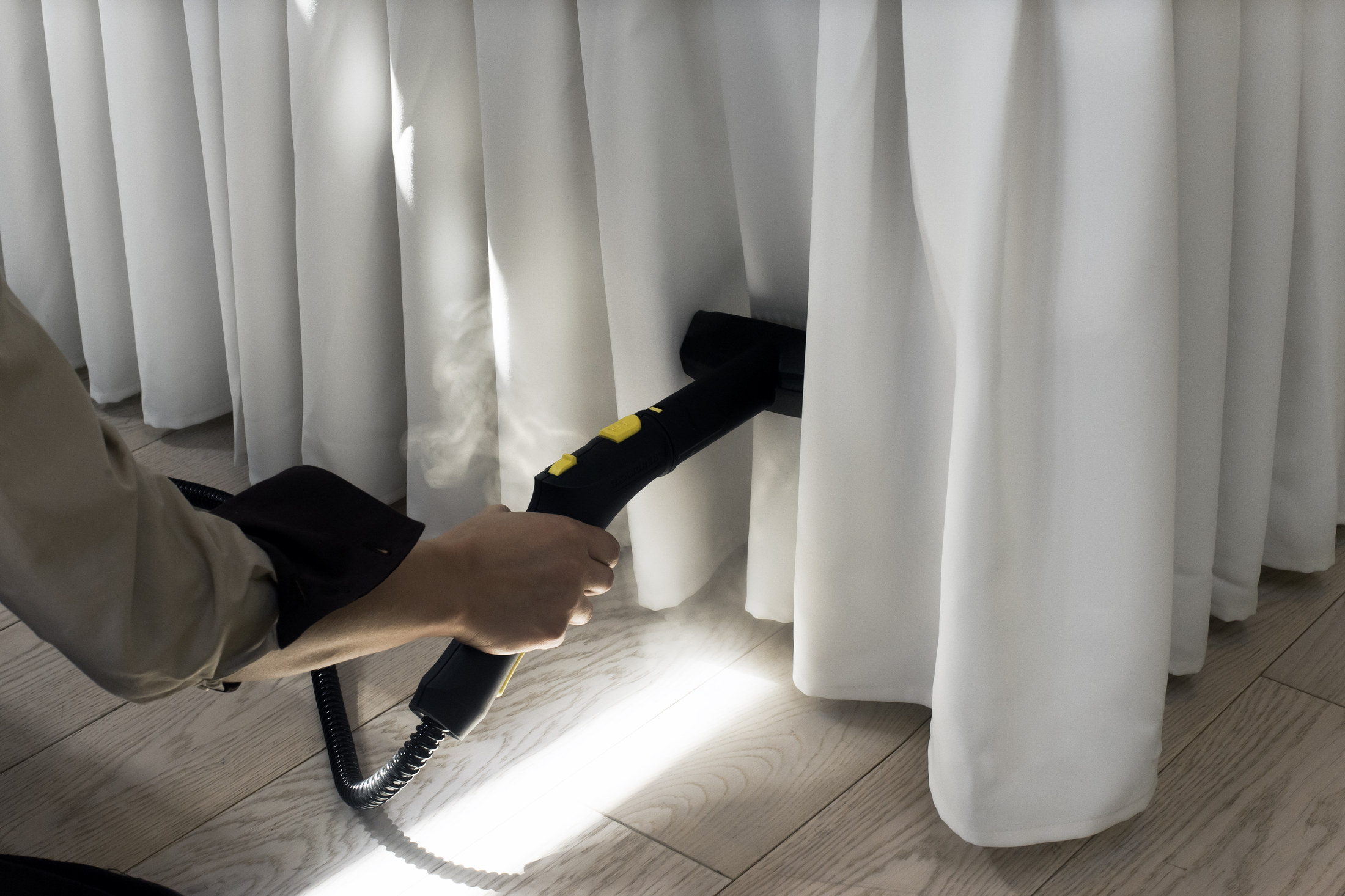
A hand-held steamer freshens curtains in place and drops the creases, and one curtain maker suggests it for exactly that. Follow the steamer's instructions, keep it moving, and test on a hidden fold first — steam marks some fabrics.
Faded stripes along the leading edge are sun damage, not dirt, and washing will not bring the colour back. One maker notes that fading from sunlight is always possible and that drawing curtains well back, lining and interlining all help them last.
THE PART THAT DECIDES THE FINISH
Preparing the curtains — by what kind they are
Find your curtains below and do their preparation before anything comes down. If they are two of these, follow the stricter one.
Unlined cotton, polyester or linen
Light curtains you can see daylight through when held up.
- Read the wash tub symbol for the temperature and whether it is machine or hand
- Measure the drop of each curtain and write it down
- Shake them outside to drop loose dust
- Test a hidden corner for colour by dabbing with a damp white cloth
Lined curtains with a detachable lining
The lining hangs on its own hooks or tapes and comes away.
- Separate the lining from the curtain
- Read the labels on both; they may differ
- Wash the lining separately on its own setting
- Measure the drop of each part so you can check for shrinkage
Sewn-in lining, interlining or blackout
The lining is stitched to the face fabric all round.
- Assume they need a curtain specialist unless the label clearly says otherwise
- Vacuum them in place with a soft brush attachment
- Spot clean small marks only, after a hidden test
- Steam out creases rather than washing
Net curtains and voiles
Sheer, light, often with a rod pocket.
- Take them down carefully; they tear on rough rods
- Put each in a mesh wash bag
- Use a cool, gentle cycle with a mild detergent and a low spin
- Plan to hang them back on the rod while damp
Curtains with mould or damp marks
Black spots near the bottom hem or behind the curtain, often on a cold window.
- Take them down and wash them on their own if the label allows
- Do not shake mouldy curtains indoors; take them outside first
- Read the mould guide for the window; condensation is the cause
- Check the window reveal and sill behind them before rehanging
THE JOB
How to wash curtains, in order
Read the labels and measure
15 minUse the surfaces section above to match your curtains, and read every label — curtain and lining. Then measure the drop of each curtain from the top of the heading to the hem, and the width, and write it down with the date. That number is your proof if anything shrinks. Note where the hooks sit in the heading tape so you can put them back in the same pockets.
- Photograph the label and the hooks in place
- Count the hooks so none go missing
- If the labels disagree, follow the stricter one
Mistake to avoid: Washing without measuring. If they come out short, you cannot tell whether it was the wash or whether they were always that length.
Take them down safely
20 minSet the stepladder on firm, level floor facing the window, fully open with its locks engaged. The HSA's ladder guidance says not to stand on the top two steps of a stepladder unless it has a handrail, and to keep your belt buckle between the stiles rather than leaning out. Lift each curtain off one section at a time, move the ladder along rather than stretching, and pass the weight down to someone if they are heavy.
- Never stand on a chair, a bed or a windowsill to reach
- Take off rings or gliders in order and keep them together
- Check the track and pole while you are up there
Mistake to avoid: Stretching sideways off the ladder to unhook the far end. Overreaching is how most ladder falls happen.
Remove hooks and dust thoroughly
20 minTake the hooks out and loosen the heading tape cords without unknotting them, so the curtain lies flat. Shake each curtain outside, then lay it over a clean bedspread or table and vacuum it with a soft brush attachment, top to bottom, without pulling the fabric. One curtain maker recommends this before any wash or spot clean, because dust that gets wet turns to grey streaks.
- Tie the loose cord ends together so they do not tangle in the wash
- Brush along the folds, not across them
- Vacuum the window frame and sill too
Mistake to avoid: Washing a dusty curtain without shaking and vacuuming it first. The wash water turns grey and redeposits dirt along the folds.
Test for colour and treat marks
15 minDab a hidden part of the hem with a white cloth dampened in your detergent solution. If colour comes off, stop — that curtain needs a specialist. Treat any marks by dabbing gently with a soft cloth and the solution, testing first, and leave them a few minutes. Do not scrub; curtain fabric fluffs and the pattern rubs off.
- Test the lining too if it is going in
- Treat watermarks at the hem by washing the whole curtain, not the spot
- Mould spots: treat the whole curtain, and fix the window
Mistake to avoid: Rubbing a stain out of the middle of a curtain. It leaves a pale, fuzzy patch that shows every time the light comes through.
Wash by machine — cool and gentle
1 hourWash one curtain at a time in a machine that has room for it to move; a packed drum does not rinse. Choose the gentle or delicate cycle at or below the temperature on the label, with a mild non-bio detergent and no fabric softener or bleach. Use a low spin. Take it out the moment the cycle ends, as one maker advises, so the creases do not set.
- Nets and voiles go in mesh bags
- Fold the curtain loosely rather than balling it
- Run a rinse-only cycle if there are suds left
Mistake to avoid: Washing hot to get them cleaner. Heat is what shrinks fabric and separates linings, and the label number is the limit, not a target.
Or wash by hand in the bath
45 minFor hand-wash curtains, half-fill the bath with cool water and a little mild detergent. Lay the curtain in, press it gently down and move it through the water without twisting. Let it soak briefly, drain, and refill with clean cool water to rinse, pressing the water through rather than wringing. Repeat until no suds appear.
- Kneel on a folded towel; this is hard on the knees
- Never wring a curtain; it stretches and creases permanently
- Press water out by folding and pushing down on the curtain
Mistake to avoid: Wringing a wet curtain by hand. It twists the weave out of shape and leaves creases you cannot iron out.
Dry it in the shade without heat
Several hoursHang the curtain over a clean line or two airers placed apart, folded over at its middle with no fold too tight, in the shade or indoors with a window open. Keep it off the ground and away from radiators. Unless the label shows a tumble dryer symbol, do not tumble dry, and even then use low heat only. Turn it every hour or so.
- Spread the weight across two lines if you can
- Avoid pegs on the face fabric; they leave marks
- Take it in before it is bone dry
Mistake to avoid: Drying curtains in direct sun or on a hot radiator. Sun fades the colour on the exposed side and heat can shrink and stiffen it.
Rehang while slightly damp
20 minWhen the curtain is dry to the touch but still has a little moisture in it, put the hooks back in the same pockets, pull the heading cords to the width you measured and hang it. The curtain's own weight drops most creases as it finishes drying in place. Use the stepladder exactly as before. Steam any stubborn creases once it is up.
- Hang the leading edges first so the pair meets cleanly
- Dress the folds into even pleats with your hands and tie them loosely for a few hours
- Open the window so it finishes drying
Mistake to avoid: Ironing a long curtain flat on a board. It takes ages, leaves shine on the fabric and the creases come back on the pole anyway.
Measure again and note it
5 minOnce fully dry, measure the drop again and compare it with your notes. A small difference can be taken up by moving the hooks up or down a pocket in the heading tape — one curtain maker describes doing exactly that when curtains drop. Note the date of the wash, the cycle and the result so the next wash goes the same way.
- Check both curtains of a pair finish at the same height
- If one shrank more, it was washed differently; note why
- Keep the spare hooks with your notes
Mistake to avoid: Not checking until they look wrong. By then you cannot remember which setting you used.
The mistakes that ruin curtains
- Washing lined, interlined or blackout curtains at home
- Washing hotter than the label, or tumble drying without the symbol
- Wringing them, or leaving them crumpled in the drum
- Standing on a chair or the top steps of a ladder to take them down
- Skipping the measurement, so shrinkage goes unnoticed
Stop here and get a curtain cleaner
- The label shows dry-clean only, or a crossed-out wash tub
- The curtains are lined, interlined or blackout-lined with the lining sewn in
- The colour test shows dye on the cloth
- The track is over a stairwell or a window you cannot reach from a stepladder on level floor
| WHAT YOU SEE | WHY, AND THE FIX |
|---|---|
| The curtains came out shorter | They shrank from heat or a hot dryer. Move the hooks up a pocket in the heading tape to drop them; if that is not enough, they need lengthening or replacing. |
| The lining has puckered or pulled | The lining and face fabric shrank differently. A curtain maker can sometimes unpick and reset the hem; next time, dry-clean. |
| Deep creases that will not drop | They were left in the drum or wrung. Steam them on the pole, or rewash briefly and rehang damp. |
| Pale streaks along the edge | Sun fading, which washing reveals rather than causes. The colour will not return; line the curtains to protect the rest. |
| Grey streaks along the folds | Dust that went in wet, or an overloaded drum. Rewash on its own with more water and an extra rinse. |
| The net curtain tore in the wash | It snagged without a mesh bag or on a rough hook. Small tears can be mended; always bag nets. |
| Black spots at the hem came back | Mould from condensation on the window. Wash them again and deal with the condensation — ventilation and wiping the glass each morning. |
| The pair no longer meet in the middle | The heading cords were pulled to different widths. Loosen and re-gather both to the width you measured. |
WHAT YOU SAVE
What it costs to do it yourself
| Mild non-bio laundry liquid | €5.99 |
|---|---|
| Mesh wash bags, set of two | €1.49 |
| Clothes line | €1.99 |
| Total, one pair | €9.47 |
| DIY total | €9.47 |
Guide prices compiled by the Locufy team from published Irish and UK provider price lists and 2026/27 cost guides. Updated 2026.
The detergent does many washes, and the bags and line last for years, so the next pair costs almost nothing. A stepladder is the one bigger item if you do not already own one; borrow one rather than using a chair.
RATHER NOT?
Curtain cleaners near you, with prices shown
The ones who cover your area, nearest first, with one score from every review. No account needed to look.
Or post the job free and let them come to you.
Vacuum curtains with a soft brush attachment every few weeks and air the room daily. A steamer freshens them in place.
Wipe the glass each morning in cold weather and keep the curtains a little off the window; damp fabric against cold glass is how mould starts.
Dry the mesh bags and store spare hooks with your measurement notes. Fold the stepladder and store it upright.
Curtains do not go in the general or recycling bin. Good ones can go to a charity shop; worn ones go to a textile or clothing bank, which mywaste.ie lists, or your local civic amenity site.
Washing curtains at home: questions people ask
Usually not. One curtain maker advises that lined, interlined and blackout-lined curtains be dry cleaned by a specialist, because the fabric and lining shrink differently. A detachable lining can be washed separately if its own label allows.
No hotter than the number in the wash tub on the care label, and cooler is safer. Use a gentle cycle with a mild detergent and a low spin.
Only if the label shows the tumble dryer symbol, and then on low heat. Otherwise dry them in the shade and rehang them slightly damp so the creases drop.
Rehang them while slightly damp so their weight pulls the creases out, or use a hand-held steamer on the pole as one curtain maker suggests.
The Locufy price guide puts professional curtain cleaning at €30–€120 per pair, typically €60. Lined, interlined and very long curtains cost more.
Vacuum them every few weeks and wash or clean them once or twice a year. The HSE suggests cleaning curtains often if anyone in the home has a dust mite allergy.
MORE GUIDES
More DIY guides
Sources — checked October 2026
- 247 Curtains — how to clean made-to-measure curtains
- Vanessa Arbuthnott — made-to-measure curtains: linings, cleaning and fading
- HSE — preventing allergic rhinitis: curtains and dust mites
- HSA — using ladders safely
- HSA — using and storing detergents
- MyWaste.ie — curtains
- Mr Price — price check: laundry liquid, October 2026
- Mr Price — price check: mesh wash bags and clothes lines, October 2026