DIY GUIDE · CLEANING · CHECKED OCTOBER 2026
How to clean a mattress yourself
A day, mostly drying time. £10–£30 for a protector, bicarbonate and an enzyme cleaner.
Which rules your mattress follows, dry methods first, cold-water blotting for stains, and a long dry.
- Every step, start to finish
- Checked October 2026 — sources at the end
- Honest about when to call a pro
FIRST, THE HONEST ANSWER
Do it yourself, or get a cleaner?
Do it yourself if…
- The mattress has a sewn-in label, or you know the maker and can find its care guidance
- The problem is dust, general freshness, sweat marks or a recent spill
- You can strip the bed and leave the mattress uncovered in a ventilated room for most of a day
- The mattress is otherwise sound — no sagging springs, torn cover or persistent damp smell
Get a pro if…
- There is a large urine, vomit or blood stain that has soaked deep into the mattress
- The mattress smells musty or shows mould spots — that can mean moisture inside
- You suspect bed bugs: small dark spots on seams, bites, or live insects
- The mattress is a high-value natural-filling model still under a guarantee that names its own care
Safety first
- Use cold water on blood and protein stains; warm water sets them. Never pour liquid onto a mattress — dab with a damp cloth.
- Never mix cleaning products, and keep bleach well away from mattress covers.
- Mattresses are heavy and awkward. Get a second person to lift, turn and rotate it, and bend your knees.
- Wear gloves when treating urine, vomit or blood, and wash your hands afterwards.
- Do not use a carpet extraction machine on a memory foam mattress; the hire maker lists memory foam as unsuitable.
- Do not make the bed until the mattress is completely dry right through.
| MATERIAL | COVERAGE | FOR THIS JOB |
|---|---|---|
| Bicarbonate of soda | A thin, even layer over the surface | About a box for a double |
| Enzyme cleaner for mattresses and upholstery | For urine and organic stains; test first | One bottle |
| Breathable mattress protector | Cotton or wool-faced, not plastic sheeting | One per bed, two if you want one in the wash |
How much bicarbonate of soda
Bicarbonate ≈ mattress area in m² × about 200 g per m² for a light, even layer. A double mattress of 1.35 × 1.9 m is 2.6 m², so 2.6 × 200 ≈ 500 g — about one standard box.
A thin layer works as well as a thick one and is far easier to remove completely.
Mattress makers say not to remove the sewn-in labels, because they carry the care and content details. The label tells you whether the mattress is turnable or one-sided, what the fillings are and often how to clean it. Look up the maker's own care page if the label is vague.
One maker of natural-filled pocket-sprung mattresses says to clean the mattress every other month with a soft brush and not to use a vacuum cleaner, because suction disturbs the upholstery fillings. The same maker says to treat spills at once with dry towels or paper towels and not to use detergents or chemical cleaners.
For foam and hybrid mattresses, one retailer's guide suggests vacuuming with an upholstery attachment, paying attention to seams and edges, and keeping liquid to a minimum on memory foam. Another maker says detergents or chemical cleaners are likely to damage the fabric and stitching — so if you use any, use very little, diluted, on a cloth.
A layer of bicarbonate of soda left on the surface for at least an hour, or overnight, and vacuumed off thoroughly draws moisture and neutralises everyday odours. On natural-filled mattresses where vacuuming is ruled out, brush it off instead.
Urine leaves smell-causing deposits that ordinary detergents do not break down. An enzyme cleaner sold for mattresses and upholstery, used sparingly on a cloth after blotting, is the right product. Test it on a hidden area first.
Makers recommend a good-quality breathable protector, and one warns that not using one could affect the guarantee. Choose cotton or wool-faced, not plastic sheeting, which traps condensation and risks mould.
THE PART THAT DECIDES THE FINISH
Preparing the mattress — by what you are dealing with
Strip the bed completely before deciding anything — sheets, protector, topper — and look at both sides and the seams in good light.
General freshening
Every few months, or when you change the seasons.
- Strip the bed and wash the bedding and protector as their labels allow
- Open the window and let the mattress air uncovered
- Brush or vacuum the surface according to the maker's rule for your filling
- Pay attention to seams, buttons and the border, where dust and skin collect
Fresh spills
Drinks, water, a child's accident caught quickly.
- Blot at once with dry towels or paper towels, pressing hard
- Stand the mattress on its side if you can, so liquid drains to a corner rather than through the middle
- Keep blotting with fresh towels until nothing more comes up
- Then treat the stain by type as below
Blood
Protein stain; cold water only.
- Blot fresh blood with a dry cloth
- Use only cold water — warm water sets it
- Mix a little washing-up liquid into cold water and dab from the outside of the stain inwards, if your maker allows detergent
- For dried blood, a paste of bicarbonate of soda and cold water left for 30 minutes, then dabbed away
Urine
The commonest mattress stain and smell.
- Blot as much as possible with a thick absorbent cloth, pressing firmly
- Dab with a cloth dampened in cool water and a little mild detergent, or an enzyme cleaner
- Cover the damp area with bicarbonate of soda and leave it for several hours or overnight
- Vacuum or brush it off and dry fully
Sweat marks and yellowing
Usually on the top third of the mattress.
- Vacuum or brush first
- Use a paste method only on foam or hybrid mattresses whose maker allows a mild cleaner
- Dab, do not scrub, and use as little moisture as possible
- Accept that old yellowing on a cover rarely lifts completely
Memory foam
Foam layers absorb liquid and hold it.
- Use the least liquid of any mattress type — a barely damp cloth only
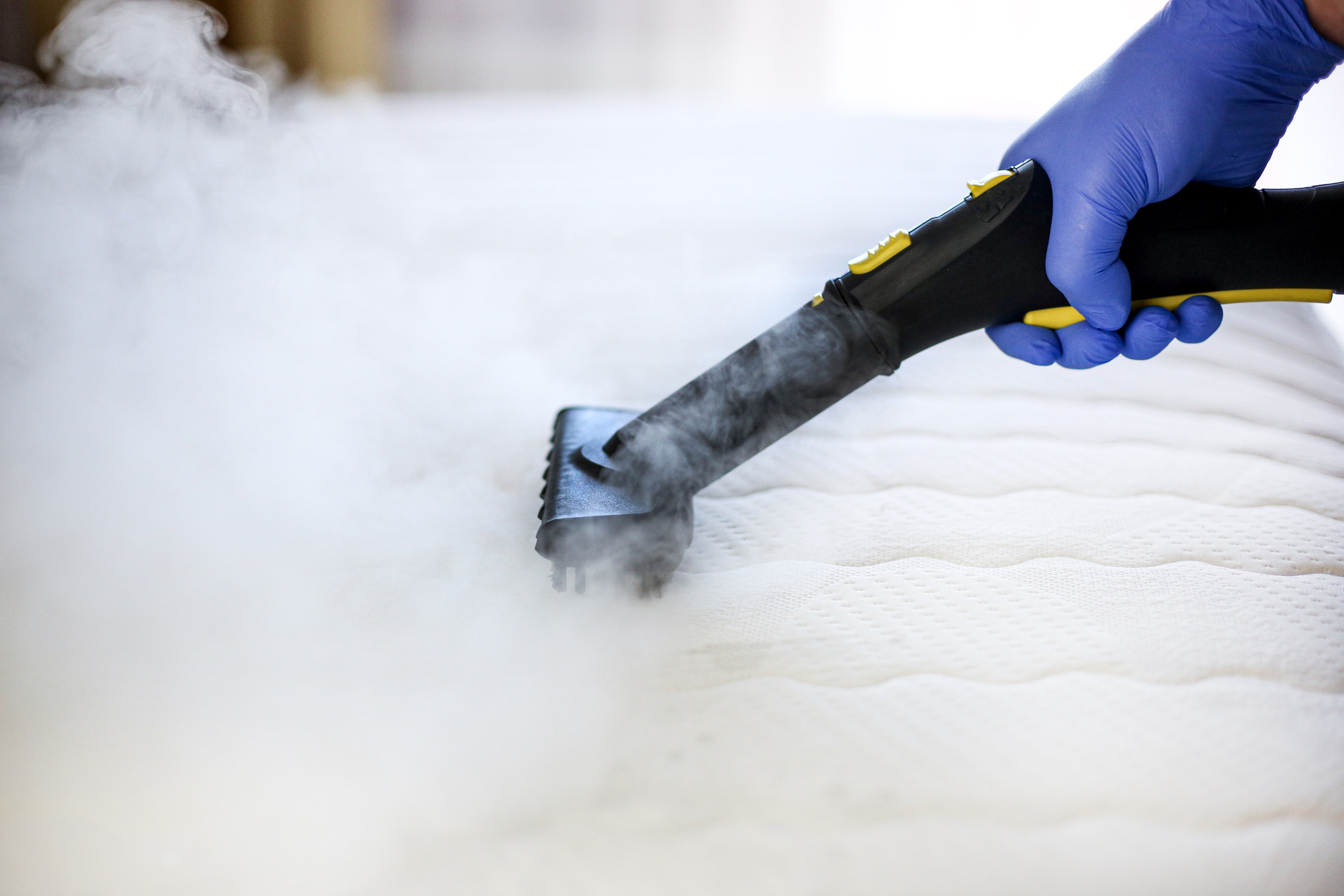
- Never use an extraction machine or a steam cleaner
- Stand it on its side in a warm room with a fan to dry any damp patch
- Check the cover: some zip off for washing, but check the label before you wash it
THE JOB
How to clean a mattress, in order
Strip the bed and read the label
15 minTake off every layer — sheets, protector, topper — and put them in the wash as their labels allow. Find the sewn-in label on the mattress and check the maker's care advice. Decide from it whether you will vacuum or brush, and whether any detergent is allowed. Open the window.
- Photograph the label for next time
- Wash the protector at the same time; it holds most of the dirt
- If the label is missing, treat it as a natural-filling mattress — brush, no detergent
Mistake to avoid: Cleaning a natural-filling mattress like a foam one. Vacuuming and detergent can disturb its fillings and void its guarantee.
Brush or vacuum the surface
15 minWork methodically across the top in overlapping strips, then along every seam, round any buttons or tufts and along the borders. With a brush, use short strokes and flick dust off the side. With a vacuum, use the upholstery tool, not the floor head, and keep it moving.
- Seams and borders hold more dust than the flat surface
- Do both sides on a turnable mattress
- Empty the vacuum or tap out the brush outside
Mistake to avoid: Pressing a strong floor head into a pillow top. It drags at the stitching and can pull fillings through the ticking.
Blot any fresh spill
10 minIf something has just been spilled, blot it at once with dry towels or paper towels, pressing hard and replacing them as they get wet. Do not rub. Stand the mattress on its edge if the patch is large, so the liquid runs to an edge instead of soaking through.
- Stand on a towel and press with your full weight on the paper towels
- Keep going until fresh towels come away dry
- Then treat by stain type
Mistake to avoid: Rubbing a spill. It pushes the liquid deeper and spreads the stain sideways.
Treat stains with as little moisture as possible
20 minUse the method for the stain from the section above. Mist or dab, never pour. Work from the outside of the mark inwards with a clean part of the cloth each time. On blood use cold water only. On a natural-filling mattress whose maker rules out detergent, use cold water and blotting only.
- Damp cloth, not a wet one
- Test any product on the underside or border first
- Two light treatments beat one heavy one
Mistake to avoid: Soaking a stain to get it out in one go. The water goes into the fillings and leaves a ring bigger than the stain.
Deal with urine properly
20 minAfter blotting, dab the area with an enzyme cleaner or a cool-water and mild-detergent solution, on a cloth. Then cover the damp patch generously with bicarbonate of soda and leave it for several hours or overnight to absorb moisture and smell. The retailer's guide also suggests a vinegar-and-water mist for dried urine before the bicarbonate.
- Gloves on, and the window open
- Do not mix vinegar with an enzyme cleaner or any bleach product
- Repeat the next day rather than wetting it more today
Mistake to avoid: Treating urine with bleach. It does not remove the deposits that cause the smell and it damages the cover.
Freshen the whole surface
10 minShake a thin, even layer of bicarbonate of soda over the whole top surface through a sieve. Leave it for at least an hour, or overnight if you can, with the window open. This takes up everyday moisture and odours from the cover.
- Thin and even is enough
- Keep pets off the mattress while it sits
- Do it in the morning so it can sit all day
Mistake to avoid: Leaving a thick layer. Bicarbonate that is not removed works into the fabric and leaves a dull, dusty surface.
Remove the bicarbonate thoroughly
15 minVacuum it off slowly with the upholstery tool, going over every area twice, including the seams. On a natural-filling mattress where vacuuming is ruled out, brush it off firmly towards the edge and onto a sheet on the floor.
- Go slowly — bicarbonate is fine and needs time to lift
- Check the seams with your fingertips
- Empty the vacuum afterwards; the powder clogs filters
Mistake to avoid: Making the bed over bicarbonate residue. It holds moisture and leaves a film on the sheets.
Dry it completely
Several hoursLeave the mattress uncovered with the window open and a fan if possible until any damp patch is dry right through. Press the treated area firmly with a dry paper towel; if it comes up cool or damp, it is not dry. Stand it on its side to let air reach both faces, with help.
- Air movement dries faster than heat
- Never put a mattress against a radiator
- A damp mattress made up tonight smells tomorrow
Mistake to avoid: Putting the protector back on while it is still slightly damp. Trapped moisture is how mould starts inside a mattress.
Rotate or turn it
10 minWhile the bed is stripped, rotate the mattress head to foot, and turn it over if it is double-sided. Makers differ on the rhythm: one asks for a weekly rotate and turn through the first quarter of a year, then a change each season; another asks for weekly changes over the first couple of months, then one a month. Use the side handles only to position it, not to lift its full weight.
- Two people, always
- Note the date and which way it now lies
- Single-sided and pillow-top mattresses rotate but do not turn
Mistake to avoid: Lifting a mattress by its handles. Makers say the handles are for positioning and lifting by them damages the border.
Protect it and remake the bed
10 minFit a clean, breathable protector and make the bed. Leave the bedding turned back for a few hours each week so the mattress can breathe — one maker suggests airing it weekly in this way.
- Cotton or wool-faced protector, not plastic
- Wash the protector as often as the sheets
- Air the bed every morning before making it
Mistake to avoid: Using a plastic or vinyl sheet as a protector. It traps condensation and risks mould.
The mistakes that spoil mattresses
- Soaking a stain, so water gets into the fillings and leaves a ring or a smell
- Hot water on blood or protein stains, which sets them
- Detergent, bleach or a carpet machine on a mattress whose maker rules them out
- Making the bed before the mattress is dry right through
Stop here and get a mattress cleaner
- There is a large soaked-in stain, or a smell that returns after cleaning and airing
- You see mould spots or the mattress smells musty, which can mean moisture inside
- You find signs of bed bugs — that is pest control, not cleaning
- The mattress is expensive or still under a guarantee and its maker names a professional process
| WHAT YOU SEE | WHY, AND THE FIX |
|---|---|
| A ring or tide mark after cleaning a stain | Too much water spread the stain outwards. Lightly mist the whole ring to its outer edge, blot evenly and dry fast with a fan. |
| The mattress smells musty | Moisture is trapped inside. Stand it on its side in a warm, ventilated room with a fan; if the smell persists, it may be mould and the mattress may need replacing. |
| A urine smell comes back on warm nights | Deposits are still in the fillings. Treat with an enzyme cleaner, bicarbonate overnight and dry fully; a deep accident may need a professional. |
| Yellow patches on the top third | Sweat and body oils. Light treatment on foam or hybrid mattresses can lighten them; old yellowing on natural ticking rarely lifts fully. Use a protector from now on. |
| Blood stain went darker after cleaning | Warm water or rubbing set it. Treat again with cold water and a bicarbonate paste; a set stain may only fade. |
| White powdery film on the surface | Bicarbonate of soda left behind. Vacuum or brush slowly again, paying attention to seams. |
| Dips and ridges in the mattress | Not dirt — body impressions in the fillings, which makers say are normal. Rotate and turn it as the maker recommends. |
| Small dark spots along the seams | Could be bed bug signs rather than dirt. Do not move the mattress round the house; call pest control. |
WHAT YOU SAVE
What it costs to do it yourself
| Bicarbonate of soda | £1–£3 |
|---|---|
| Enzyme cleaner for mattresses and upholstery | £4.98–£15.99 |
| Breathable mattress protector | £7.99–£19.99 |
| Total | £10–£30 |
| DIY total | £10–£30 |
Guide prices compiled by the Locufy team from published Irish and UK provider price lists and 2026/27 cost guides. Updated 2026.
The protector is the best money you will spend here; it stops most of the stains that make a mattress need cleaning at all.
RATHER NOT?
Mattress cleaners near you, with prices shown
The ones who cover your area, nearest first, with one score from every review. No account needed to look.
Or post the job free and let them come to you.
Turn the covers back for a few hours each week and air the bed every morning before making it.
A mattress that is mouldy, soaked or infested cannot be cleaned. Your council runs a bulky waste collection or takes mattresses at the household waste recycling centre; some retailers take the old one when they deliver a new one. Never leave it on the street.
Keep enzyme cleaners and detergents in their own bottles, closed, out of reach of children, and put empty bottles in your council recycling.
Write the date on your phone each time you rotate or turn it, so it becomes a habit with the seasons.
Cleaning a mattress: questions people ask
Strip it, brush or vacuum it as the maker allows, treat stains with as little moisture as possible, freshen it with bicarbonate of soda for at least an hour, remove the bicarbonate thoroughly and let it dry completely before making the bed.
Not on memory foam, which the hire machine maker lists as unsuitable, and a retailer's guide advises against it for most mattresses because of the water. A hand tool on a sprung mattress is possible, but use very little water and dry it fully.
Blot hard with dry towels, dab with an enzyme cleaner or cool water and mild detergent, cover with bicarbonate of soda for several hours or overnight, then vacuum or brush it off and dry fully.
It depends on the maker. One natural-filling maker says not to vacuum, because suction disturbs the fillings, and to brush instead. Foam and hybrid makers and retailers generally suggest vacuuming with an upholstery tool.
The Locufy UK price guide puts professional mattress cleaning at £30–£95 per mattress, typically £55. Large or heavily stained mattresses cost more.
Brush or vacuum it every couple of months, freshen it with the seasons when you rotate it, and treat spills straight away. A washable protector cuts the need for deep cleaning.
MORE GUIDES
More DIY guides
Sources — checked October 2026
- Hypnos — bed care guide: soft brush, no vacuum, no detergents, turning and airing
- Silentnight — product FAQs: no detergents or chemical cleaners, turning
- Rug Doctor — FAQs: mattresses with the hand tool, memory foam unsuitable
- Dreams — mattress care guide: stains, bicarbonate, drying
- HSE — safe use of cleaning substances (CAIS22): never mix, gloves
- B&Q — price check: mattress protectors, October 2026
- B&Q — price check: enzyme cleaners, October 2026
- Sainsbury's — price check: bicarbonate of soda, October 2026
- GOV.UK — recycling collections: find your council