DIY GUIDE · CLEANING · CHECKED OCTOBER 2026
How to deep-clean a kitchen and bathroom yourself
A weekend. £13–£27 in degreaser, descaler, a hob scraper and gloves.
Degrease the kitchen, descale the bathroom, top to bottom, and never let the two chemistries meet.
- Every step, start to finish
- Checked October 2026 — sources at the end
- Honest about when to call a pro
FIRST, THE HONEST ANSWER
Do it yourself, or get a cleaner?
Do it yourself if…
- The kitchen and bathroom are dirty but sound — no leaks, loose tiles or failed seals
- You can empty the kitchen cupboards and move freestanding appliances that are not gas-connected
- You have a weekend, or two separate days, to give the rooms
- You are comfortable on a stepladder for cupboard tops and light fittings, staying off the top steps
Get a pro if…
- Moving the cooker means disconnecting a gas supply — that is a Gas Safe registered engineer's job, not a cleaner's
- Black mould covers a large area, or grout and sealant are failing as well as dirty
- Grease or limescale is so thick that two treatments have not moved it
- The surfaces are natural stone, antique tiles or specialist finishes you are unsure about
Safety first
- Keep kitchen degreasers and bathroom acid descalers apart, and never mix bleach with acid cleaners or ammonia — HSE warns the mix gives off harmful gases.
- Wear goggles when cleaning cupboard tops, extractor hoods and ceilings: HSE advises eye protection when you clean at eye level or above.
- Switch off and unplug appliances before cleaning inside or behind them, and switch the cooker hood off at the isolator before taking its filters out.
- Do not move a gas cooker or disconnect its supply yourself; clean around it where it stands.
- Use a stepladder with all four feet down, facing the work, and keep off its top three steps.
- Wear gloves throughout and moisturise afterwards; HSE notes wet hands for long periods lead to dermatitis.
| MATERIAL | COVERAGE | FOR THIS JOB |
|---|---|---|
| Kitchen degreaser | Spray, leave briefly, wipe | One bottle for a kitchen |
| Bathroom limescale remover | Acid; follow the label's contact time | One bottle |
| White vinegar | For shower heads | Enough to submerge the head |
| Toilet cleaner | Bleach or acid gel, never both | One bottle |
| Hob cleaner | Made for glass and ceramic hobs | One bottle |
How long each room takes
Kitchen ≈ 30 minutes per run of wall units + 30 for the hob and hood + 30 per appliance moved + 60 for cupboard insides. A kitchen with two runs of wall units and two appliances to move is 60 + 30 + 60 + 60 = 210 minutes, about three and a half hours, before the oven. A bathroom is about two to three hours.
If it has been more than a year, add half again. Grease that has been left hardens and needs two applications.
Kitchen film is grease that has hardened. A degreasing spray or a strong washing-up solution in hot water dissolves it; the trick is time — spray, leave a few minutes, then wipe. On painted and lacquered cupboard doors, test on the inside of a door first.
Limescale only dissolves in acid. A bathroom limescale remover, or white vinegar for shower heads, used for the time on the label, then rinsed. One shower maker soaks heads in white vinegar for at least 30 minutes and ideally about an hour, but never brass heads for longer than 30 minutes.
One hob maker's list of unsuitable products is specific: undiluted detergent, dishwasher detergent, abrasive cleaners, oven spray or stain remover, abrasive sponges and steam cleaners. Use a hob cleaner or soapy water, and a scraper at 30 to 45° for burnt-on residue.
Metal grease filters need regular washing — one maker says once a month, another every 1 to 3 months depending on use. Some are dishwasher-safe; check the manual. Charcoal recirculation filters are different: some wash, some must be replaced. A hood maker warns that neglected filters are a fire risk.
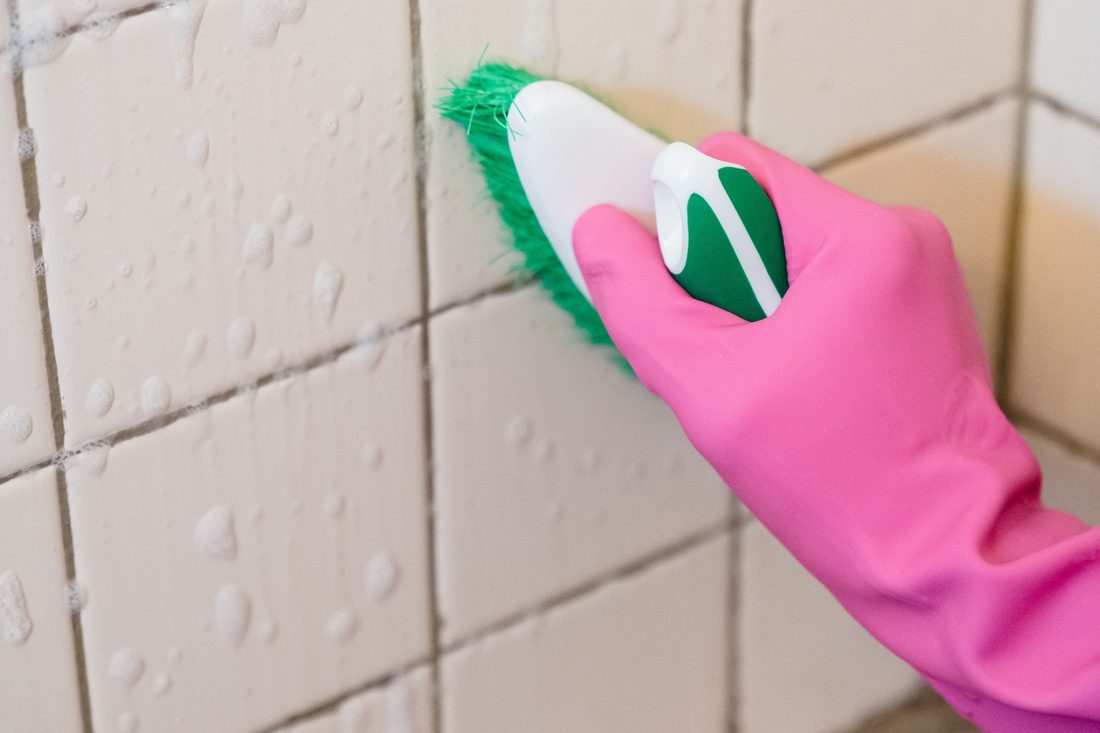
A grout cleaner and an old toothbrush, with the solution left to soak; one shower maker leaves it for 30 minutes before brushing. Sealant that is black inside will not clean and needs replacing once the joint is dry.
Quartz and composite worktops have strict limits: one worktop maker lists oven, grill, toilet and drain cleaners and caustic products as ones to avoid entirely, and recommends warm water and mild soap. Never use sealers or polishes on quartz.
THE PART THAT DECIDES THE FINISH
Preparing the rooms — by what you are cleaning
Empty and protect first. A deep clean is slow because of the clearing, and fast once the surfaces are bare.
Kitchen cupboards, inside and out
Doors, handles, shelves and the tops of wall units.
- Empty one cupboard at a time onto the table, checking dates as you go
- Vacuum crumbs out of the corners before wiping
- Test the degreaser on the inside of one door
- Put a sheet of newspaper on the tops of wall units after cleaning, to catch next year's grease
Hob and extractor hood
Glass hob, steel or glass hood, filters.
- Make sure the hob is off and cold
- Switch the hood off at the wall and remove the grease filters as its manual shows
- Check whether the filters are dishwasher-safe or hand wash
- Note the charcoal filter type: washable or replace-only
Behind and under appliances
The fridge, washing machine, dishwasher and freestanding electric cooker.
- Unplug before moving anything, and walk appliances out slowly so you do not tear a hose
- Do not move a gas cooker; clean around it in place
- Check behind the washing machine that hoses are not kinked or stretched
- Vacuum the fridge's rear grille and the floor before washing
Shower, screen and head
Limescale and soap scum.
- Unscrew the shower head if it is handheld, keeping the rubber washer safe
- For a fixed head, half-fill a plastic bag with white vinegar and tie it round the head so it is submerged
- Spray limescale remover on the screen and taps and leave for the label's time
- Open the window and run the extractor
Bath, basin, tiles and grout
Ceramic, enamel, acrylic.
- Check what the bath is: acrylic scratches with cream cleaners and scourers
- Apply grout cleaner to the grout lines only and leave it to soak
- Push hair and debris out of the plug holes before any product goes down
- Check the sealant bead: loose or black inside means replacement, not cleaning
Toilet and its surroundings
Bowl, rim, cistern, seat hinges, floor behind.
- Put toilet cleaner under the rim and leave it, with no other product in the bowl
- Undo the seat hinge covers to reach the grime underneath
- Clean the floor and skirting behind the pan, where splashes collect
- Use your toilet-only cloth and gloves for all of it
THE JOB
How to deep-clean a kitchen and bathroom, in order
Start the slow soaks first
20 minBegin in the bathroom: remove a handheld shower head and soak it in white vinegar, or bag a fixed one, keeping brass heads to the 30-minute limit the shower maker gives. Spray limescale remover on the screen and taps, and put toilet cleaner under the rim. Then go to the kitchen and put the hood's metal grease filters to soak in hot soapy water, or in the dishwasher if the manual allows.
- Set timers for each soak
- Never put two products in the toilet bowl
- Remove the hood filters with the hood switched off at the wall
Mistake to avoid: Leaving a brass shower head in vinegar for hours. The finish dulls and the metal can pit.
Kitchen: top down, starting overhead
45 minWith goggles on and the stepladder set square, clean the tops of the wall units, the light fittings and the extractor hood body first. Spray degreaser, leave it a few minutes to soften the film, then wipe with a cloth rinsed often in hot water. Anything that drips lands on surfaces you have not cleaned yet.
- Work one unit at a time and rinse the cloth constantly
- Lay newspaper on cleaned unit tops
- Wipe the hood's underside last, with the hob covered
Mistake to avoid: Cleaning the worktops first. Grease and drips from above land on them an hour later.
Cupboards inside and out
60 minEmpty each cupboard, vacuum the crumbs, wipe the shelves and sides with a mild solution and dry them before refilling. Clean the doors outside with degreaser on a cloth, paying most attention round the handles and along the top edges near the hob. Dry painted doors straight away.
- One cupboard at a time keeps the kitchen usable
- Bin anything out of date as you go
- Wipe hinges and the door edges
Mistake to avoid: Soaking chipboard shelves. Water in the cut edges swells them and they never go back flat.
Hob, splashback and worktops
30 minWith the hob cold, lift loose food with a damp cloth, then work hob cleaner or soapy water in circles with a soft cloth. Use the scraper at a 30 to 45° angle on burnt residue, as the hob maker describes, then wipe and polish dry. Degrease the splashback tiles. Clean the worktops with warm water and mild soap, following the worktop maker's rules for quartz and stone.
- Remove sugar spills promptly — they damage glass
- Polish the hob dry with a microfibre
- Rinse and dry the worktop to avoid a film
Mistake to avoid: Using oven spray on the hob. The hob maker lists it as damaging.
Behind and under the appliances
60 minUnplug the fridge, washing machine and any electric freestanding cooker and walk them out slowly. Vacuum the floor, the skirting and the fridge's rear grille, then wash the floor and walls behind. Check hoses are not kinked as you push them back. Leave a gas cooker where it is and clean around it.
- Lay an old towel to slide appliances on
- Push back gently so feet do not catch the hoses
- Plug back in and check each one runs
Mistake to avoid: Moving a gas cooker to clean behind it. Any strain on the gas connection is dangerous; that is a job for a registered engineer.
Wash the filters and refit
20 minScrub the soaked grease filters gently with a soft brush, rinse in hot water and leave them to dry before refitting. Wash a washable charcoal filter only as its maker says — one gives every two months in hot water or a 65°C dishwasher cycle on its own — and replace a disposable one.
- Dry filters fully before refitting
- Note the date on a sticker inside the hood
- Discoloured metal filters after a dishwasher cycle are normal
Mistake to avoid: Refitting filters wet or leaving them out. Grease then coats the fan and ducting, which is a fire risk.
Bathroom: shower head and screen
30 minLift the head out of its vinegar soak, rinse it, and scrub the nozzles with a toothbrush, then rinse again and refit, running the shower for a minute to flush loose scale. Rinse the limescale remover off the screen and taps with clean water and dry them with a microfibre so new water marks do not start straight away.
- Rub the rubber nozzles with a finger to pop scale out
- Rinse the screen top to bottom
- Squeegee from now on after each shower
Mistake to avoid: Following the limescale remover with a bleach spray on the same screen without rinsing. The combination reacts.
Grout, tiles and sealant
45 minApply grout cleaner along the grout lines and let it soak — one shower maker leaves it 30 minutes — while you clean elsewhere. Then brush along each line with the grout brush, rinse and dry. Clean the tiles with bathroom cleaner. Check the sealant: if it is black inside or lifting, plan to cut it out and reseal on a dry day.
- Brush along the line, not across it
- Rinse well; grout cleaner residue goes chalky
- Mark failing sealant for replacement
Mistake to avoid: Scrubbing grout dry with a wire brush. It scratches tiles and rakes the grout out of the joints.
Toilet, basin, bath and floor
45 minScrub the toilet bowl and under the rim, flush, then clean the cistern, handle, seat and the hinges with the toilet cloth. Clean the basin and bath with bathroom cleaner, using cream cleaner only on ceramic or enamel. Clean the floor last, including behind the toilet pan and along the skirting.
- Undo seat hinge covers for the grime underneath
- No cream cleaner on acrylic baths
- Mop out of the door
Mistake to avoid: Using a cream cleaner on an acrylic bath. It dulls and scratches the surface.
Close up, ventilate and reset
20 minRun the extractor and leave windows open while everything dries. Put the cupboards back in order, refit the hood filters, and take every product back to its own storage, bathroom and kitchen chemicals apart. Wash cloths, mop heads and grout brushes hot.
- Keep the bathroom door open to dry it
- Write the date of the deep clean inside a cupboard door
- Moisturise your hands
Mistake to avoid: Shutting the bathroom up while it is still wet. Mould starts in the grout you have just cleaned.
The mistakes that damage surfaces or hurt people
- Letting a kitchen degreaser, a bathroom acid and a bleach meet on one surface
- Oven spray, abrasive pads or steam cleaners on a glass hob
- Moving a gas cooker to clean behind it
- Brass shower heads left in vinegar, and cream cleaner on acrylic baths
Stop here and get a deep cleaning service
- Cleaning behind the cooker would mean disconnecting a gas supply
- Grout, sealant or tiles are failing, or there is a leak under the bath or sink
- Large areas of mould, or grease and scale that two treatments have not moved
- You need a guaranteed result for a tenancy check-out or sale
| WHAT YOU SEE | WHY, AND THE FIX |
|---|---|
| Cupboard doors are still tacky after cleaning | Grease was smeared rather than dissolved. Spray degreaser, wait a few minutes, wipe with a cloth rinsed in hot water, and dry. |
| The shower still sprays unevenly | Scale inside the head. Soak it again for the time the maker allows and rub the nozzles to clear them. |
| White marks on taps and screen after drying | Limescale remover not fully rinsed, or hard water drying. Rinse thoroughly and dry with a microfibre. |
| Grout looks patchy after cleaning | Some lines were stained, not just dirty. A grout pen or regrouting evens the colour. |
| Sealant still black | The mould is inside the silicone. Cut it out, clean and dry the joint fully, and reseal. |
| Hood fan is noisy or extracting weakly | Filters clogged or refitted wrongly. Wash or replace them and check they click in. |
| Water on the floor after pushing the washing machine back | A hose was kinked or pulled loose. Unplug, pull it out, and check both hose connections. |
| Hob shows a cloudy film or rings | Cleaner residue or cleaning while warm. Clean again when cold and polish dry with a microfibre. |
WHAT YOU SAVE
What it costs to do it yourself
| Kitchen degreaser | £1.20–£5 |
|---|---|
| Bathroom limescale remover | £4–£4.50 |
| Toilet cleaner | £1.50–£1.80 |
| Cream cleaner | £1.05–£1.60 |
| Goggles | £2.30–£7.99 |
| Household gloves | £2.85–£6 |
| Total | £13–£27 |
| DIY total | £13–£27 |
Guide prices compiled by the Locufy team from published Irish and UK provider price lists and 2026/27 cost guides. Updated 2026.
Add a hob scraper if you do not have one. The oven, done the night before, is a separate kit.
RATHER NOT?
Deep cleaners near you, with prices shown
The ones who cover your area, nearest first, with one score from every review. No account needed to look.
Or post the job free and let them come to you.
Squeegee the shower after each use, wipe the hob once it cools after cooking, and wash the hood filters monthly.
Kitchen degreasers, bathroom acids and bleach on separate shelves, upright, in their own bottles.
Out-of-date food and packaging into your council's food waste and recycling. Rinsed empty cleaning bottles into recycling. Unwanted strong cleaners go to the household waste recycling centre rather than down the drain.
Every six to twelve months, with the hood filters, grout and shower head done more often.
Deep-cleaning a kitchen and bathroom: questions people ask
Everything a weekly clean skips: cupboard tops and insides, extractor filters, the hob properly, behind and under appliances, shower heads, screens, taps, grout, sealant and behind the toilet.
Soak it in white vinegar — a removable head in a bowl, a fixed one in a tied plastic bag — for at least 30 minutes, ideally about an hour, but no more than 30 minutes for brass. Rinse, brush the nozzles and flush.
Hood makers suggest metal grease filters monthly or every few months depending on use. Washable charcoal filters every couple of months; disposable ones replaced as the manual says.
An electric freestanding cooker can be unplugged and walked out carefully. Do not move a gas cooker; clean around it in place.
The Locufy UK price guide puts deep cleaning at £100–£600 per visit, typically £250. Kitchen and bathroom only is usually towards the lower end.
Spray a degreaser, leave it a few minutes, wipe with a cloth rinsed in hot water, then dry. Test it inside a door first on painted or lacquered finishes.
MORE GUIDES
More DIY guides
Sources — checked October 2026
- HSE — safe use of cleaning substances (CAIS22): never mix, eye protection above eye level
- HSE — types of ladder and using them safely: stepladders
- Mira Showers — how to clean and descale your shower head
- Mira Showers — how to clean your bathroom: grout soak
- NEFF — how to clean induction and ceramic hobs
- NEFF — how to clean cooker hood filters
- Beko — how to clean a cooker hood filter: monthly, charcoal at 65°C, fire risk
- Aire Valley Worktops — quartz worktop aftercare
- Sainsbury's — price check: degreasers, October 2026
- Sainsbury's — price check: limescale removers and toilet cleaners, October 2026
- Sainsbury's — price check: cream cleaners, October 2026
- B&Q — price check: safety goggles, October 2026
- B&Q — price check: rubber gloves, October 2026
- West Sussex County Council — how to dispose of cleaning products