DIY GUIDE · TRADES & CONSTRUCTION · CHECKED OCTOBER 2026
How to fit a carpet yourself
A day for one room. £213–£375 in gripper, underlay, a door bar and the stretching tools; the carpet itself is extra.
New gripper, taped underlay, stretch before you cut — and leave stairs and very long rooms to a fitter.
- Every step, start to finish
- Checked October 2026 — sources at the end
- Honest about when to call a pro
FIRST, THE HONEST ANSWER
Do it yourself, or get a fitter?
Do it yourself if…
- It is one room of a simple shape, with the carpet in a single piece and no seams
- The floor is sound and dry, and you can lift the old carpet and gripper yourself
- You can hire or buy a knee kicker and are prepared to work on your knees for a day
- You accept that a cutting mistake can cost you a new piece of carpet
Get a pro if…
- It is a staircase, a landing or a winding flight — stairs need a different technique and real practice
- The room is long enough to need a power stretcher, or the carpet has to be seamed
- It is a woven or patterned carpet whose pattern has to be kept straight across the room
- The old floor turns out to have tiles or adhesive you suspect contain asbestos
Safety first
- Lift with your knees bent and the load close to your body. A roll of carpet for a single room is heavy and awkward, and the law that protects workers from manual handling injuries is built on avoiding the lift where you can — so get a second person for the roll, and cut it to rough size in a larger room or outside before you carry it in.
- Wear thick work gloves when you lift old gripper and handle new strips; the pins are designed to bite, and they bite hands as readily as carpet backing.
- Cut away from yourself, with the blade on the line and your other hand behind it. A carpet knife slips on a hard pile, and most fitting injuries are cuts to the hand holding the carpet.
- Wear knee pads and push the kicker with the soft part above the kneecap, never the bone itself. Repeated kicking with the kneecap is how carpet fitters damage their knees.
- If lifting the old carpet uncovers old floor tiles or black bitumen adhesive in a home built before 2000, stop: older floor tiles can contain asbestos, and scraping or breaking them releases the fibres.
- Collect old gripper, nails and staples as you go and keep them in a box, not loose on the floor where someone kneels on them.
| MATERIAL | COVERAGE | FOR THIS JOB |
|---|---|---|
| Carpet | Room size plus a trimming margin on each side | Four-by-four room: a piece a little over 4 × 4 m from a single roll width |
| Underlay | Room area, joins taped | 16 m² |
| Gripper | Room perimeter, less door openings | 16 m perimeter, less the door: ten strips |
| Door bar or threshold | One per doorway | One |
| Carpet tape and staples | All underlay joins and timber edges | One roll and a box |
How much gripper and underlay
Gripper: room perimeter minus door widths, divided by the strip length, rounded up. Underlay: room length × width, rounded up to the roll or the square metre. A 4 × 4 m room has a 16 m perimeter; less a 0.8 m door that is 15.2 m, so at 1.52 m a strip you need ten strips, and 16 m² of underlay.
Order the carpet itself by the room's longest and widest points plus a trimming margin, and check it will come from one roll width without a seam.
Underlay is what makes a carpet feel good and wear well. It cushions the pile so it recovers after being walked on, insulates against sound and cold, and stops the carpet shifting on the floor. A denser underlay supports a busy room better than a thick, soft one that collapses; a cheap underlay under a good carpet shortens the carpet's life.
Crumb rubber and felt-and-crumb combinations are firm and long-lasting and grip a woven back well. One carpet maker recommends a felt and crumb rubber underlay under its woven carpets for exactly that reason. Foam underlays are lighter and softer and suit bedrooms better than halls. Check the underlay's own label if the room has underfloor heating.
Old gripper is often loose, damaged or set at the wrong distance for the new carpet, and the same maker recommends new gripper for a new carpet. Use the wide gripper with nails for a timber floor and the version with hardened masonry pins or adhesive for concrete.
Order the carpet a little larger than the room on both sides so you have material to trim into the skirting. Decide which way the pile will run before it is cut: the pile should lean away from the main window or the door you enter by, so the colour reads evenly. Make sure the roll width covers the room without a seam if at all possible.
Each doorway needs a bar to grip and protect the cut edge. A carpet-to-carpet bar joins two carpets; a carpet-to-hard-floor joiner covers the change to laminate, tiles or vinyl. Pick the profile to match what is on the far side of the door, and fit it before the carpet goes down.
On stairs the gripper is set at a different spacing on the riser and the tread, the underlay is cut tread by tread, and the carpet is tensioned step by step from the bottom up. It is not a harder version of a room; it is a separate skill, and the one most worth paying for.
THE PART THAT DECIDES THE FINISH
Preparing the floor — by what you are laying over
Carpet hides a floor, but it does not forgive one. Bumps telegraph through the pile, squeaks get louder, and draughts from gaps between boards push dust through the carpet edges. Find the floor you have below and do its list before the underlay goes down.
Old carpet and gripper still down
The usual starting point, and the messiest hour of the job.
- Cut the old carpet into strips about a metre wide with a knife so it can be rolled and carried
- Lift the old underlay and pull every staple left in a timber floor with pliers or a staple lifter
- Prise up the old gripper with a flat bar or floor scraper, wearing gloves, and fill any big holes it leaves
- Sweep and vacuum thoroughly, then check the floor underneath against the list for its type below
Timber floorboards
The common upstairs floor.
- Screw down any board that moves or squeaks before you cover it
- Hammer down or remove proud nail heads; anything sticking up will wear a hole through the underlay and carpet
- On a suspended timber floor, lay lining paper or hardboard first so air from below does not push dust up through the gaps, as one carpet maker advises
- Check for damp patches or soft boards along outside walls and fix the cause before covering it
Concrete or screed
The ground-floor case.
- Check the floor is dry and that any new screed has had its full drying time
- Scrape off lumps of old adhesive, plaster or paint so the underlay lies flat
- Fill cracks and dips with a floor patching compound and let it cure
- Use gripper with hardened masonry pins or a suitable adhesive; ordinary nails will bend or blow out the concrete
Over old vinyl, lino or tiles
Possible, with care.
- Leave firmly stuck vinyl or lino in place if it is flat, and fix the gripper through it into the floor
- Lift loose or curling sheet material so the underlay does not ride over a lump
- In a home built before 2000, do not break up or sand old thermoplastic tiles or black adhesive: older floor tiles can contain asbestos and are safer left intact and covered
- Check the extra height clears the doors before you commit
A room with doorways and other floors
Plan the edges before you start.
- Fit the correct door bar or threshold at every doorway first
- Decide where the carpet will end under each door, normally on the line of the closed door
- Check doors will clear the new carpet and underlay together; take the door off and trim it now rather than later
- Where carpet meets laminate or tiles, fit the joiner level with the hard floor
THE JOB
How to fit a carpet in a room
Clear the room and lift the old floor covering
1–2 hoursEmpty the room completely and take the door off its hinges. Cut the old carpet into strips with your knife so it rolls up small, lift the underlay, and prise out the old gripper and every staple. Then work through the list in the floor section above for whatever you find underneath.
- Wear gloves for the whole of this step
- Roll the old carpet pile side in to keep the dust inside
- Keep a box for nails, staples and pins as you pull them
Mistake to avoid: Reusing the old gripper to save an hour. It is often loose, blunt or the wrong distance from the wall for the new carpet, and the new carpet will not hold.
Prepare the floor
1 hourFix down loose boards, remove proud nails, fill holes and dips, and on a suspended timber floor lay lining paper or hardboard. Vacuum the whole floor. Fit the door bar or threshold at each doorway now, on the line where the door closes.
- Run your hand over the floor; you will feel nails and lumps you cannot see
- Check every doorway: the bar goes in before the carpet
- Keep the floor dry and clean from here on
Mistake to avoid: Laying over a squeaking or uneven floor. Carpet does not hide either for long, and the only fix later is lifting the new carpet.
Fit the gripper
45 minNail the gripper strips round the room with the angled pins pointing towards the wall. Set the strips off the skirting by about two-thirds of the carpet's thickness, as one carpet maker's guide specifies, using an offcut of the carpet as a spacer if that helps. Cut strips to length with snips or a saw, and leave the doorways clear for the bar.
- Pins towards the wall, always
- Fix every strip at least near each end and in the middle so it cannot lift
- Follow bays and alcoves with short pieces rather than leaving a gap
Mistake to avoid: Setting the gripper tight against the skirting or too far from it. Too close and the edge has nowhere to tuck; too far and the carpet edge curls up and frays.
Lay and fix the underlay
30–45 minRoll out the underlay inside the gripper, rubber or textured side down unless the label says otherwise. Butt the strips together without overlapping and tape every join with a single-sided tape, as the carpet maker advises. On timber, staple the underlay every so often near the edges; on concrete use adhesive or double-sided tape. Trim it with the knife so it stops at the inside edge of the gripper.
- Never let underlay ride over the gripper pins; it stops the carpet gripping
- Run the strips across the room at right angles to the way the carpet will run
- Smooth out every wrinkle before you tape
Mistake to avoid: Overlapping the underlay joins. Every overlap becomes a ridge you can see in the finished pile and feel underfoot.
Rough cut the carpet
30 minUnroll the carpet in a larger room, the garden or the hall, pile side down, and mark the room's longest and widest measurements plus a margin on each side. Cut through the backing along a straight edge from the back. Carry it in, lay it in the room with the pile running the chosen way, and let it relax flat.
- Cut from the back, along the line of the weave where you can see it
- Leave a generous margin turning up every wall
- Let a carpet that was cold or tightly rolled relax before you start stretching
Mistake to avoid: Trimming the carpet to the room size before it is stretched. Stretching pulls it; if you cut first you end up short at one wall.
Hook one corner and the first walls
20 minStart in the corner furthest from the door. Press the carpet onto the gripper along the first short length of each of the two walls meeting at that corner, so it is anchored. This is the fixed point everything else is stretched away from.
- Start well away from the door so you finish at it
- Press the carpet onto the pins with the side of a tucking tool or a gloved fist
- Check the pile direction is right before you anchor anything
Mistake to avoid: Starting in the middle of a wall. Without a fixed corner the carpet drifts as you stretch, and the pattern or the pile line wanders.
Stretch with the knee kicker
1–2 hoursSet the kicker's head a short way in from the gripper, angled slightly away from the skirting — one maker's guide gives about 10 degrees — and bump it with the pad above your knee to drive the carpet onto the pins. Work along the length of the room first, then across the width, moving away from your anchored corner. A room much longer than about 5 m really needs a power stretcher, which one maker recommends above that length.
- Stretch the length before the width
- Small, firm bumps; one huge kick tears the backing
- Aim to stretch into a doorway or the door bar last
Mistake to avoid: Laying the carpet by pushing it with your hands. It looks flat on the day and rucks into waves within months as people walk on it.
Trim and tuck the edges
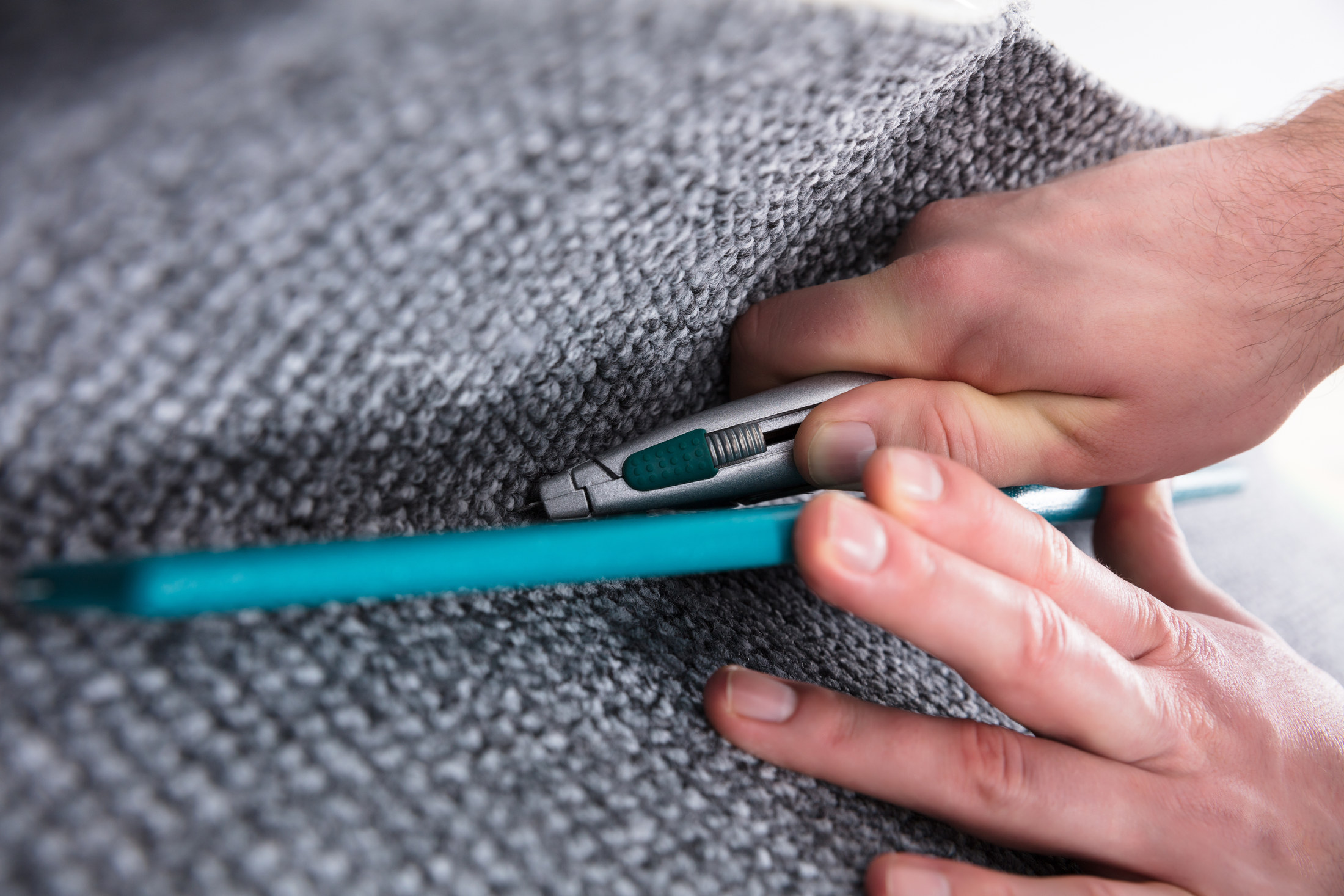
1 hourWith the carpet hooked all round, trim the surplus along each wall. Run the knife along the angle where the carpet meets the skirting, or use a wall trimmer, leaving just enough to tuck. Push the edge down into the gap between gripper and skirting with the tucking tool so it disappears.
- Trim a little long; you can always take more off
- Change to a fresh blade before you trim
- Tuck with a proper tool, not a builder's bolster that can chip the skirting
Mistake to avoid: Trimming tight to the skirting in one pass. A carpet cut short at the wall shows a gap you cannot hide or fix without patching.
Finish the doorway
20 minAt the door bar, trim the carpet so it reaches into the bar's jaw, seal the cut edge with a little latex or carpet adhesive to stop it fraying, and close the bar down onto it by tapping along it with a hammer and a block of wood. Rehang the door and check it swings clear.
- Seal every cut edge that will be walked on
- Protect the bar's face with a block of wood as you close it
- Trim the door bottom if it drags rather than compressing the carpet
Mistake to avoid: Leaving the carpet loose at the door. The doorway is the most walked-on edge in the room and it frays within weeks if it is not gripped and sealed.
Vacuum and settle
15 minVacuum the new carpet thoroughly to lift the loose fibres that every new carpet sheds. Put the furniture back by lifting it rather than dragging, and check over the next few days for any ripples that need a little more stretching.
- New carpets shed fluff for a few weeks; this is normal
- Use cups under heavy furniture feet
- Re-kick any ripple early, before it sets
Mistake to avoid: Dragging a heavy wardrobe across a newly stretched carpet. It pulls the carpet off the gripper on one side and creates a ruck that is hard to remove.
The mistakes that show
- Reusing old gripper or setting new gripper at the wrong distance from the skirting
- Overlapping underlay joins, which show as ridges
- Trimming the carpet before it is stretched
- Laying without a knee kicker, so the carpet rucks within months
- Trying stairs or a long room without the right tools and experience
Stop here and get a carpet fitter
- It is a staircase or landing — the gripper spacing, the underlay and the tensioning are a different technique
- The room is long enough to need a power stretcher, or the carpet must be seamed with heat tape
- It is a woven or patterned carpet whose pattern has to run true across the room
- You uncover old floor tiles or black adhesive that might contain asbestos and would have to be lifted
| WHAT YOU SEE | WHY, AND THE FIX |
|---|---|
| The carpet has rucked or rippled | It was not stretched enough, or furniture was dragged across it. Lift the edge off the gripper nearest the ripple, re-stretch with a knee kicker towards that wall and re-hook it. |
| The edge is coming away from the skirting | The gripper is too far from the wall, loose, or the carpet was trimmed short. Refix or reposition the gripper; if the carpet is short there is no fix except a patch or a new piece. |
| There is a visible ridge across the room | Overlapped underlay or a lump under it. Lift the carpet back to that point, re-lay the underlay butted and taped, and stretch again. |
| The doorway edge is fraying | The cut edge was not sealed or the door bar was not closed fully. Trim the frayed strands, seal the edge with latex adhesive and close the bar down firmly. |
| Dark lines along the skirting | Dust drawn through the carpet edge by draughts coming up through a suspended floor. Seal the gap at the skirting, and use lining paper or hardboard under the underlay next time. |
| The carpet creaks or squeaks underfoot | A loose board or nail beneath. Find the spot, fold the carpet back to it and screw the board down. |
| The pile looks a different colour in one part | The carpet was laid with the pile running different ways, often where two pieces meet. This cannot be corrected; join pieces with the pile running the same way. |
| Bald or flattened patches after a few weeks | Heavy furniture or a soft, cheap underlay that has collapsed. Move furniture regularly, use cups under feet, and lift the pile with a stiff brush. |
WHAT YOU SAVE
What it costs to do it yourself
| Gripper, two packs | £26.58 |
|---|---|
| Underlay for the room | £111.84–£271.84 |
| Door bar | £6.39–£8.19 |
| Knee kicker | £55.99 |
| Carpet tucker | £11.99 |
| Total, excluding the carpet | £213–£375 |
| DIY total | £213–£375 |
Guide prices compiled by the Locufy team from published Irish and UK provider price lists and 2026/27 cost guides. Updated 2026.
The underlay is priced from £6.99 to £16.99 a square metre at a national flooring retailer. The carpet itself is the largest cost and varies more than anything here. A fitter's price per square metre, from the price guide, is shown alongside.
RATHER NOT?
Carpet fitters near you, with prices shown
The ones who cover your area, nearest first, with one score from every review. No account needed to look.
Or post the job free and let them come to you.
A new carpet sheds loose fibres for its first weeks. Vacuum it regularly; the shedding is not a fault.
Roll the largest offcut and keep it. A burn, a stain or a pet accident can be patched invisibly from the same roll.
Old carpet and underlay go to your council's household waste and recycling centre as general household waste, or via the council's bulky waste collection; old gripper and nails go in the scrap metal or general waste as the site directs. Many councils apply DIY-waste limits, so check your council's page first.
Change the knife blade and dispose of old blades wrapped in tape. Wipe the kicker's teeth clean and set them to suit the pile height of your next job.
Fitting a carpet: questions people ask
One carpet maker's fitting guide, based on the British Standard for fitting carpets, sets the gap between gripper and wall at two-thirds of the carpet's thickness. It gives different spacings on stairs, which is one reason stairs are a fitter's job.
Yes. Without stretching, a carpet laid by hand looks flat on the day and ripples once it is walked on. A knee kicker is enough for a normal room; very long rooms need a power stretcher.
It is better not to. Old gripper is often loose, blunt or wrongly spaced for the new carpet, and the maker's guide recommends new gripper for a new carpet.
Generally away from the main window or the door you come in by, so the colour looks even. Wherever two pieces meet, the pile must run the same way or the join shows as a colour change.
It is possible but it is a separate skill: the gripper spacing changes, the underlay is cut tread by tread, and the carpet is tensioned from the bottom up. It is the part of carpet fitting most worth paying for.
The Locufy UK price guide puts carpet fitting at £3–£6 per m², typically £4 — the same three figures as the strip at the top of this page. That is the fitting labour; the carpet and underlay are on top.
MORE GUIDES
More DIY guides
Sources — checked October 2026
- HSE — manual handling at work: avoid, assess and reduce the risk of lifting injuries
- Ulster Carpets — retailer fitting guide, based on BS 5325:2001: gripper two-thirds of carpet thickness from the wall, new gripper, taped underlay, lining paper on suspended floors, kicker at about 10 degrees, power stretcher over 5 m
- UKHSA on gov.uk — asbestos general information: floor tiles, homes built before 2000
- North Northamptonshire Council — what can be recycled at household waste recycling centres (general household waste, DIY waste rules)
- Toolstation — flooring tools price check: knee kicker £55.99, carpet tucker £11.99
- Toolstation — carpet and metal edging price check: gripper £13.29 a pack, door bars £6.39–£8.19
- Carpetright — underlay price check: £6.99–£16.99 per m²