DIY GUIDE · VEHICLES & TRANSPORT · CHECKED OCTOBER 2026
How to valet a car yourself
Two to three hours. £29–£121 in shampoo, cloths, mitts, buckets and cleaners that last many washes.
Shade, two buckets, wheels first, roof down, dry with microfibre — and vacuum before you clean the cabin.
- Every step, start to finish
- Checked October 2026 — sources at the end
- Honest about when to call a pro
FIRST, THE HONEST ANSWER
Do it yourself, or get a cleaner?
Do it yourself if…
- You have somewhere in the shade to wash, with water and a drain that takes dirty water to the sewer
- The paint is in reasonable condition and you want it cleaned, not corrected
- You can spend a morning on it and work carefully round the car
- The interior needs vacuuming and cleaning, not stain removal from deep in the seat foam
Get a pro if…
- You have no suitable place to wash without the run-off reaching a surface water drain
- The car has heavy stains, mould, smoke or pet odour soaked into the upholstery
- The paint is matt, satin or wrapped and needs specialist products
- You need it done at work or on the street, where a mobile valeter brings water and collects run-off
Safety first
- Wear nitrile gloves for wheel cleaners, tar removers and solvent products, and work with the doors open. The safety regulator's guidance on valeting with solvent-based products warns of dermatitis, of vapours causing headaches and dizziness, and of the danger of solvent vapour building up inside a car.
- Read every label and keep the caps on. The same guidance says to follow the instructions on the label and to put caps back on containers immediately after use.
- On a hybrid or electric car, keep the pressure washer out of the engine bay and away from the underbody. The safety regulator warns that pressure washing can damage high-voltage components and cables, usually coloured orange, and says to check the vehicle maker's guidance before valeting those areas.
- Do not pressure-wash tyres, door seals or badges at close range; the jet can cut rubber and lift trim.
- Keep chemicals away from children and pets, and never decant them into drink bottles.
- Wear eye protection when you spray wheel cleaner or use a pressure washer, because the spray comes back off the wheel.
| MATERIAL | COVERAGE | FOR THIS JOB |
|---|---|---|
| Car shampoo | Dilute to the label, such as two capfuls in 10 litres | One wash: one bucket |
| Wheel cleaner | Spray per wheel as the label says | Four wheels |
| Glass cleaner | A light mist per window | All windows |
| Interior cleaner | Spray lightly onto surfaces or onto a cloth | Whole cabin |
| Tyre dressing, optional | A thin coat per tyre | Four tyres |
How much shampoo
Shampoo = the label dose per bucket × buckets used. At two capfuls in 10 litres, a 10-litre wash bucket refreshed once during the wash is four capfuls; a 500 ml bottle at about 15 ml a capful gives roughly sixteen washes.
Doses differ between products; follow your shampoo's label. More shampoo does not clean better, it just takes longer to rinse.
Use a car shampoo diluted to its label; the one we looked at uses two capfuls in 10 litres of water. Washing-up liquid strips wax and dries the rubber seals. Use warm or cold water, but not very hot water, which the shampoo maker says makes the shampoo dry on the paint.
A deep-pile microfibre or lambswool mitt holds grit away from the paint far better than a sponge. Use two buckets: one of shampoo, one of clean rinse water, and rinse the mitt in the clean bucket before every reload. A grit guard in the bottom of each bucket keeps dirt out of the mitt.
A large, soft microfibre drying towel takes water off without dragging, and the shampoo maker recommends drying with one to stop water spots. Keep separate cloths for glass, for paint and for wheels, and never use a paint cloth on the wheels.
Wheels carry brake dust, which is abrasive and clings. A dedicated wheel cleaner and a soft brush lift it without scratching. Choose a product safe for your wheels' finish if they are polished, chrome or painted.
A multi-surface interior cleaner handles plastics and fabrics, sprayed lightly and worked with a cloth or soft brush. Leather needs a cleaner applied to a cloth, not sprayed on. A vacuum with a crevice tool and a brush does most of the interior work.
THE PART THAT DECIDES THE FINISH
Preparing the car — by what state it is in
The same valet takes half the time on a car that is just dusty and twice as long on one that has done a winter of muddy lanes. Find your car below and do its list first.
A car that is just dusty
The quick, regular valet.
- Park in the shade and let the panels cool to the touch
- Rinse the whole car from the top down to lift loose dust before any mitt touches it
- Go straight to the wheels and the two-bucket wash
A car caked in mud or road film
Lift the dirt before you touch the paint.
- Rinse the lower panels, arches and sills thoroughly to soften and wash off mud
- Use a pre-wash or snow foam if you have one, left to dwell and rinsed off, to lift grime without contact
- Change the rinse water as soon as it looks dirty during the wash
An interior with pet hair, crumbs or stains
Most of the work is the vacuum.
- Take out all mats, child seats and loose items first
- Lift pet hair with a rubber glove or a pet-hair brush before you vacuum
- Spot-test any cleaner on a hidden part of the fabric before treating a stain
A hybrid or electric car
The same valet, with more care underneath.
- Keep the remote key away from the car while you work so it cannot be powered up or moved by accident
- Keep the pressure washer out of the engine bay and away from the underbody and charging port
- Check the vehicle handbook before cleaning near any orange cabling or under the bonnet
Matt, satin or wrapped paint
Different products entirely.
- Check the shampoo is safe for matt or satin finishes; the one we looked at is not
- Never polish or wax matt paint; it fills the texture and leaves shiny patches
- Use a dedicated matt shampoo and pat the surface dry
THE JOB
How to valet a car
Set up in the shade
10 minPark out of direct sun on a surface where the water can drain to a foul sewer, or onto grass or gravel, rather than straight into a road drain. Let the panels cool. Fill one bucket with shampoo at the label dose and one with clean water, lay out the cloths, and go to the section above for the state of your car.
- Feel the bonnet; if it is warm, wait
- Shampoo bucket and rinse bucket side by side
- Take the mats out now to clean separately
Mistake to avoid: Washing in bright sun on a hot car. The shampoo dries before you can rinse, leaving spots and streaks.
Pre-rinse and pre-wash for the conditions
15 minRinse the whole car from the top down to wash off loose grit. On a very dirty car, apply a pre-wash or snow foam, let it dwell for the time on its label without drying, and rinse it off. The aim is to remove as much dirt as possible before the mitt touches the paint.
- Work from the roof downwards
- Concentrate on the lower panels and arches
- Keep the pressure washer jet back from seals and badges
Mistake to avoid: Going straight in with the mitt on a muddy car. Every stroke drags that mud across the paint.
Clean the wheels and tyres
20 minDo the wheels first so their dirty spray does not land on clean paint. Spray wheel cleaner on one wheel at a time, work it in with the wheel brush, including behind the spokes, and rinse thoroughly before it dries. Scrub the tyre walls with a stiff brush.
- One wheel at a time, rinsed before the next
- Use a separate brush and cloth for wheels only
- Do not spray wheel cleaner onto hot brakes
Mistake to avoid: Using the paint mitt on the wheels. It picks up brake dust, which then scratches the paint on the next wash.
Wash with the two-bucket method
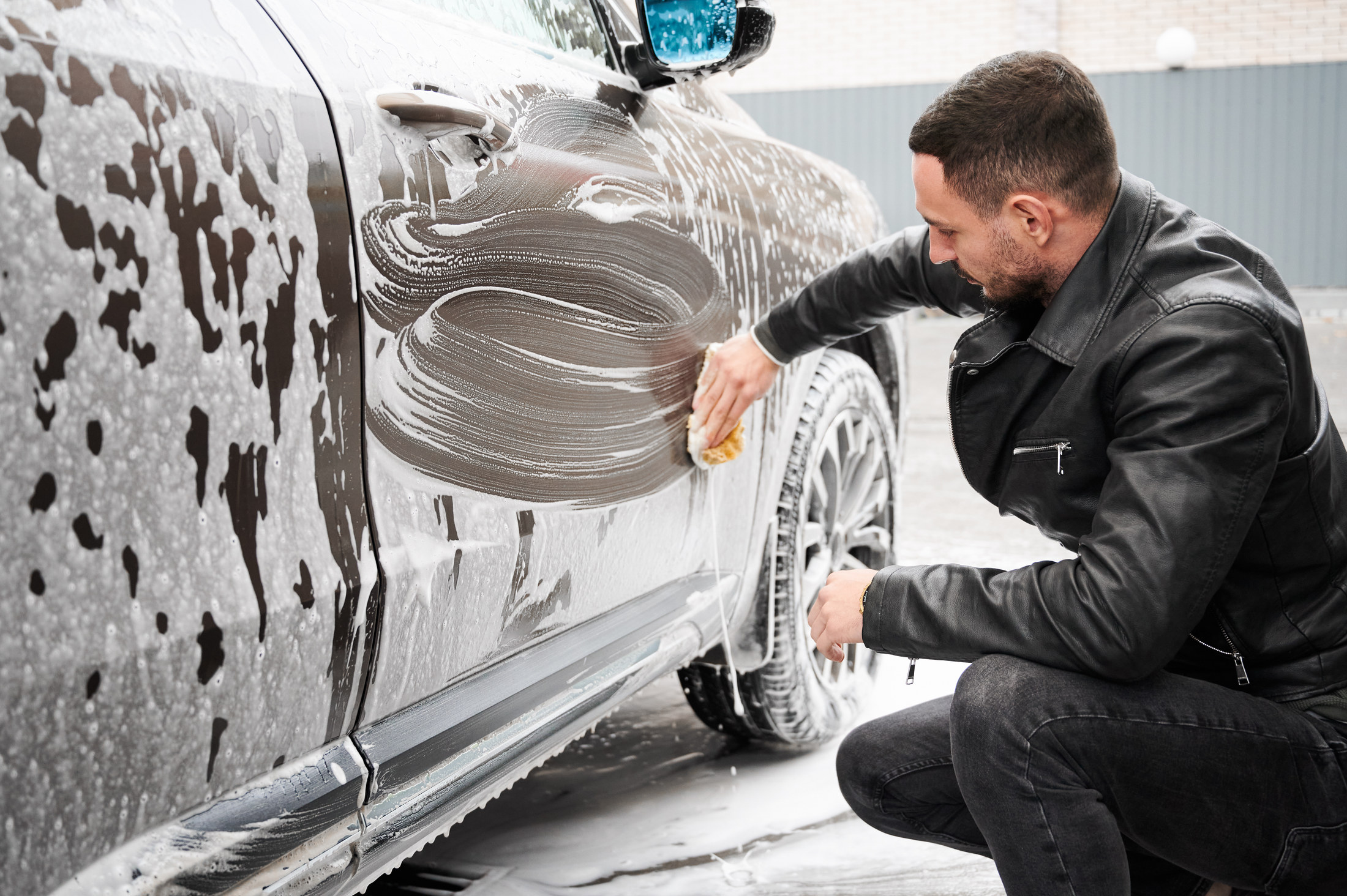
25 minLoad the mitt from the shampoo bucket and wash one panel at a time in straight, overlapping lines, starting with the roof and working down. After each panel, rinse the mitt in the clean water bucket, wring it, and reload from the shampoo. Leave the lowest, dirtiest panels until last.
- Straight lines, not circles, so any light scratch is less visible
- Rinse the mitt after every panel
- Keep the panels wet; rinse sections if the day is warm
Mistake to avoid: Using one bucket. The grit rinsed off the mitt goes straight back into the shampoo and onto the next panel.
Rinse thoroughly
10 minRinse the car from the top down with plenty of clean water until no foam remains, paying attention to the gaps around doors, mirrors and the fuel cap. The shampoo maker is clear the shampoo must not be allowed to dry on the car.
- Let the water sheet off the panels
- Rinse door shuts and mirror bases where foam hides
- Do one last top-to-bottom rinse
Mistake to avoid: Leaving foam in the panel gaps. It runs out later and dries as streaks down the doors.
Dry with microfibre
15 minLay the drying towel flat on a panel, pat or drag it gently towards you, and lift it off. Wring it out as it fills. Work from the top down, then dry the door shuts, mirrors and sills with a second towel.
- Lay and lift, do not scrub
- Wring out the towel often
- Open the doors and dry the shuts so they do not drip
Mistake to avoid: Leaving the car to air dry. Minerals in the water dry as spots that etch into the paint over time.
Clean the glass inside and out
15 minMist glass cleaner onto a dedicated glass cloth, not onto the glass where it overspray hits the dash, and wipe each window. Buff with a second dry cloth. Wind each window down slightly to clean the top edge.
- Wipe one direction outside and the other inside, so you can tell which side a streak is on
- Clean the mirrors and the reversing camera lens
- Do the inside of the windscreen with the back of your hand on the cloth
Mistake to avoid: Spraying cleaner straight onto the inside of the windscreen. It runs onto the dashboard and the screens.
Vacuum the interior
20 minTake everything out. Vacuum from the top down — headlining edges, seats, between and under the seats, the footwells and the boot — using the crevice tool for the seams and rails. Vacuum the mats outside the car.
- Slide the seats fully forward and back to reach underneath
- Brush the carpet pile up as you vacuum to lift grit
- Beat the mats before vacuuming them
Mistake to avoid: Cleaning the interior surfaces before vacuuming. The dust smears into the cleaner and you do it twice.
Clean the dash, trim and upholstery
25 minSpray interior cleaner lightly onto hard surfaces and wipe off, or onto a cloth for anything near screens and switches. The interior cleaner maker says not to use it on a hot surface, to keep it off display screens, and to apply it to a cloth rather than straight onto leather. For fabric, mist lightly, agitate with a cloth or soft brush and wipe.
- Cloth, not spray, near screens and switches
- Spot-test fabric cleaners first
- Do not soak fabric; it dries slowly and smells
Mistake to avoid: Soaking the seats. Water gets into the foam, takes days to dry and can leave a tide mark and a musty smell.
Finish and check
15 minApply tyre dressing thinly if you use it, and wipe off any excess. Refit the mats. Walk round the car in good light to catch missed spots and streaks, and wipe the door shuts and sills one last time.
- Thin tyre dressing; excess slings onto the paint
- Check under the door handles and round the badges
- Open the windows for a few minutes to air the cabin
Mistake to avoid: Slapping on tyre dressing and driving straight off. It flings greasy spots up the side of the clean car.
The mistakes that show
- Washing in the sun, so shampoo and water dry as spots
- Using one bucket or a sponge, which drags grit round the paint
- Doing the wheels last, or with the paint mitt
- Air drying, or drying with an old bath towel
- Soaking the upholstery and spraying cleaner onto screens
Stop here and get a valeter
- You have nowhere to wash without the run-off going into a surface water drain
- The upholstery has deep stains, mould, smoke or pet odour that needs extraction cleaning
- The paint is matt, satin or wrapped and you do not have the right products
- The paint is swirled or scratched and needs correcting — that is detailing, not valeting
| WHAT YOU SEE | WHY, AND THE FIX |
|---|---|
| White spots on the paint after washing | Water or shampoo dried on the panel in the sun. Rewash in the shade and dry promptly with microfibre; stubborn spots may need a quick detailer spray. |
| Swirl marks visible in sunlight | Grit dragged across the paint during washing or drying. Switch to two buckets and a mitt; to remove existing swirls you need a polish. |
| Streaks on the inside of the windscreen | A dirty cloth, too much cleaner, or residue from the dash. Use a clean, dry microfibre and a light mist, and buff dry. |
| Tide marks on the seats | Too much water or cleaner soaked into the fabric. Lightly dampen the whole panel evenly, blot it dry, and let it dry with the windows open. |
| Brake dust still on the wheels | It has baked on over time. Use a dedicated wheel cleaner, let it dwell as the label says and brush again; very old deposits may need an iron fallout remover. |
| The tyres look greasy and fling spots | Too much tyre dressing. Wipe the tyres with a cloth and apply a thinner coat next time. |
| A musty smell in the car | Damp in the carpets or a blocked drain or pollen filter. Dry the carpets thoroughly and check the pollen filter and door drains. |
| Water drips from the mirrors after drying | Water trapped in the mirror housing and trim. Blow it out with a little air or wait, then wipe the runs away. |
WHAT YOU SAVE
What it costs to do it yourself
| Car shampoo | £8.00–£21.12 |
|---|---|
| Microfibre cloths and drying towel | £5.49–£27.83 |
| Buckets, sponges or mitt and brushes | £1.99–£19.20 |
| Wheel cleaner | £4.90–£27.00 |
| Interior cleaner | £8.30–£25.49 |
| Total | £29–£121 |
| DIY total | £29–£121 |
Guide prices compiled by the Locufy team from published Irish and UK provider price lists and 2026/27 cost guides. Updated 2026.
Prices from a national motoring retailer. Almost everything lasts many washes, so the cost per valet after the first is a few pounds. A valeter's price from the price guide is shown alongside.
RATHER NOT?
Car valeters near you, with prices shown
The ones who cover your area, nearest first, with one score from every review. No account needed to look.
Or post the job free and let them come to you.
Pour bucket water into a foul drain such as an outside gully that goes to the sewer, or a toilet, never a road drain. Only clean rainwater belongs in a surface water drain, which usually runs straight to a stream or river.
Keep products upright, capped and out of reach of children. Take unwanted car chemicals in their containers to your council's household waste and recycling centre; one council takes household chemicals up to 5 litres a month, and empty aerosols go in the aerosol recycling.
Wash microfibre cloths separately, without fabric softener, and keep wheel cloths apart from paint cloths.
A quick wash every week or two stops dirt bonding to the paint and makes each valet faster.
Valeting a car: questions people ask
One bucket of shampoo and one of clean water. After every panel, rinse the mitt in the clean bucket before reloading with shampoo, so grit from the car never goes back into the wash water.
It is better not to. It strips wax and protection and can dry out rubber seals. A car shampoo at the label dose cleans without stripping.
No. The shampoo maker we looked at asks for a cool surface and says not to let the shampoo dry on the car. Sun dries shampoo and water into spots before you can rinse.
The bodywork, yes, with care. The safety regulator warns that pressure washing can damage high-voltage components and cables, so keep the jet out of the engine bay and away from the underbody, and check the vehicle maker's guidance.
Into a foul drain or onto grass or gravel, not a road drain. Government pollution guidance says only clean water should go into a surface water drain, because those drains often run straight to rivers.
The Locufy UK price guide puts a car valet at £35–£144 per valet, typically £77 — the same three figures as the strip at the top of this page.
MORE GUIDES
More DIY guides
Sources — checked October 2026
- HSE — SR17 COSHH essentials: valeting of vehicles with solvent-based products (dermatitis, vapours, ventilation, nitrile gloves, caps back on)
- HSE — electric and hybrid vehicles: pressure washing can damage high-voltage components; orange cables; check maker's guidance before valeting under the body
- Autoglym — Bodywork Shampoo Conditioner: two capfuls in 10 litres, cool surface, roof down, do not let it dry, microfibre drying towel; not for matt or satin
- Autoglym — Interior Shampoo: vacuum first, spray lightly and agitate, not on hot surfaces or screens, apply to a cloth on leather
- gov.uk — pollution prevention for businesses: contaminated water to the foul sewer, only clean water to surface water drains
- North Northamptonshire Council — what can be recycled at household waste recycling centres (up to 5 litres of household chemicals a month, aerosols)
- Halfords — car shampoo price check: £8.00–£21.12
- Halfords — microfibre cloths price check: £5.49–£27.83
- Halfords — sponges, brushes and buckets price check: £1.99–£19.20
- Halfords — wheel and tyre cleaning price check: £4.90–£27.00
- Halfords — interior cleaning price check: £8.30–£25.49