DIY GUIDE · HOME REPAIRS & HANDYMAN · CHECKED OCTOBER 2026
How to fix a dishwasher that will not drain, fill or clean yourself
An hour or so. Usually nothing; €9–€25 for a cleaner and a bag of salt.
The owner’s checks for a dishwasher that will not drain, fill or clean — filters, valve, pump, inlet, hoses — and where to stop.
- Every step, start to finish
- Checked October 2026 — sources at the end
- Honest about when to call a pro
FIRST, THE HONEST ANSWER
Do it yourself, or get a repairer?
Do it yourself if…
- Dirty water sits in the base after the programme ends, or the drain light flashes
- The inlet light flashes or the machine hums but never fills, and the stopcock and hose are reachable
- Dishes come out gritty, filmy or still greasy and the filters have not been cleaned for a while
- The machine smells, or the spray arms look clogged with seeds, labels or limescale
Get a pro if…
- There is a burning smell, a scorched plug or socket, or the circuit trips when the machine starts
- Water leaks from underneath with the door seal, hoses and filters all dry
- The drain pump hums but the impeller is clear and still the water stays, or the machine will not heat
- The door hinge, the door lock or the control panel is broken, or the machine is under the maker’s guarantee
Safety first
- Switch off and unplug before every check. If the plug is behind the units, isolate at the appliance switch and the fuse board and tape a note over it.
- Wear gloves in the pump housing. Broken glass is the commonest thing in there, and it is nearly invisible in dirty water.
- Keep the inlet connection dry. On many machines it contains a mains-voltage valve, and it must never be put in water.
- Never take the kick plate, side panels or door panels off to look inside. Behind them are the heater, pump, wiring and control board.
- A dishwasher pulled out of a run of units is heavy and awkward. The HSA’s manual handling advice is to plan the move and share the load — slide it out with a helper, never lift it alone.
Stop here: Inside the cabinet, and anything wired
The danger is mains electricity and hot water together. The heater, pump motor, inlet valve wiring, door switch and control board sit behind panels that only come off when the machine is pulled out and opened, and a part refitted wrongly can make the case live or flood the kitchen. The makers keep owner care to the filters, valve, spray arms, inlet filter and hoses. A fault in the socket or the circuit itself is restricted electrical work under S.I. 264/2013, and only a Registered Electrical Contractor may do it. How to hire a dishwasher engineer →
| MATERIAL | COVERAGE | FOR THIS JOB |
|---|---|---|
| Dishwasher cleaner | One dose per empty hot programme | One dose now, then every month or two |
| Dishwasher salt | Fills the softener reservoir | Top up when the salt light comes on |
| Rinse aid | Fills the dispenser in the door | Top up when the rinse aid light comes on |
Is the water pressure enough?
Fill a one-litre jug from the cold tap at the kitchen sink with the tap fully open and time it. As a rough check, a tap that takes many seconds to fill a litre has weak flow everywhere, and the dishwasher will struggle against a limit like one maker’s 50 kPa minimum. If the sink fills a litre quickly but the dishwasher still shows an inlet fault, the problem is between the stopcock and the machine — the tap, the hose or the inlet filter.
The jug test is a rough guide only. A plumber can fit a gauge and read the pressure properly if you suspect the supply.
Water standing in the base points at the drain path: filter combination, non-return valve, drain pump, drain hose, the sink spigot. An inlet light or a dry machine points at the supply: stopcock, inlet hose, the small filter in the screw connection, and the house water pressure. Poor results with no fault light usually mean dirty filters, blocked spray-arm holes, too little salt or rinse aid, or a machine loaded so the arms cannot turn.
The filters in the base catch the food that comes off the plates. When they are full, water cannot get back to the pump, the machine cannot drain and the wash water recirculates grit onto clean dishes. One maker’s instructions are to switch off, twist the handle to release the filter combination, lift it out, tip away the solids and rinse every part under the tap, opening the inner flap to clean the inside too.
Under the filter, many machines have a small hinged valve that stops dirty water flowing back from the drain. If it has been knocked out of position, the machine cannot pump away. Below that is the drain pump impeller, which catches glass, bones and fruit stones. Both are reachable from inside the tub with the plug out and the water bailed out; a sponge pressed into the pump soaks up the last of it so you can see.
A dishwasher needs a minimum flow at the tap to fill in time. One maker gives the lower limit as 50 kPa, or 0.5 bar. If the cold tap at the sink runs weakly too, or the whole house has low pressure, the dishwasher is a symptom: the stopcock, the supply or the mains is the thing to look at, and that is a plumber’s call.
Hard water leaves limescale on glasses and in the spray arms; dishwasher salt feeds the softener that stops it, and rinse aid helps the water sheet off so dishes dry without marks. A cleaner in an empty hot programme lifts grease from the tub, the filters and the hidden pipes. These cost little and are worth doing at the end of every repair.
THE PART THAT DECIDES THE FINISH
Before you start — the machine and the space
Pick the case that matches what the machine is doing. Each has its own set-up, and each starts with the machine switched off and unplugged.
Water left in the base
The programme ends, the door opens and there is dirty water in the bottom.
- Switch off at the socket and pull the plug; leave it out until the last test
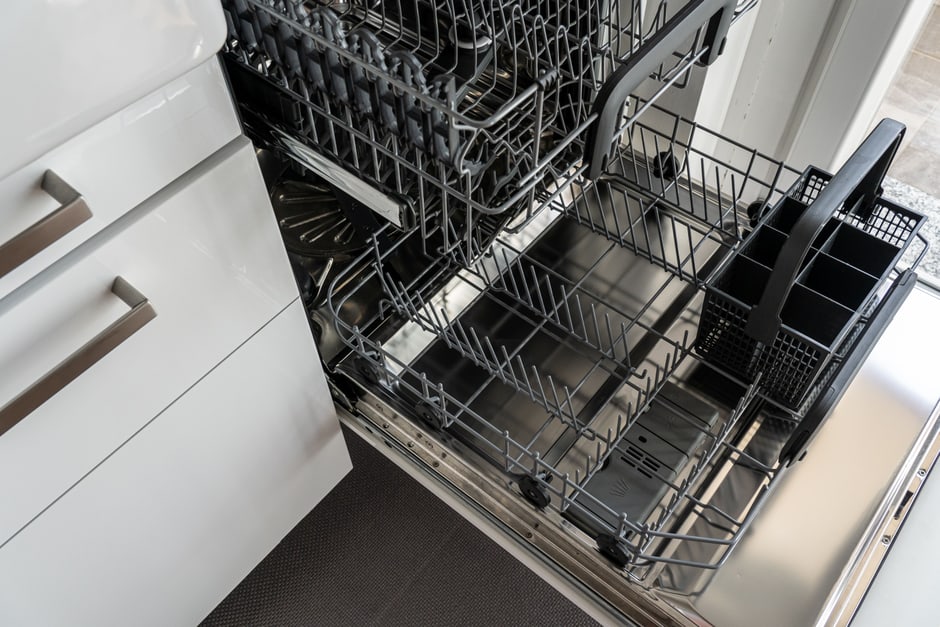
- Take out the lower basket so you can reach the base
- Lay towels along the front of the door and have a jug, a bowl and a sponge ready
- Put on rubber gloves — there may be broken glass
Will not fill, or the inlet light flashes
The machine hums or waits but no water comes in.
- Check the stopcock or appliance valve under the sink is fully open
- Run the cold tap at the sink to see whether the house pressure is normal
- Find where the inlet hose meets the valve and put a cup and a cloth under it
- Close the valve before you undo anything
Dishes come out dirty, gritty or filmy
The machine runs normally but the results are poor.
- Take out both baskets and look at the spray arms for blocked holes and arms that do not spin freely
- Check the salt and rinse aid lights or levels
- Plan to clean the filter combination even though the machine drains
- Look at how you load it: tall plates and pans in the wrong place stop the arms turning
Smells, grease or black marks
The tub smells stale or the door seal and corners have grime.
- Wipe round the door seal and the bottom edge of the door, where food collects out of sight
- Plan to take out and wash the filters first
- Have a dishwasher cleaner ready for an empty hot programme
- Leave the door ajar afterwards so the tub dries
THE JOB
How to fix a dishwasher, in order
Switch off, unplug and clear the tub
10 minSwitch the machine off and pull the plug out at the socket. Take out the lower and upper baskets and the cutlery basket and set them in the sink. Lay towels along the open door. Read the case above that matches your fault so you know which checks you are about to make, and put on rubber gloves.
- If the plug is behind the units, switch off at the appliance switch and the fuse board, and tape a note over it
- Check the plug, cable and socket for scorching while you are there
- Keep a bowl for whatever you take out of the filter and pump — you may want to show a technician
Mistake to avoid: Reaching into the pump housing with the power on because the display is dark. The pump can still be energised.
Bail out the water
15 minUse a small jug or cup to scoop the standing water out of the base into a bowl, working round the filter. When the jug will not reach any more, press a large sponge into the low point and wring it out into the bowl, over and over, until the base is nearly dry. Dirty water that will not go down at all with the filter out is your clue that the blockage is below it, in the valve or pump.
- Work slowly; dirty water slops easily over the door seal
- Tip the dirty water down the toilet rather than the sink you suspect is blocked
- A turkey baster reaches into tight corners of the sump
Mistake to avoid: Pulling the filter out first while the base is full. The debris floats off the filter and down into the pump.
Take out and clean the filter combination
15 minTurn the filter handle the way the arrow shows — usually anticlockwise — and lift the whole filter combination out. Tip the solids into the bin, not the sink. Rinse the coarse filter, the fine filter and the flat mesh under the tap, using a soft brush on grease. If your filter opens, press the grips together and open the inner flap so you can rinse the inside, then close it until it clicks. Refit the filter so it lies flat in the base and twist it until it locks with the arrows lined up.
- Never run the machine without the filters in; coarse food goes straight into the wash system
- Warm soapy water and a soft brush lift grease; wire brushes tear the mesh
- Check the flat mesh lies flat and unbent — a gap lets grit through
Mistake to avoid: Refitting the filter loose or tilted. It lets coarse soil past into the circulation system, which is the blockage you were trying to avoid.
Check the non-return valve and the drain pump
20 minWith the filter out, look into the opening below. On machines with a non-return valve, press its catch, tip it inwards and lift it out, then check it is clean and reseat it straight down from above so it sits flush with the edge. Press a sponge into the pump opening to soak up the last water, then shine the torch in. Remove any glass, bone, labels or fruit stones you can see with gloved fingers or pliers. Turn the impeller gently by hand: it should move, with a little resistance.
- Glass splinters are hard to see in water; dry the housing with the sponge before you feel in
- A cocktail stick lifts a label wrapped round the impeller
- Check the valve catch clicks fully home before you refit the filter
Mistake to avoid: Prising at the impeller with a knife or screwdriver. A cracked impeller or housing means a new pump, and that is inside the machine.
Check the drain hose and the sink spigot
20 minUnder the sink, follow the grey drain hose from the back of the machine to where it joins the sink trap or the standpipe. Straighten any kinks and loops, and watch those spots afterwards, as plastic that has been kinked can split. Loosen the clip, pull the hose off the spigot over a bowl and check both are clear; food and grease from the sink set hard in the spigot. If the sink itself drains slowly, plunge it or clean the trap before you blame the dishwasher.
- A new sink trap may have a blanking disc in its spigot that must be cut out before it takes water
- Fit the hose clip back on firmly — a loose hose on the spigot leaks into the cupboard
- If the hose is cracked, it is replaced by model number, not taped
Mistake to avoid: Leaving the drain hose lying low on the cupboard floor. Without a high loop, dirty sink water can run back into the dishwasher.
Clean the inlet filter at the tap
15 minIf the inlet light flashed or the machine will not fill, close the valve and unscrew the inlet hose where it meets it, with a cup underneath. On many machines the connection housing contains an electrical valve, so keep it out of water and never dip it. Take out the rubber seal, then grip the small plastic filter by its bar with pliers and pull it out. Rinse it under the tap, push it and the seal back in, screw the hose back on hand-tight and open the valve slowly. If it drips, tighten a little more.
- The filter must go back in; running without it lets grit into the inlet valve
- Check the inlet hose along its length for kinks and bulges while you are there
- Open the valve slowly — a sudden surge can unseat the seal
Mistake to avoid: Dipping the connection housing in a basin to clean it. It contains a mains-voltage valve and must stay dry.
Clear the spray arms
15 minLift or unclip the spray arms according to your manual. Hold each one up to the light and look through the holes; seeds, lemon pips and limescale block them. Clear each hole with a cocktail stick, rinse the arm under the tap and shake it to hear anything rattling inside. Refit each arm and spin it by hand — it should turn freely without touching anything in the baskets.
- Never use a metal pin or drill bit — it enlarges the holes and changes the spray
- Soak a limescaled arm in warm water with a little vinegar before you clear it
- Turn the lower arm by hand with the baskets in; a tall pan handle often stops it
Mistake to avoid: Clearing the holes with a skewer. A wider hole sprays weaker, and the arm stops turning properly.
Top up salt and rinse aid, then run a service wash
10 minOpen the salt reservoir in the base, fill it with dishwasher salt using the funnel, wipe away any spills and screw the cap on tight. Fill the rinse aid dispenser in the door to the mark. Put a dishwasher cleaner in the empty machine and run the hottest programme with nothing else inside.
- Spilt salt in the tub corrodes; run a rinse straight after filling if you spill
- Set the softener to your water hardness in the settings menu if the manual allows
- Leave the door ajar at the end so the tub dries
Mistake to avoid: Using table salt in the softener. The additives clog it and can ruin it.
Test, then watch the first wash
30 minPlug in, switch on and run a short programme with the machine empty. Listen for the fill, the wash and the drain, and look under the sink at the hose clip and the inlet connection while it runs. Open the door at the end: the base should be empty except for a little water around the filter, which is normal. If the same fault returns with the filter, valve, pump and hoses clear, the problem is inside, and this is where you stop.
- Keep a towel under the sink for the first wash
- Write down any fault code shown; it saves the technician time
- Note the date you cleaned the filters on the inside of the cupboard door
Mistake to avoid: Loading a full wash for the first test. If it fails again, you are bailing out dirty water round a load of dishes.
The mistakes that make it worse
- Reaching into the pump with the power still connected
- Lifting the filter out before bailing, so the debris drops into the pump
- Feeling for the blockage with bare hands when there may be glass
- Dipping the inlet connection, with its electrical valve, in water
- Running the machine without the filters fitted
Stop here and get a dishwasher repair technician
- The same fault code comes back with the filters, valve, pump and hoses clear
- The pump hums but will not run, or the machine will not heat the water
- Water leaks from underneath with the door seal and the hoses dry
- There is any sign of burning, the fuse blows again at once, or the circuit trips
| WHAT YOU SEE | WHY, AND THE FIX |
|---|---|
| Dishwasher not draining, water in the bottom | Usually a clogged filter combination, then a non-return valve out of place or something in the drain pump. Bail out, clean the filters, reseat the valve, clear the pump, then check the drain hose and sink spigot. |
| Inlet or drain light flashing | The machine could not take in or pump out water in time. Check the stopcock is open, clean the inlet filter, straighten the hoses, and check the filter combination and pump. |
| Dishes gritty or dirty after a wash | Dirty filters recirculating food, blocked spray-arm holes, or arms stopped by the load. Clean the filters and arms and check that both arms spin freely with the baskets in. |
| White film or spots on glasses | Hard-water scale. Top up the salt, set the softener to your water hardness, fill the rinse aid and run an empty programme with a cleaner. |
| Dishwasher smells | Food trapped in the filter, the door seal and the bottom edge of the door. Clean them and run an empty hot programme with a cleaner; leave the door ajar between washes. |
| Water in the cupboard under the sink | A loose drain hose on the spigot or a weeping inlet connection. Tighten the clip and the hose nut; replace a cracked hose by model number. |
| Machine hums but will not fill | Closed or part-closed stopcock, a kinked inlet hose, a choked inlet filter, or low house pressure. Work back from the tap; if the whole house is weak, call a plumber. |
| Puddle on the floor in front | Overloading with the wrong detergent can froth out of the door. If the door seal is sound and the hoses dry, water from underneath means a leak inside — stop. |
WHAT YOU SAVE
What it costs to do it yourself
| Dishwasher cleaner, pack of three | €9 |
|---|---|
| Dishwasher salt | €9.65 |
| Sink plunger, if the trap is blocked | €8 |
| Total, a typical drain or fill fault | €0–€25 |
| DIY total | €0–€25 |
Guide prices compiled by the Locufy team from published Irish and UK provider price lists and 2026/27 cost guides. Updated 2026.
Most drain and fill faults cost nothing. A cleaner, salt and a plunger come to well under a call-out; if the fault is inside the cabinet, the price guide band is what the repair costs.
RATHER NOT?
Dishwasher engineers near you, with prices shown
The ones who cover your area, nearest first, with one score from every review. No account needed to look.
Or post the job free and let them come to you.
Look under the sink and in front of the door during the first full programme. A dry cupboard and a dry floor at the end mean the joints are sound.
Lift out and rinse the filter combination every week or two, scrape plates before loading, and top up salt and rinse aid when their lights come on.
Food waste from the filter goes in the brown bin or the general waste. A dead dishwasher is electrical waste: a shop selling you a new one must take the old one back free like-for-like, and any civic amenity site or recycling centre takes household electrical waste free — mywaste.ie lists the drop-off points.
A closed, damp tub grows the smell back within days. Leave the door slightly open after the last wash of the day.
Fixing a dishwasher that will not drain, fill or clean: questions people ask
Most often the filter combination is clogged, the non-return valve is out of place, or something is caught in the drain pump. Unplug the machine, bail out the water, clean the filters, reseat the valve, check the pump, and then the drain hose and sink spigot.
Every week or two in a busy kitchen, and straight away if water is left in the base or results get worse. It takes a few minutes and prevents most drain faults.
Check the stopcock is open, then clean the small inlet filter where the hose meets the valve and straighten the hose. If the house pressure is low everywhere, the machine cannot fill in time — one maker’s minimum is 50 kPa, or 0.5 bar.
Not beyond the filters, valve, spray arms, inlet filter and hoses. Behind the panels are the heater, pump motor, wiring and control board. Those are a technician’s job.
No. Use dishwasher salt only; table salt contains additives that clog and damage the softener.
On the Locufy price guide for Ireland a repair costs €70–€260 per repair, typically €120. The low end is a call-out with a cleared blockage or a simple part; the high end is a pump, heater or control board.
MORE GUIDES
More DIY guides
Sources — checked October 2026
- Miele Ireland — water is not being pumped away: filter combination, non-return valve, drain pump
- Miele Ireland — inlet/drain light flashing: inlet filter, electrical valve housing, minimum 50 kPa (0.5 bar)
- HSA — electricity
- HSA — manual handling
- MyWaste — WEEE help and FAQs: free like-for-like retailer take-back and civic amenity sites
- Irish Statute Book — S.I. No. 264/2013, Restricted Electrical Works Regulations
- diy.ie — dishwasher cleaner and salt, price check October 2026
- diy.ie — sink plungers, price check October 2026