HOW TO HIRE · TRADES & CONSTRUCTION · CHECKED OCTOBER 2026
How to hire an extension builder in the UK
The checks, the questions and the paperwork.
An extension needs building regulations approval or a Scottish warrant, and often party wall notice. The checks, the questions and the paperwork for a sale.
- Search and compare — no account needed
- Nearest to you first
- One score from Google, Trustpilot and Locufy reviews
THE 60-SECOND VERSION
Hiring an extension builder in five steps
- Sort planning and building regulationsTwo different approvals; you might need both.
- Get drawings and a specificationEvery extension builder prices the same thing.
- Serve party wall notice in timeIn England and Wales, before work near a shared wall or boundary.
- Agree stage paymentsFoundations, walls, roof, first fix, completion.
- Get the completion certificateFrom building control, or the accepted completion certificate in Scotland.
BEFORE YOU BOOK
Check before you book
No register applies
No law licenses extension builders in England, Wales, Scotland or Northern Ireland; for the extension build the law controls the work itself, through building regulations approval where it is needed.
Get a clear answer on approval for the extension build, and the reference number if there is one. gov.uk →
Building regulations approval
Extensions are squarely within the Building Regulations 2010, as gov.uk explains, so the extension build needs approval from building control, and planning permission is a separate question. If the extension build is approved on full plans in England, expect building control's completion certificate within about 8 weeks of the finish, as long as it complies. Scotland puts the warrant duty on the owner: if the extension build needs a building warrant and there is none, the council can fine you and order the work taken out, whoever built it. Northern Ireland asks you to notify the council's building control before the extension build begins.
Get the building control reference for the extension build before anything starts. Check the warrant (Scotland) or the building control reference (Northern Ireland) is in place before the extension build. gov.uk →
Party wall notice
Under the Party Wall etc. Act 1996 you must tell neighbours in England and Wales before building work on or near a shared wall or boundary, and the extension build often is; a party wall agreement is separate from building regulations approval. Scotland has different rules.
Agree who serves party wall notice for the extension build, and when. gov.uk →
Who holds the client duties (CDM 2015)
For the extension build on your own home, CDM 2015 does not leave the client duties with you: HSE says they pass to the contractor, or the principal contractor where there are several.
Get the principal contractor for the extension build named in writing. hse.gov.uk →
VAT
An extension to an existing house is standard-rated at 20%; only building a separate new dwelling is zero-rated, and the 5% rate is for converting or renovating a home empty for two years or more, so a builder over the £90,000 threshold should charge 20% and show it on its own line.
Ask for the VAT number, and look for VAT as its own line on the extension contract. gov.uk →
A good answer: A named person and building control body, and a reference before foundations are dug.
A good answer: Finished examples of similar size and specification, with a client to call.
A good answer: Ground conditions and building control's requirements, with how extra depth is priced.
A good answer: The opening, the steel and its temporary support, from a structural engineer's design.
A good answer: The extension builder, a surveyor or you, agreed before the start date.
A good answer: A written programme by stage and how weather delays are handled.
A good answer: Payments tied to finished, inspected stages, never a large sum up front.
Getting the quote right
- Price against the drawings, broken into stages
- Foundations and any extra depth priced per metre
- Steel, glazing and roof covering named
- Building control fees and who pays
- Who actually attends — the builders and each trade on the extension, employed or subcontracted — and the business's VAT number, with VAT at 20% shown as its own line
- Provisional sums listed
- Skip, scaffold and making good the existing house
Walk away if
- Wants to start before approval or before party wall notice is served
- A single price with no stages
- Large cash deposit
- No structural design for the opening into the house
- Says building control is 'not needed for this size'
What an extension builder costs: £1,800–£4,000 per m²
Extensions are priced per square metre as a guide, then as a fixed quote from drawings; specification, storeys, foundations and glazing set the final figure. House Extension price guide →
Guide prices compiled by the Locufy team from published Irish and UK provider price lists and 2026/27 cost guides. Updated 2026.
KNOW WHAT TO LOOK FOR? NOW FIND ONE
Extension builders near you, with the badges that matter shown
ID checked, trader status and one score from every review — on the card, before you message anyone. Nearest first. No account needed to look.
Or post the job free and let them come to you.
- ApprovalsPlanning where needed, building regulations approval, party wall notice.
- GroundworksFoundations dug, inspected by building control and poured.
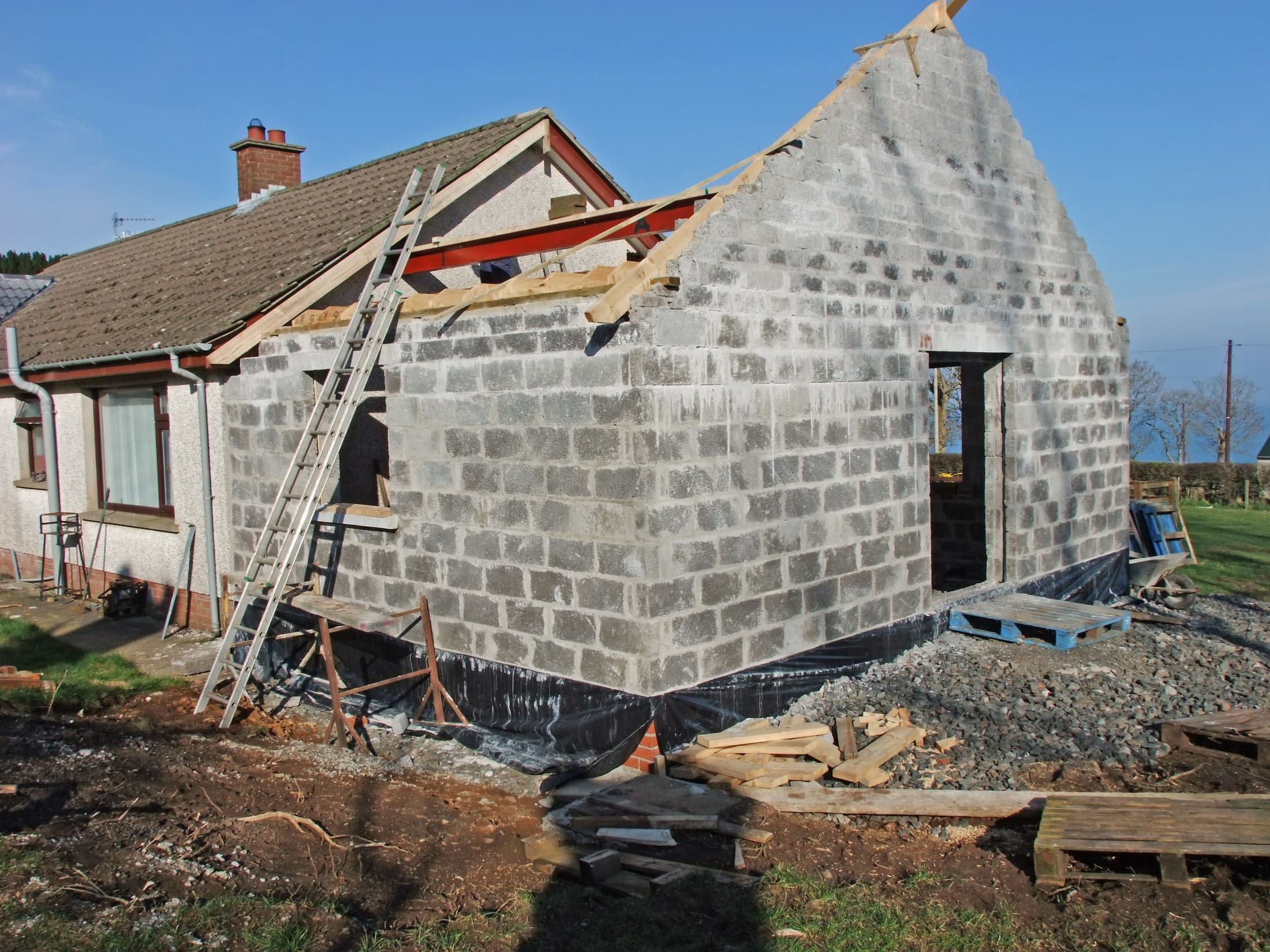
- ShellWalls to wall plate, roof on, windows in.
- Fit-outFirst fix, plaster, second fix, opening into the house formed.
- CompletionFinal inspection, completion certificate, snag list closed.
- Full plans
- A detailed building regulations application approved before work starts.
- Building notice
- A shorter application for simpler work in England.
- Wall plate
- The timber on top of the walls that the roof sits on.
- Party wall award
- The document setting out how work near a shared wall will be done.
- Lintel / steel
- The beam over a new opening.
- Completion certificate
- Building control's confirmation that the work complies.
AFTER
When the job is done
Hiring an extension builder: questions people ask
No law licenses builders. The extension build needs building regulations approval, or a building warrant in Scotland, and often planning permission.
A building control completion certificate in England, Wales and Northern Ireland, or an accepted completion certificate in Scotland, plus each specialist trade's certificate.
£1,800–£4,000 per square metre, typically around £2,700. Specification moves it most, then one or two storeys and the ground conditions. The House Extension price guide goes through it line by line; type your postcode above for extension builders in your area.
Possibly; gov.uk says planning and building regulations are different approvals and you might need both.
In England and Wales, under the Party Wall etc. Act 1996 if the work is on or near a shared wall or boundary.
HSE says your client duties pass to the contractor, or the principal contractor if there are several.
MORE GUIDES
More hiring guides in trades & construction
Extension builders near you
Sources — checked October 2026
- gov.uk — building regulations approval (England)
- gov.uk — building regulations: how to apply
- TrustMark — the Government Endorsed Quality Scheme
- mygov.scot — if a builder is doing the work for you
- nidirect — how to apply for Building Regulations approval
- gov.uk — party walls and building work
- Party Wall etc. Act 1996
- HSE — CDM 2015: domestic clients
- HSE — deciding if asbestos work must be done by a licensed contractor
- Consumer Rights Act 2015, section 49 — reasonable care and skill
- Consumer Rights Act 2015, section 54 — what you can ask for when a service falls short
- Consumer Contracts Regulations 2013, regulation 30 — the 14-day cancellation period
- Consumer Contracts Regulations 2013, regulation 28 — contracts the cancellation right does not cover
- Consumer Contracts Regulations 2013, regulation 36 — services started within the cancellation period
- Civil Procedure Rules Part 26 — the small claims track limit (England and Wales)
- Scottish Courts and Tribunals — making a claim under simple procedure
- nidirect — the small claims process (Northern Ireland)
- Buildings and construction (VAT Notice 708) — 2.1 Construction services: work to an existing building is normally standard-rated
- GOV.UK — VAT rates
- GOV.UK — Register for VAT: when to register