

WATCHDOG · 6 MIN READ
Unregistered electrician convicted in Sligo: €24,409 for a job that left a family with live sockets
A week ago the CRU won its largest electrical prosecution yet, and published a register of every case it has brought. What was done, what it cost, and the two-minute check that would have stopped it.
IN SHORT
- On 12 October 2026 Sligo District Court convicted a man of carrying out restricted electrical works while unregistered and of passing himself off as a Registered Electrical Contractor. He was ordered to pay €24,409 in fines, costs and witness expenses.
- The family, with children, had already moved in. Inspectors found bedroom sockets unsecured with exposed live parts, a light switch with no cover, an unlabelled fuse board with live terminations, and no fire-stopping above it.
- Most electrical work in a home is 'restricted': new circuits, fuse boards, bathrooms, anything needing a certificate. Only a Safe Electric Registered Electrical Contractor may do it. Check before the first cable is touched: safeelectric.ie.
What happened in Sligo
On 12 October 2026, at Sligo District Court, Judge Brendan O'Reilly convicted Greum Na hEaradh, also known as Graham Harris, with addresses at Ballinacarrow, Co. Sligo and Eskra, Omagh, Co. Tyrone, of two offences under the Electricity Regulation Act 1999: carrying out restricted electrical works while not registered, and falsely portraying himself as a Registered Electrical Contractor (REC). The Commission for Regulation of Utilities (CRU), which brought the case, named him in its release the same week.
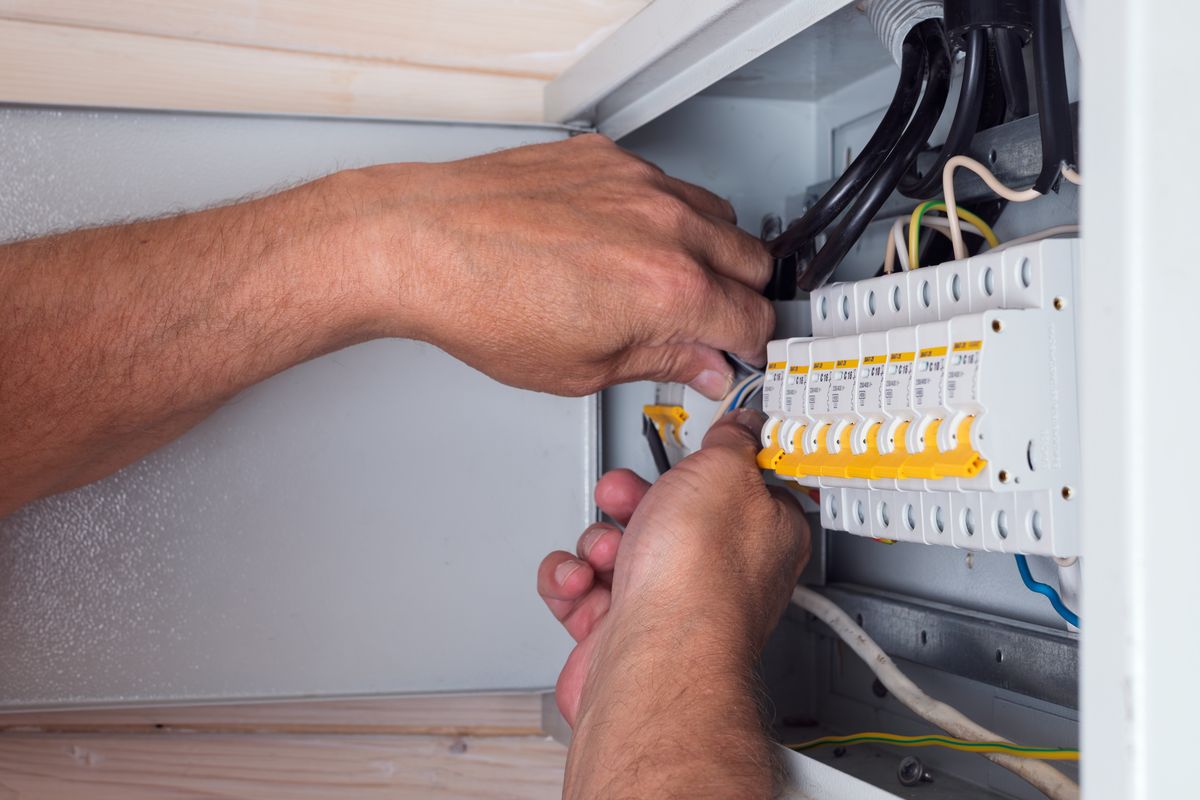
The work was done at a house in Breeogue, Co. Sligo. By the time the CRU's electrical investigation officer inspected it, a family with children was living there. The inspection found bedroom sockets not secured to the wall with live parts exposed, a light switch with no cover plate, cables with no basic protection, no fire-stopping above the distribution board, and a board that was unlabelled, with exposed live terminations and unterminated cables held with tape. A registered contractor had to redo the installation.
The court ordered him to pay €24,409 in fines, costs and witness expenses combined. The CRU did not publish the split. Rory Mee, the CRU's acting director of energy safety, said the work "put a family at risk of electric shock and fire" and urged customers "to always check that their electrical contractor is registered with Safe Electric".
Why this one matters more than the fine
Two days later, on 14 October, the CRU published something it had never published in full before: a prosecutions register, year by year from 2020, at cru.ie. Read together, the cases show the pattern, and the pattern is not expensive for the people doing it.
- December 2025, Bray District Court. A Loughlinstown man pleaded guilty to restricted works at a family home in Co. Wicklow; the judge said "the potential for catastrophe was very real". Fine €1,000, costs €750.
- September 2025, Wexford District Court. A New Ross man who described himself as an REC did restricted works at two homes: wrong cable sizes that "could have led to overheating of the cables and potentially cause a fire", no RCD protection on some circuits, an electric shower on an existing shower supply. Ordered to repay €2,180 to the homeowners, €400 costs, and a €300 fine.
- September 2026, Dublin District Court. A Dublin 15 man convicted in his absence of illegal gas and electrical works at a house in Malahide, including a walk-in electric shower the CRU described as a serious electrocution risk. The homeowner had paid €12,000. Fines €1,500 plus €5,850 costs.
- January 2025, Ballina District Court. An Enniscrone man wired a home workshop and twice claimed he could certify it; the homeowner needed that certificate for ESB Networks to connect the supply. Repay €1,700, fines and costs €1,500.
- February 2024, Longford District Court. A Ballymahon man wired a new house and issued a fake Completion Certificate. €1,000 per offence.
Every one of these was a District Court case, where the maximum per offence is €5,000 or six months. The €50,000 and three years the CRU quotes applies only on indictment, and none has gone that way. The CRU brought no prosecutions at all in 2023; two electrical cases in 2024; four in 2025; two so far in 2026. Its own 2023 figures show 91 reports of alleged illegal electrical work that year and 67 investigations opened.
Put plainly: the deterrent is small, the register is new, and the check is yours to make.
What "restricted works" means in a normal house
The 2013 regulations (S.I. 264 of 2013) list four kinds of work that only an REC may do in a domestic property:
- A new installation that needs connecting to the ESB network.
- Fitting, replacing or altering a distribution board (fuse board), including the tails either side of the main switch, and any work in a bathroom, shower room or other "special location".
- Installing or replacing one or more circuits, including the breakers that protect them.
- Inspecting, testing or certifying an existing installation.
Safe Electric's own summary is that restricted works "cover most electrical work in a home". What is left over is minor work: a like-for-like switch or socket, moving a light fitting on an existing circuit, adding a socket to an existing radial circuit. Even minor work must meet the wiring rules; it just does not need a registered contractor.
Two things follow. A new shower circuit, a rewire, an extension, a board upgrade, solar PV, an EV charger: all restricted. And at the end of restricted work the REC must give you a Completion Certificate, issued by the contractor's named qualified certifier, with a copy lodged with Safe Electric. No certificate is the first sign something is wrong. In the Longford case the certificate was forged; in the Ballina case it was promised and could not be issued.
The two-minute check
- Before any work starts, ask: "Are you a Safe Electric Registered Electrical Contractor?" Roughly 4,000 are. Registered contractors are insured and have a sample of their work inspected every year.
- Look them up at safeelectric.ie under Find a Registered Electrical Contractor (search by county and town). Not every REC chooses to be publicly listed, so if a name does not appear, phone Safe Electric on 091 480 974 or email [email protected] and ask them to confirm.
- Ask what certificate you will get and when. Restricted work: a Completion Certificate, on completion, in your hand.
- If you suspect unregistered work, or someone claiming to be registered, report it at safeelectric.ie/help/report. That is how the Sligo case started.
On Locufy, an electrician can show their Safe Electric registration on their profile, with a link to check it on safeelectric.ie yourself. It does not replace asking; it means you can ask with the answer already in front of you.
“The unsafe and defective work put a family at risk of electric shock and fire.”
Rory Mee, Acting Director of Energy Safety, CRU, 14 October 2026
€24,409
fines, costs and expenses, Sligo, 12 Oct 2026
€300–€1,000
the fines in the other cases since 2024
≈4,000
Registered Electrical Contractors in Ireland (CRU)
By the numbers — figures from the sources listed at the end of this piece.
WHAT TO DO NEXT
Electricians near you with their Safe Electric check date — no account needed to look.Questions this piece gets asked
Can I do my own electrical work?
Minor work on existing circuits, yes, and it must still meet the National Rules. Anything restricted — a new circuit, a fuse board, a bathroom, anything that needs certifying — no, and that applies to a homeowner as much as to a trader.
What if the work is already done and I have no certificate?
Ask the contractor for it in writing. If they are registered and refuse, complain to Safe Electric. If they are not registered, report it and have an REC inspect the work; a Periodic Inspection Report will tell you what has to be put right.
Does the court order money back to the homeowner?
Sometimes. In the Wexford and Ballina cases the court ordered repayment of €2,180 and €1,700. In Sligo the €24,409 was fines, costs and witness expenses; the cost of the re-wire is a separate civil matter.
Sources
- CRU, 'Sligo man convicted for false portrayal as a Registered Electrical Contractor and carrying out illegal electrical works', 14 Oct 2026
- CRU prosecutions register (2020–2026)
- CRU, Bray District Court conviction, Dec 2025
- CRU, Wexford convictions, 25 Sep 2025
- CRU, Dublin conviction for illegal gas and electrical works, €7,350, Sep 2026
- CRU, Ballina District Court conviction, 22 Jan 2025
- CRU, Longford District Court conviction, 19 Feb 2024
- S.I. No. 264/2013, Electricity Regulation Act 1999 (Restricted Electrical Works) Regulations 2013
- Electricity Regulation Act 1999, ss.9D and 9E (revised)
- Safe Electric, Controlled and restricted electrical works
- Safe Electric, Completion certificates
- Safe Electric, Find a Registered Electrical Contractor
- CRU Energy Safety Report 2023 (reports and investigations)
FOLLOW WATCHDOG
One email a month — the watchdog piece, the day it goes out. One tap to stop.
Comments 3
TopNewest
- REAoife M.Customer · Dublin 8EDITOR'S PICK2 h ago
The register link is the useful bit. Looked up the lad who quoted us for the board last month — not on it. Saved us a job.
- PRMarta R.Provider · Electrician · Crumlin1 h ago
Every one of these cases is a board or a shower. Ask for the certificate before the balance, every time. A registered contractor will not blink.
- RECiara D.Customer · Cork40 min ago
The thirty-day rule should be on a sticker on every front door.
Signed-in Locufy customers and providers only. Comments close 30 days after publication. Report anything that names a person unfairly — we act on every report.
NEXT IN WATCHDOGBogus tradesmen at the door: reports up 57%, one landscaper jailed, and the 30-day right most people don't know they have7 min read
More in Watchdog
All watchdog →

MOST READ THIS MONTH
FOLLOW A SECTION
Pick your sections. The month's piece arrives the day it goes out.
Nothing is pre-ticked. Choose one section or all 20; you get at most one email per section per month.
One email per section per month, the day the piece goes out. Stop in one tap. Privacy.