DIY GUIDE · ELECTRICAL · CHECKED OCTOBER 2026
How to switch to LED and replace a light fitting yourself
An hour for a room of lamps; an hour or two for a fitting. €11–€95 for lamps, a fitting, a dimmer and a voltage tester.
Match the cap, the colour and the dimmer; then, if the fitting is tired, swap it like for like with the circuit off and proved dead. Leave new points and bathrooms to a registered contractor.
- Every step, start to finish
- Checked October 2026 — sources at the end
- Honest about when to call a pro
FIRST, THE HONEST ANSWER
Do it yourself, or get a electrician?
Do it yourself if…
- You are swapping bulbs for LED lamps of the same cap, or replacing a fitting with one of the same kind on the same wires
- The light is in a living room, bedroom, hall, kitchen or landing, not a bathroom or outside
- You can switch off the lighting circuit at the board and prove it dead with a voltage tester
- The wiring at the ceiling rose or wall box is in good condition
Get a pro if…
- You want a new light point, extra downlights cut into the ceiling or a light moved to a new circuit
- The light is in a bathroom, shower room or outside
- The wiring at the rose is brittle, scorched or has no earth where the new fitting needs one
- The lighting breaker trips repeatedly, or lights flicker throughout the house
Safety first
- Switch off the lighting circuit at the board and prove the terminals dead with a tester you have proved on a live circuit before and after. The HSA's electricity guidance sets out that check.
- A loop-in ceiling rose can carry live cables even when the wall switch is off. Always isolate at the board.
- On the stepladder, keep three points of contact and do not stand on the top two steps unless there is a handrail, as the HSA's ladder guidance says.
- Let halogen and filament bulbs cool before handling; they burn fingers badly.
- Never work on lights in a bathroom or shower room yourself; even like-for-like replacement there is restricted work under Irish law.
Stop here: Stop here: new points, new circuits, bathrooms and the board
Under the Restricted Electrical Works Regulations, S.I. No. 264 of 2013, swapping a light fitting while keeping its existing circuit counts as minor work. A new circuit, any change at the distribution board and any work on the electrical installation in a special location such as a bathroom are restricted in Irish law to a Registered Electrical Contractor, who tests and certifies the work, and the CRU prosecutes unregistered restricted work. New light points cut into a ceiling are new work too: leave them to a registered contractor. How to hire an LED lighting installer →
| MATERIAL | COVERAGE | FOR THIS JOB |
|---|---|---|
| LED lamps | Same cap, matching lumens, warm or cool white to suit, dimmable if on a dimmer | One per lamp holder |
| Replacement light fitting | Same type, suited to the ceiling and the wiring | One, if replacing |
| Strip connector or the fitting's terminal block | Rated for lighting circuits | One, usually supplied |
| Green-and-yellow sleeving | For any bare earth core | A short length |
Will the dimmer work with the new lamps
Usable LED load = dimmer rating × the share the lamp maker allows for an ordinary dimmer. On a 400 W dimmer with a 20% allowance, that is 80 W of LED, or about thirteen 6 W lamps; on an LED-rated dimmer, the full rating applies.
Most problems are at the other end: too few lamps for the dimmer's minimum load. One or two LED lamps on an old high-wattage dimmer is the classic cause of flicker and glow.
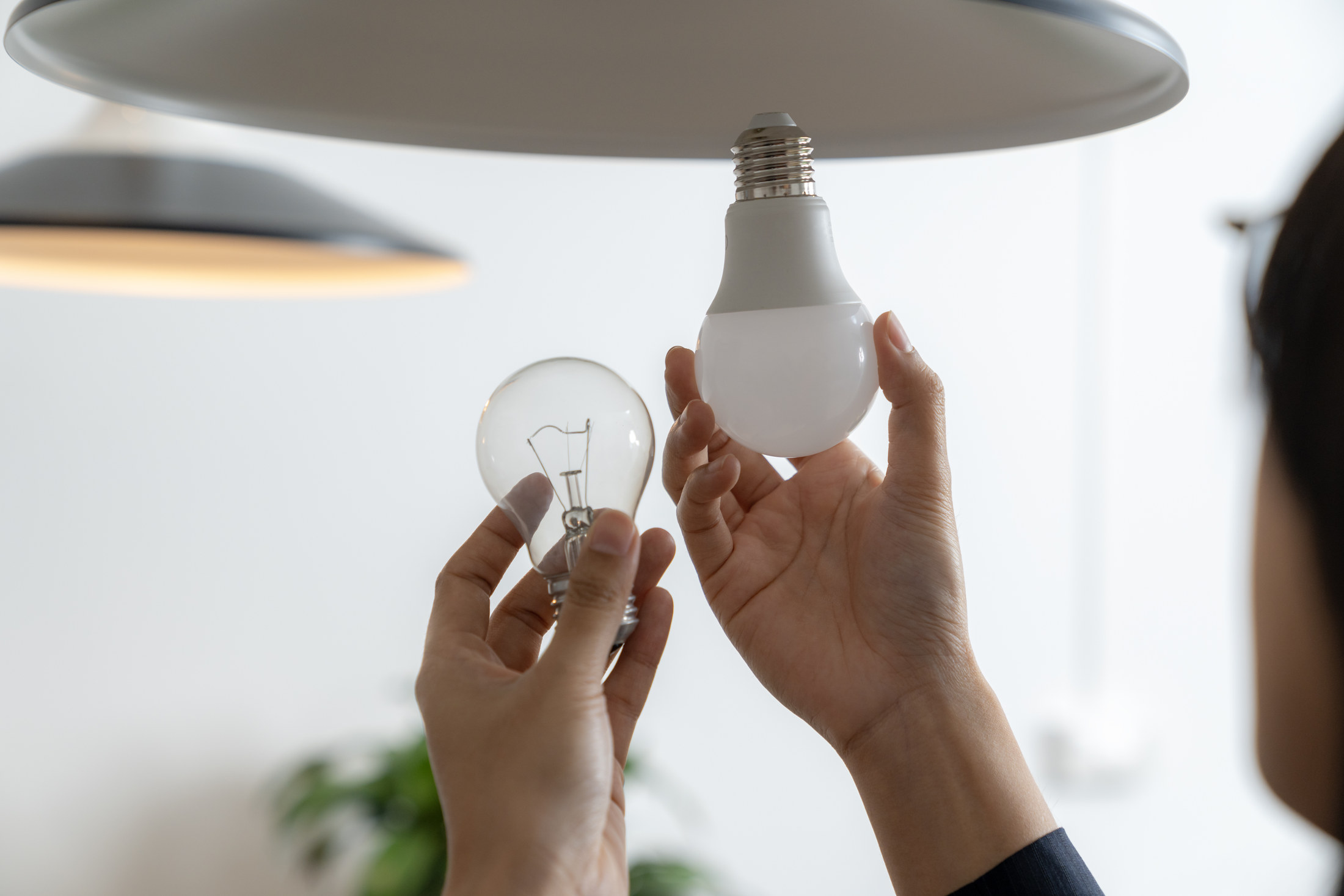
Look at the base of the old bulb. Bayonet and screw caps come in a large and a small size each, and spotlights use two-pin push-and-twist caps. The lamp has to match exactly. Take the old one to the shop if you are not sure.
An LED lamp uses a fraction of the power of the bulb it replaces. Packs show the old equivalent and the light output in lumens. Choose by lumens and by the old equivalent printed on the pack, not by the LED's own small wattage.
Light colour is given in kelvin. Around 2700 K is the warm, yellowish white of old filament bulbs and suits living rooms and bedrooms. Higher numbers look whiter and cooler, which some people like in kitchens and utility rooms. Use the same colour across one room.
A lamp must be marked dimmable to go on a dimmer, and many older dimmers are made for far heavier loads than LED lamps draw. A lamp maker's dimmer compatibility list we read notes that most ordinary dimmers can be loaded with LED lamps to only 20% of their rated power, while LED dimmers can take their full rating. Low loads cause flicker and a faint glow when off.
A pendant for a pendant, a flush ceiling fitting for a flush ceiling fitting, on the same wires at the same point. Check whether the new fitting is double-insulated or needs an earth, how heavy it is, and that its fixing plate will screw into the ceiling where the old one did.
THE PART THAT DECIDES THE FINISH
Before you start — what you are changing
Match your job to one of these and do its prep first.
Just the lamps
The fitting stays; the bulbs change to LED.
- Switch off and let old halogen or filament bulbs cool fully before touching them
- Note the cap and size of each, and whether it is on a dimmer
- Wipe dust from the lamp holder while the bulb is out
- Check spotlight holders for brittle or browned plastic; replace a damaged fitting rather than relamping it
Pendant or flush fitting on a ceiling rose
One fitting at a ceiling rose, often with several cables inside.
- Switch off the lighting circuit at the board, not just the wall switch
- Unscrew the rose cover and prove every terminal dead with your tested tester
- Photograph the connections: there are often three or four cables in a loop-in rose
- Label the switched live core and the loop cables with tape before you touch them
Wall light
A fitting on a wall box, often on its own switch or the room switch.
- Switch off the circuit at the board and prove dead at the box
- Photograph the connections and the earth
- Check the new fitting's back plate matches the box fixings
- Scan for pipes and cables if new screw holes are needed
Spotlights or downlights
Recessed lamps in the ceiling.
- Relamping is fine; changing the downlights themselves is like for like only if they fit the same holes and wiring
- Check whether they run at mains voltage or through a transformer before buying lamps
- Look for a fire rating mark if they are in a ceiling below a bedroom
- Do not cut new holes; that is new work
THE JOB
How to switch to LED and replace the fitting
Switch off and make safe
10 minFor lamps only, switch off at the wall and let old bulbs cool. For a fitting, switch off the lighting circuit at the board, tape over the breaker and leave a note. Set the stepladder up fully opened on a level floor.
- Turn on the light before you switch off at the board, so you see which breaker kills it
- Keep a head torch on
- Clear the floor under the ladder
Mistake to avoid: Switching off only at the wall switch. At a loop-in ceiling rose, some terminals stay live even with the switch off.
Do the prep for your job
10 minThis is the prep from the cards above. For a fitting, open the rose or box, prove every terminal dead with a tester you have just proved on a live socket, then photograph and label the connections. For lamps, note caps, sizes and dimmers.
- Prove the tester again after testing
- Count the cables entering the rose
- Note which core goes to the light and which loop on
Mistake to avoid: Skipping the photograph. A loop-in rose with four cables is very hard to rebuild from memory.
Fit the LED lamps
15 minRemove each old bulb and fit an LED lamp of the same cap. For spotlights, push and twist gently until they lock. Do not force a lamp that will not seat; check the cap type instead.
- Hold LED spots by their body, not the lens
- Fit one and test it before buying a full set
- Use the same colour throughout the room
Mistake to avoid: Fitting non-dimmable LED lamps on a dimmer. They flicker, buzz and fail early.
Sort out the dimmer
20 minSwitch on and run the dimmer through its range. If the lamps flicker, glow when off, or buzz, the dimmer and lamps do not suit each other. Either add more lamps to the circuit, choose lamps the maker lists as compatible, or replace the dimmer like for like with an LED-rated one, with the circuit off and proved dead.
- An LED dimmer often has a minimum-level adjustment; set it as its sheet shows
- Check the dimmer's box depth before buying
- Two-way dimmers must be matched with the other switch
Mistake to avoid: Living with a buzzing dimmer. It strains the lamps' electronics and they fail in months rather than years.
Take down the old fitting
20 minWith the circuit off and proved dead, support the old fitting's weight and undo its fixing screws. Lower it and, following your photograph, release its cores from the terminal block one at a time. Leave the house cables at the rose or box exactly as they were.
- Have a helper hold a heavy fitting
- Loosen terminal screws, do not remove them
- Keep loop cables together as they were
Mistake to avoid: Letting a fitting hang by its wires while you undo them. The weight pulls cores out of the block and strains the cable in the ceiling.
Fix the new fitting's plate
20 minHold the new fitting's mounting plate to the ceiling over the box or rose position. Use the existing holes if they line up; if not, scan the ceiling before drilling new ones, and fix into a joist or with fixings suited to plasterboard. Check the plate is secure enough for the fitting's weight.
- Mark holes through the plate with a pencil
- Fix into timber for heavy fittings
- Keep the cables clear of the screw positions
Mistake to avoid: Hanging a heavy glass fitting on plasterboard plugs alone. It pulls the board down in time.
Connect the new fitting
15 minConnect the house cores to the new fitting exactly as your photograph shows: the switched live to the fitting's live, neutral to neutral, earth to earth. If the fitting is double-insulated, terminate the earth in a terminal block at the rose, sleeved, without leaving it loose. Tighten each terminal firmly and tug each core.
- No copper should show outside a terminal
- Fold cables neatly into the canopy so none are pinched
- Follow the fitting's own sheet for its terminal layout
Mistake to avoid: Leaving the house earth loose and unconnected. A loose bare earth in a ceiling canopy can touch a terminal; it must always be sleeved and terminated.
Fit the canopy, lamps and test
15 minPush the canopy up over the connections and fix it. Fit the LED lamps. Remove the tape from the breaker and switch on. Test the light from every switch that controls it, and run the dimmer through its range if there is one.
- Check the canopy sits flat and the fitting hangs level
- Watch for flicker at low dimmer settings
- Check other lights on the circuit still work
Mistake to avoid: Assuming the job is right because the light comes on. Check every other light on the loop; a disturbed loop connection can kill the next room's light.
Tidy and dispose
10 minPut the old lamps and fitting in a bag for recycling. Write down which lamps you bought, with cap and colour, and keep it with your house papers.
- Keep one spare LED lamp of each type
- Keep the fitting's sheet
- Note the date for the warranty
Mistake to avoid: Throwing old bulbs in the bin. Lamps are electrical waste and some contain mercury.
The mistakes that show
- Switching off only at the wall switch before opening a ceiling rose
- Putting non-dimmable LED lamps on a dimmer
- Losing track of loop cables in a ceiling rose
- Leaving a house earth loose in a double-insulated fitting
- Hanging a heavy fitting from plasterboard plugs
- Mixing warm and cool LED colours in one room
Stop here and get a Registered Electrical Contractor
- You want a new light point, extra downlights or a light on a new circuit
- The light is in a bathroom, shower room or outside
- The wiring is scorched, brittle or does not match what you photographed
- Lights flicker throughout the house, or the lighting breaker keeps tripping
| WHAT YOU SEE | WHY, AND THE FIX |
|---|---|
| LED lamps flicker on a dimmer | The dimmer is not suited to LED loads or the load is too low. Use lamps the maker lists as compatible, add lamps, or fit an LED-rated dimmer. |
| LED lamps glow faintly when switched off | A low load on an ordinary dimmer or a single-pole switch. The lamp maker notes that double-pole switching or an LED dimmer usually cures it. |
| Dimmer buzzes | An old dimmer driving a light LED load. Replace it like for like with an LED-rated dimmer. |
| New fitting does not light | A loose terminal or the switched live on the wrong terminal. Switch off, prove dead and check against your photograph. |
| Other lights stopped working after the swap | A loop connection at the rose was disturbed. Switch off, prove dead, and reconnect the loop cores exactly as they were. |
| Breaker trips when switched on | A core touching the plate or crossed connections. Switch off, prove dead and recheck everything. |
| LED spotlight will not fit | Wrong cap, or the LED body is longer than the old halogen. Measure the holder depth and buy a shorter lamp. |
| Lamps fail within months | Overheating in an enclosed fitting, a poor dimmer match, or voltage problems. Check the lamp is rated for enclosed fittings and the dimmer suits LED. |
WHAT YOU SAVE
What it costs to do it yourself
| LED lamps, single | €5.49–€21.99 |
|---|---|
| LED spotlights, three-pack | €10.99 |
| LED dimmer switch | €29.99 |
| Ceiling light fitting | €16–€53 |
| Voltage tester | €11.95 |
| Total | €11–€95 |
| DIY total | €11–€95 |
Guide prices compiled by the Locufy team from published Irish and UK provider price lists and 2026/27 cost guides. Updated 2026.
Changing lamps costs little and pays back in lower bills. The top of the range is a new fitting, an LED dimmer and a tester you keep.
RATHER NOT?
LED lighting installers near you, with prices shown
The ones who cover your area, nearest first, with one score from every review. No account needed to look.
Or post the job free and let them come to you.
Light bulbs, energy-saving lamps and fluorescent tubes are electrical waste. Mywaste.ie says they go to a WEEE drop-off point or a civic amenity site, free of charge; energy-saving lamps contain small amounts of mercury and must not go in the bin.
An old light fitting is electrical waste too, and goes the same way. Shops selling you a new fitting must take back an old one like for like.
Note each room's cap, size, colour and whether it is on a dimmer. Next time you buy the right lamp first time.
Over the first weeks, listen for buzzing and watch for flicker. Either is a sign the lamp and dimmer are not a good match.
Switching to LED and replacing a light fitting like for like: questions people ask
Yes, if you are replacing a fitting on the same circuit at the same point, outside a bathroom. The Restricted Electrical Works Regulations treat that as minor work. New points, new circuits and bathroom work are for a Registered Electrical Contractor.
Usually a dimmer not designed for LED loads, or too few lamps on it. A lamp maker's list we read says most ordinary dimmers can take LED lamps to only 20% of their rating. Use compatible lamps or an LED dimmer.
Around 2700 K, sold as warm white. Higher kelvin numbers look whiter and cooler.
If the cap matches and the lamp fits, yes. In enclosed fittings, choose lamps rated for enclosed use; in a dimmer circuit, choose dimmable lamps.
Bring them to a WEEE drop-off point or civic amenity site, free of charge. Energy-saving lamps contain mercury and must not go in the bin.
Locufy's Irish price guide puts LED lighting work at €80–€350 per job, typically €150. New downlights or points cost more than a like-for-like swap.
MORE GUIDES
More DIY guides
Sources — checked October 2026
- Philips — consumer LED mains-voltage lamps: recommended dimmer compatibility list
- HSA — guide to Part 3 of the General Application Regulations 2007: electricity
- HSA — using ladders safely information sheet
- S.I. No. 264 of 2013 — Electricity Regulation Act 1999 (Restricted Electrical Works) Regulations
- Safe Electric — restricted and controlled electrical works
- MyWaste.ie — light bulbs
- MyWaste.ie — energy-saving bulbs
- MyWaste.ie — WEEE help and FAQs: retailer take-back
- Woodie's — light bulbs (price check)
- Woodie's — switches and sockets: LED dimmer (price check)
- DIY.ie — ceiling lights (price check)
- Ganly's — electrical accessories: voltage detector (price check)