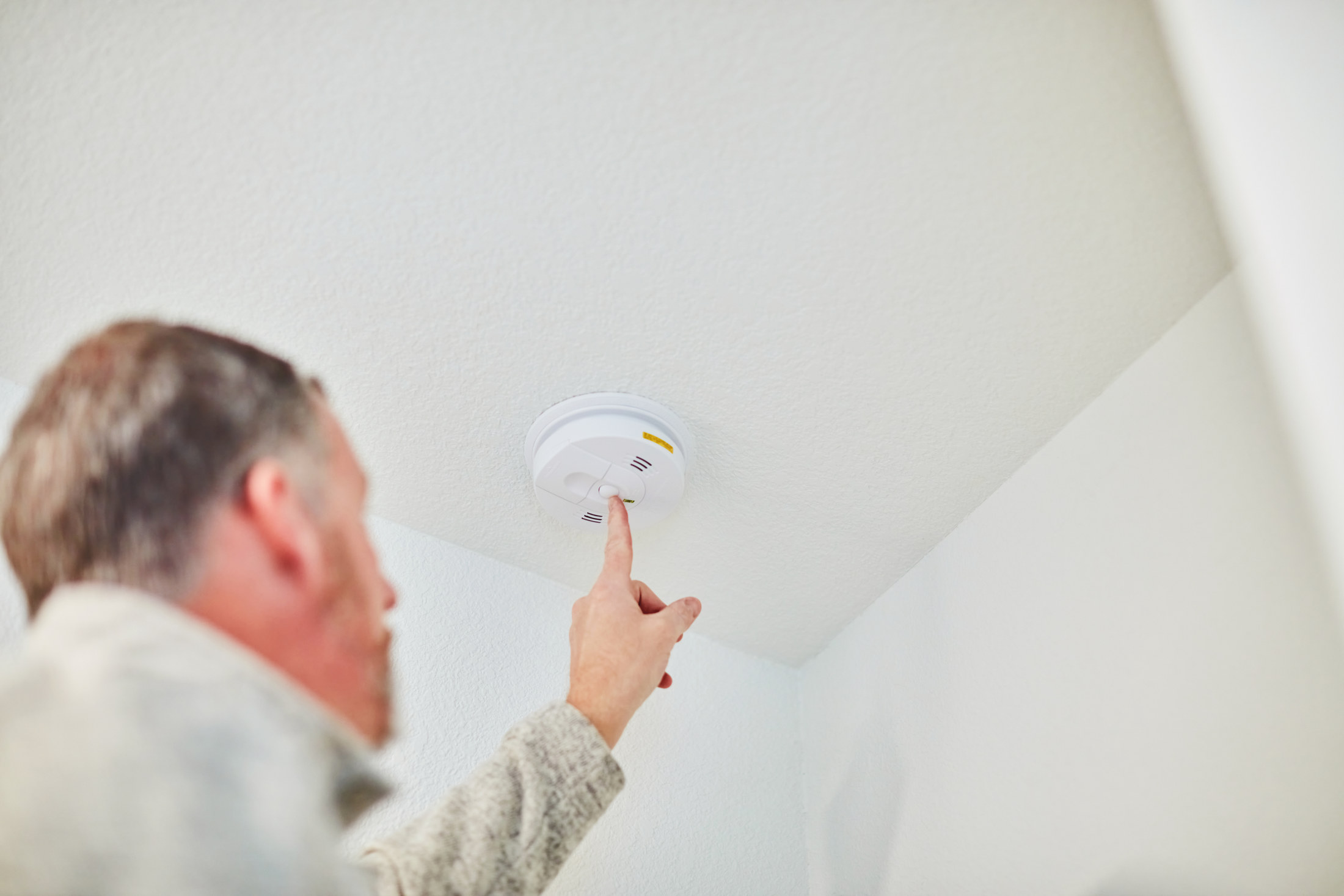
DIY GUIDE · ELECTRICAL · CHECKED OCTOBER 2026
How to fit a carbon monoxide alarm yourself
Half an hour. €23–€60 for one or two battery alarms with ten-year sealed batteries.
Right room, right height, right distance from the appliance: one alarm where the boiler, stove or fire is, and one near the bedrooms. Test it, and never treat it as a substitute for servicing.
- Every step, start to finish
- Checked October 2026 — sources at the end
- Honest about when to call a pro
FIRST, THE HONEST ANSWER
Do it yourself, or get a electrician?
Do it yourself if…
- You are fitting a battery or plug-in carbon monoxide alarm, or replacing one like for like
- You can reach the ceiling or high on the wall safely from a stepladder
- You can drill two small holes and plug them for the wall or ceiling you have
- The fuel-burning appliances in the house are serviced and working normally
Get a pro if…
- You want mains-powered alarms interlinked across the house, which need a supply wired in
- An appliance is sooty, burns with a lazy yellow flame, or you already feel unwell when it runs
- A new boiler, stove or open fire is being installed, which brings its own alarm requirement
- An alarm has gone off and you do not know why
Safety first
- Carbon monoxide can kill. The HSA notes that early symptoms are easily confused with flu or tiredness; at higher levels they include headaches, fatigue, vomiting and nausea. Leave the house and get medical help if you suspect it.
- On the stepladder, keep three points of contact and do not use the top two steps unless there is a handrail, as the HSA's ladder guidance says.
- Scan for cables and pipes before drilling a ceiling or wall, especially near a boiler or a light fitting.
- Never test an alarm with real carbon monoxide from an engine, a match or a stove.
- If you have gas appliances and smell gas, do not use switches or flames; leave the house and call the gas emergency number from outside.
Stop here: Stop here: wired alarms, gas appliances and flues
A mains-powered alarm on a new circuit is restricted electrical work under Irish law, S.I. No. 264 of 2013, which only a Registered Electrical Contractor may carry out and certify. Any work on a gas boiler, gas fire or gas cooker, including finding out why an alarm sounded, is restricted to a Registered Gas Installer, and the CRU prosecutes unregistered work. Under the Building Regulations, Part J, the installer of a new or replacement fuel-burning appliance is the one who must provide the carbon monoxide alarms, so ask for them as part of that job. How to hire a carbon monoxide alarm fitter →
| MATERIAL | COVERAGE | FOR THIS JOB |
|---|---|---|
| Carbon monoxide alarm | To I.S. EN 50291-1, with an end-of-life warning and third-party certification | One per room as the guidance sets out |
| Wall plugs and screws | Usually supplied; suited to plaster, block or timber | Two per alarm |
| A marker pen | To write the fitting date on the alarm | One |
Is the alarm in range of the appliance
Check: horizontal distance from the appliance edge to the alarm must fall between the guidance's minimum and maximum. If the stove is in one corner and you fix the alarm on the ceiling 2.4 m across the room and 400 mm from the wall, it is inside the range and clear of the wall.
Measure along the floor from the nearest edge of the appliance, then transfer the point up to the ceiling with the tape. Recheck the distance from the wall before you drill.
Technical Guidance Document J asks for alarms that comply with I.S. EN 50291-1, carry a visual and audible warning when their working life is ending, and have third-party certification from the maker. Look for the standard and the certification mark on the box, not just the words carbon monoxide.
An alarm with a sealed lithium battery that lasts the life of the sensor needs no battery changes and cannot have its battery borrowed for the remote control. The maker we read gives a product life of 10 years for its sealed model. Note the date you fit it on the alarm.
The guidance asks for an alarm in the room with a fuel-burning appliance that is not only for cooking — a boiler, a stove, an open fire, a gas fire — and another either in each bedroom or within 5 m of the bedroom door, measured along the corridor. If a flue or chimney passes through a habitable room, that room needs one too.
On the ceiling, the alarm should be at least 300 mm from any wall. On a wall, it should be as high as possible, above any door or window, but not within 150 mm of the ceiling. In both cases it should be between 1000 mm and 3000 mm horizontally from the appliance.
The maker we read lists places that give false alarms or none: outside the building, in a cupboard, directly above a sink or cooker, next to a window, vent or extractor fan, over a radiator, and anywhere the temperature can fall below −10 °C or rise above 40 °C. Keep it at least a metre from any cooking appliance.
THE PART THAT DECIDES THE FINISH
Before you start — the room and the fixing surface
Look at the room the appliance is in, then the ceiling or wall you will fix to. Match it to one of these.
Living room with a stove or open fire
A solid-fuel stove or fire with a chimney; often the room people sit in for hours.
- Measure the horizontal range from the appliance and mark it on the floor with tape
- Choose a ceiling point at least 300 mm from the wall inside that range
- Keep it away from the door, any window and the chimney breast's warm air
- Check the ceiling there for cables with the detector
Kitchen or utility with a boiler
A wall-hung or floor-standing boiler, often near a cooker and an extractor.
- Measure from the boiler, not the cooker, for the range
- Stay at least a metre from the cooker and away from the hob and extractor
- Avoid fixing above the sink or kettle, where steam reaches
- Scan the wall or ceiling; pipes and cables run near boilers
Bedroom or landing
The second alarm, inside each bedroom or within the distance of the bedroom doors.
- If one landing alarm can be within 5 m of every bedroom door, measure along the corridor to check
- Inside a bedroom, fit it near the height where people breathe when lying down
- Keep it away from curtains and wardrobes that could block it
- Avoid fixing over a radiator
Plasterboard or old lath ceiling
A hollow ceiling rather than solid plaster on block.
- Use plugs made for plasterboard, or fix into a joist found with the detector
- Do not overtighten; the board crumbles round the plug
- On an old lath-and-plaster ceiling, drill gently and expect dust
- If the ceiling sounds loose, fix to the wall instead, within the rules
THE JOB
How to fit the alarm
Set up safely
10 minRead the alarm's instruction leaflet first; its siting rules and the Building Regulations guidance agree on most points. Set up the stepladder on a flat floor, fully opened. Clear the space below, and keep children out of the room while you drill.
- Keep the leaflet; the maker asks for it to stay with the householder
- Put on safety glasses for drilling overhead
- Have a damp cloth ready for dust
Mistake to avoid: Standing on the top step of a stepladder to reach the ceiling. The HSA advises against using the top two steps unless there is a handrail.
Do the prep for your room
10 minThis is the prep from the cards above. Measure the horizontal range from the appliance, mark the target area, and choose a ceiling point well clear of the wall or a high wall point below the ceiling line. Scan for cables and pipes at that exact point.
- Measure twice and mark lightly in pencil
- Look up for a light fitting nearby; cables run to it
- Pick a point you can reach to test the alarm
Mistake to avoid: Fixing the alarm where it is easy rather than where it works. An alarm in the wrong spot is late to sound, or sounds for the wrong reason.
Mark and drill the holes
10 minHold the mounting plate exactly where you want it and mark both screw holes through it. Drill each hole with the bit size the maker gives, taking care to avoid wiring. Push the plugs in until they sit flush.
- On a ceiling, drill slowly and let gravity take the dust down
- Keep the plate square to the room so the alarm looks neat
- On timber, a pilot hole is enough; no plug needed
Mistake to avoid: Drilling without checking again with the detector. A cable to the ceiling light often runs right past the best spot.
Fix the mounting plate
5 minScrew the plate firmly to the ceiling or wall. On a wall, check it sits flat; on plasterboard, stop as soon as the screw is snug.
- Hand tighten the last turn
- Check the plate does not rock
- Wipe off any dust before fitting the alarm
Mistake to avoid: Overtightening into plasterboard. The plug spins and the alarm drops off within weeks.
Activate and fit the alarm
5 minOn a sealed battery model, the battery connects when you fit the alarm to its plate. Line it up, press it home and twist as its leaflet shows. The lights should flash in sequence to show it is powered.
- Write the date you fitted it on the side with a marker
- Check the green power light is showing after a minute
- Fit the second alarm the same way
Mistake to avoid: Leaving the alarm in its box until later. An alarm is no use unfitted, and that is when people forget it.
Fit the bedroom alarm
20 minNow fit the second alarm near where people sleep. On a landing that serves several bedrooms, measure along the corridor from each bedroom door and find a point that sits within the guidance's distance of all of them; if no single point does, fit one inside each bedroom instead. Inside a bedroom, the guidance asks for the alarm to be fairly close to where people breathe while lying down, so a wall position above the bed height but below the ceiling line often works better than the middle of the ceiling.
- Walk the corridor with the tape and write each distance down
- Avoid the top of the stairs, where warm air rushes up
- Keep it clear of wardrobes, curtains and shelves
Mistake to avoid: Putting one alarm downstairs and none near the bedrooms. Carbon monoxide does most harm at night, when people are asleep and will not notice the symptoms.
Test it
5 minPress and hold the test button until the alarm sounds, as the leaflet shows. Stand back and cover your ears; it is loud. The maker we read recommends testing at least once a month and warns against testing with real carbon monoxide.
- Tell the household what the alarm pattern sounds like and how it differs from a smoke alarm
- Test the second alarm too
- Set a monthly reminder on your phone
Mistake to avoid: Testing with a car exhaust or a smouldering match. It can damage the sensor and puts carbon monoxide in the room.
Make a plan for when it sounds
15 minAgree with everyone in the house what happens if it goes off: open doors and windows, turn off fuel appliances, leave the house, and get medical help for anyone with symptoms. Then call the gas or fuel emergency number and have the appliance checked before it is used again.
- Keep the emergency number for your fuel by the front door
- Make sure children know the sound and what to do
- Never silence an alarm and carry on as normal
Mistake to avoid: Assuming a sounding alarm is faulty. It is reacting to carbon monoxide until proven otherwise.
Check the appliances are serviced
15 minAn alarm is a backstop. The guidance itself says it is not a substitute for correct installation and regular servicing of the appliance. Look at when the boiler, stove and chimney were last serviced and swept, and book them if it has been over a year.
- Keep the service record with the alarm's leaflet
- Look for soot, staining or a yellow flame on appliances
- Make sure air vents in rooms with appliances are open and clear
Mistake to avoid: Treating the alarm as the safety measure. It tells you when something has already gone wrong; servicing stops it going wrong.
The mistakes that show
- Fixing the alarm too close to a wall, the ceiling corner or the cooker
- Putting it in a cupboard, above the kettle or next to the extractor
- Buying an alarm without the I.S. EN 50291 mark
- Never testing it after the day it was fitted
- Treating the alarm as a substitute for servicing appliances
Stop here and get a registered professional
- You want mains-powered, interlinked alarms, which need a supply wired in
- An alarm has sounded, or an appliance shows signs of poor combustion
- A new boiler, stove or fire is being installed
- You suspect a blocked or leaking flue or chimney
| WHAT YOU SEE | WHY, AND THE FIX |
|---|---|
| Alarm sounds in full alarm | Treat it as real. Open doors and windows, turn off appliances, leave the house, get medical help for anyone unwell and call your fuel's emergency number. |
| Short chirps every so often | A fault, low battery or end of life. Check the leaflet's indicator table; a sealed alarm at end of life must be replaced. |
| Alarm sounds when air freshener or paint is used | The sensor reacts to some fumes. Keep sprays, solvents and fresheners away from it and ventilate. |
| Alarm sounds when the stove is lit | Possibly real: a cold chimney may not draw at first. Ventilate, let the fire die and have the chimney checked. |
| Green light off | The alarm is not fitted properly to its plate, or it has failed. Refit it; if the light stays off, replace it. |
| Alarm keeps falling off the ceiling | The plugs are spinning in plasterboard. Refix into a joist or with plasterboard fixings. |
| You feel headachy or sick when an appliance runs but the alarm is silent | Do not rely on the alarm. Turn the appliance off, ventilate, get medical advice and have the appliance checked. |
| End-of-life warning | The sensor has reached its working life. Replace the whole alarm; do not try to reset it. |
WHAT YOU SAVE
What it costs to do it yourself
| Carbon monoxide alarm, sealed battery | €22.99–€29.99 |
|---|---|
| Ten-year carbon monoxide alarm, compact | €26.95–€29.95 |
| Second alarm for the bedrooms | €22.99–€29.99 |
| Total | €23–€60 |
| DIY total | €23–€60 |
Guide prices compiled by the Locufy team from published Irish and UK provider price lists and 2026/27 cost guides. Updated 2026.
One alarm per room the guidance sets out. Against the cost of a call-out to fit them, doing it yourself saves almost the whole bill.
RATHER NOT?
Carbon monoxide alarm fitters near you, with prices shown
The ones who cover your area, nearest first, with one score from every review. No account needed to look.
Or post the job free and let them come to you.
Press the test button once a month, as the maker recommends. Put a reminder in your phone for the first of each month.
Wipe the outside of the alarm with a dry cloth now and then. Do not paint it or spray polish near it.
Write the fitting date on the alarm and replace it when its life is up, or as soon as it gives the end-of-life signal.
An old alarm is electrical waste with a battery in it. Mywaste.ie lists alarms as WEEE for a WEEE drop-off point or civic amenity site, and shops that sell batteries take them back free; never put it in the household bin.
Fitting a battery carbon monoxide alarm: questions people ask
In the room with a boiler, stove, fire or other fuel-burning appliance that is not only for cooking, and in each bedroom or within 5 m of the bedroom doors. On the ceiling at least 300 mm from the walls, or high on a wall but not within 150 mm of the ceiling.
Technical Guidance Document J puts it between 1000 mm and 3000 mm horizontally from the appliance. Keep it at least a metre from any cooking appliance.
Under the Building Regulations, Part J, alarms must be provided when a new or replacement open-flued or flueless appliance, not only for cooking, is installed. For any home with a fuel-burning appliance, they are the sensible minimum.
Not on a new circuit: that is restricted electrical work for a Registered Electrical Contractor. Battery and plug-in alarms are a householder job.
Sensors have a limited life. The sealed model we read gives a product life of 10 years and warns you when it is due. Replace the whole alarm then.
Locufy's Irish price guide puts carbon monoxide alarm installation at €60–€180 per job, typically €100. A mains-wired system costs more.
MORE GUIDES
More DIY guides
Sources — checked October 2026
- Ei Electronics — Ei207/208 carbon monoxide alarm instruction manual: siting, mounting, testing, product life
- gov.ie — Technical Guidance Document J, Heat Producing Appliances (2014): section 1.5 on carbon monoxide alarms
- S.I. No. 133 of 2014 — Building Regulations (Part J Amendment) Regulations
- HSA — carbon monoxide information sheet
- HSA — using ladders safely information sheet
- S.I. No. 264 of 2013 — Electricity Regulation Act 1999 (Restricted Electrical Works) Regulations
- CRU — RGI and Safe Electric schemes
- MyWaste.ie — fire alarms
- MyWaste.ie — batteries
- Woodie's — carbon monoxide alarms (price check)
- Ganly's — smoke and carbon monoxide alarms (price check)