DIY GUIDE · TRADES & CONSTRUCTION · CHECKED OCTOBER 2026
How to fit a carpet yourself
A day. €164–€169 before VAT in underlay, gripper, a knee kicker and fitting tools for one room, before the carpet itself.
New gripper set back from the wall, underlay taped, kick it tight, length before width, then trim and tuck.
- Every step, start to finish
- Checked October 2026 — sources at the end
- Honest about when to call a pro
FIRST, THE HONEST ANSWER
Do it yourself, or get a fitter?
Do it yourself if…
- It is one room, small enough that the carpet comes in a single piece with no seam
- The room is roughly rectangular, without a bay, a curved wall or a lot of door openings
- The floor is sound: screwed-down boards or a dry, flat concrete floor
- You can kneel for hours and lift and turn a heavy roll with a helper
- The carpet has an ordinary backing; the maker's instructions do not insist on a power stretcher
Get a pro if…
- It is a staircase, especially a winding one or one with a pattern to line up
- The room needs a seam, or is longer than the maker's limit for kicker-only fitting
- It is a woven carpet; the maker we read says installing woven carpets needs a fitter experienced with them
- The floor under the old carpet has old tiles or black adhesive in a home built before 2000
- The subfloor is damp, uneven or has loose boards you cannot fix
Safety first
- Plan the lifting. The safety regulator's manual handling guidance points to awkward postures, twisting and holding loads away from the body as the main risk factors; a roll of carpet is all three, so lift it with a helper and keep it close.
- Wear knee pads and take breaks. Carpet fitting is hours of kneeling, and the knee kicker is driven with the knee.
- Handle gripper with gloves. The pins are designed to grip and they cut and puncture skin.
- Cut away from yourself, keep your free hand behind the blade, and retract or cap the knife whenever you put it down.
- Do not break up, sand or scrape old floor tiles or black adhesive in a home built or refurbished before 2000; asbestos can be hidden in any building of that age.
- Check for pipes and cables before nailing or screwing into the floor, especially near radiators and along the walls.
| MATERIAL | COVERAGE | FOR THIS JOB |
|---|---|---|
| Carpet | Room size plus a trimming margin at each wall | One piece, no seam |
| Underlay | Sold in rolls; joins butted and taped, not overlapped | One roll for a room up to its area |
| Gripper strips | Sold in lengths of about one and a half metres, with nails for your floor | Enough for the perimeter, less the doorways |
| Door bar | To suit the floor next door | One per doorway |
| Underlay tape or staples | Single-sided tape for joins | One roll |
How much carpet, underlay and gripper
36 m² of wall → 47.4 L for 2 coats. Buy about 47.5 L.
Carpet = (longest length + 0.1 m) × (longest width + 0.1 m). Gripper lengths = room perimeter − doorways ÷ length of each strip. For a 3.5 × 4 m room: carpet 3.6 × 4.1 m from a 4 m roll; underlay 14 m², one 15 m² roll; perimeter 15 m less a 0.8 m door is 14.2 m ÷ 1.52 m = 10 strips.
Measure every wall; few rooms are square. Allow more for a bay, a chimney breast or a pattern that has to line up.
Most carpets sold for homes are tufted, with a woven or felt secondary backing, and these are the ones a householder can fit. Woven carpets, such as Axminster and Wilton, are heavier and stretch differently. The woven-carpet maker we read says installing them is a specialised skill for an experienced fitter.
Underlay makes the carpet feel softer, insulates, quietens footsteps and helps the pile recover. Foam and rubber underlays suit most rooms; the woven-carpet maker we read recommends a felt and crumb rubber underlay because it grips the back and reduces rucking. Do not reuse old underlay, which has flattened and crumbled.
Gripper is a timber strip with angled pins. Buy new gripper rather than reusing old, which the maker we read finds is often damaged, loose or wrongly spaced. Choose the nails for your floor: wood-floor nails for boards, hardened concrete nails or adhesive for concrete.
Where the carpet meets another floor at a doorway, fit a door bar that grips the carpet edge and covers it. Choose one to suit the two floors: carpet to carpet, carpet to hard floor or carpet to tiles.
Measure each wall at its longest, add a margin at each end for trimming, and work out whether the room fits within one roll width, which is usually four or five metres. Put the pile running away from the window, or towards you as you come in, so the colour looks even.
A knee kicker has a toothed head that grips the carpet and a padded end you bump with your knee to stretch it forward onto the gripper. It is the one specialist tool you cannot do without. The maker we read recommends a power stretcher for carpets over 5m long; for those rooms, hire or book a fitter.
THE PART THAT DECIDES THE FINISH
Preparing the floor — by what is underneath
The floor under a carpet decides how the gripper is fixed and whether anything needs fixing first. Lift the old carpet and underlay, then find your floor below.
Timber floorboards
Most upstairs rooms and older ground floors.
- Pull out old gripper, tacks and staples with a flat bar and pliers
- Screw down any board that moves or creaks, keeping clear of pipes and cables
- Punch down nail heads that stand proud
- On a suspended floor with gaps, lay lining paper first, as the maker we read advises, to stop draughts marking the carpet
Concrete or screed floor
Most modern ground floors.
- Check the floor is dry; a damp floor needs a damp-proof membrane before carpet
- Scrape off old adhesive, paint and plaster lumps
- Fill cracks and hollows with a floor levelling compound
- Plan to fix gripper with hardened concrete nails or gripper adhesive
Old floor tiles or black adhesive under the old carpet
Common in homes built or refurbished before 2000.
- Do not break, sand or scrape them; old floor tiles and adhesives can contain asbestos
- If they are firm and flat, leave them and fit over them
- Fix gripper with adhesive rather than nails through them
- If they are broken or lifting, stop and get advice before you disturb them
Stairs
Treads and risers.
- Check every tread is firm and does not creak
- Fit gripper on both tread and riser; the maker we read sets the gap between them at twice the carpet's thickness
- Where two pieces meet, such as the bottom step and the hall, use a gap of one and a half times the thickness
- Expect to book a fitter; stairs are the hardest part of carpet fitting
THE JOB
How to fit a carpet
Clear the room and lift the old floor
1 hourEmpty the room, take the doors off their hinges if they will not clear the new carpet, and cut the old carpet into strips about a metre wide with a sharp knife so it rolls and carries easily. Lift the underlay and pull up the old gripper. Then go to the section above and do the list for your floor.
- Wear gloves; old gripper pins are sharp and rusty
- Carry strips of old carpet out rolled, not dragged
- Vacuum the floor thoroughly
Mistake to avoid: Trying to lift a whole room of old carpet in one piece. It is heavy, awkward and hard on your back.
Prepare the subfloor
1 hourScrew down loose boards, punch proud nails and fill hollows on concrete. Sweep and vacuum the whole floor. On a suspended timber floor with gaps between the boards, lay lining paper. The floor should be clean, dry and flat before anything goes down.
- Check for pipes and cables before screwing into boards
- Leave levelling compound to dry fully
- Bring the carpet into the room to warm up
Mistake to avoid: Laying a new carpet over grit. It wears the backing from below and shows as lumps.
Fit the gripper
1 hourNail gripper round the room with the pins pointing towards the wall. Leave a gap between the gripper and the skirting of about two-thirds of the carpet's thickness, as the maker we read sets it; a spacer cut from a scrap of wood keeps it even. Leave a gap at doorways where the door bar goes. Fix it firmly; it has to hold the tension for the life of the carpet.
- Pins point towards the wall, always
- Cut short lengths for alcoves and the sides of doorways
- Fix the gripper close to the end of each length so the ends do not lift
Mistake to avoid: Pushing the gripper tight against the skirting. There is nowhere to tuck the carpet edge, and it bulges or pops off.
Lay and tape the underlay
45 minutesRoll the underlay out inside the gripper, with any printed or film side the way its maker says. Butt the joins tightly and tape them with single-sided tape, as the maker we read advises; never overlap them. Trim the underlay to the inside edge of the gripper, not over it. Staple it down on timber, or tape or glue it on concrete.
- Lay the underlay strips at right angles to the carpet's direction
- Keep the underlay off the gripper pins
- Avoid staples near pipes in the floor
Mistake to avoid: Letting underlay ride up over the gripper. The carpet cannot hook onto the pins and comes loose.
Rough-cut and position the carpet
45 minutesUnroll the carpet in a clear space or the room itself, with the pile running the way you chose. Measure the room again and cut the carpet to size with a generous margin up each wall. Lay it in place so the excess rides up every wall evenly, and make relief cuts at external corners such as a chimney breast so it can lie flat.
- Cut from the back with a straight edge for straight lines
- Work with a helper to carry and position the carpet
- Check the pile direction before you cut anything
Mistake to avoid: Cutting the carpet to the exact room size before stretching. It shrinks as you stretch and ends up short of the wall.
Hook the first corner and wall
30 minutesStart at the far side of the room from the door, as the maker we read advises. Hook the carpet onto the gripper in one corner by pressing it down onto the pins with the stair tool. Work along the first wall, hooking as you go, so one corner and one wall hold firm. This is your anchor.
- Press down firmly; you should feel the pins grip the backing
- Keep the carpet straight along this wall
- Hold off trimming for now
Mistake to avoid: Starting at the doorway. The slack ends up at the far wall, where you have no room to kick it out.
Stretch with the knee kicker
1 hourSet the kicker's head a hand's width from the wall, angled slightly, about 10 degrees from the skirting as the maker we read describes, and bump the pad with your knee to push the carpet onto the gripper. Hook it with the stair tool while the kicker holds it. Stretch along the length of the room first, then across the width. Work away from your starting corner.
- Short, firm bumps; never kick with full force
- Wear a knee pad on the kicking knee
- Work towards the doorway so the last stretch goes into the door bar
Mistake to avoid: Kicking the width before the length. Ripples form across the room that you cannot work out later.
Trim and tuck the edges
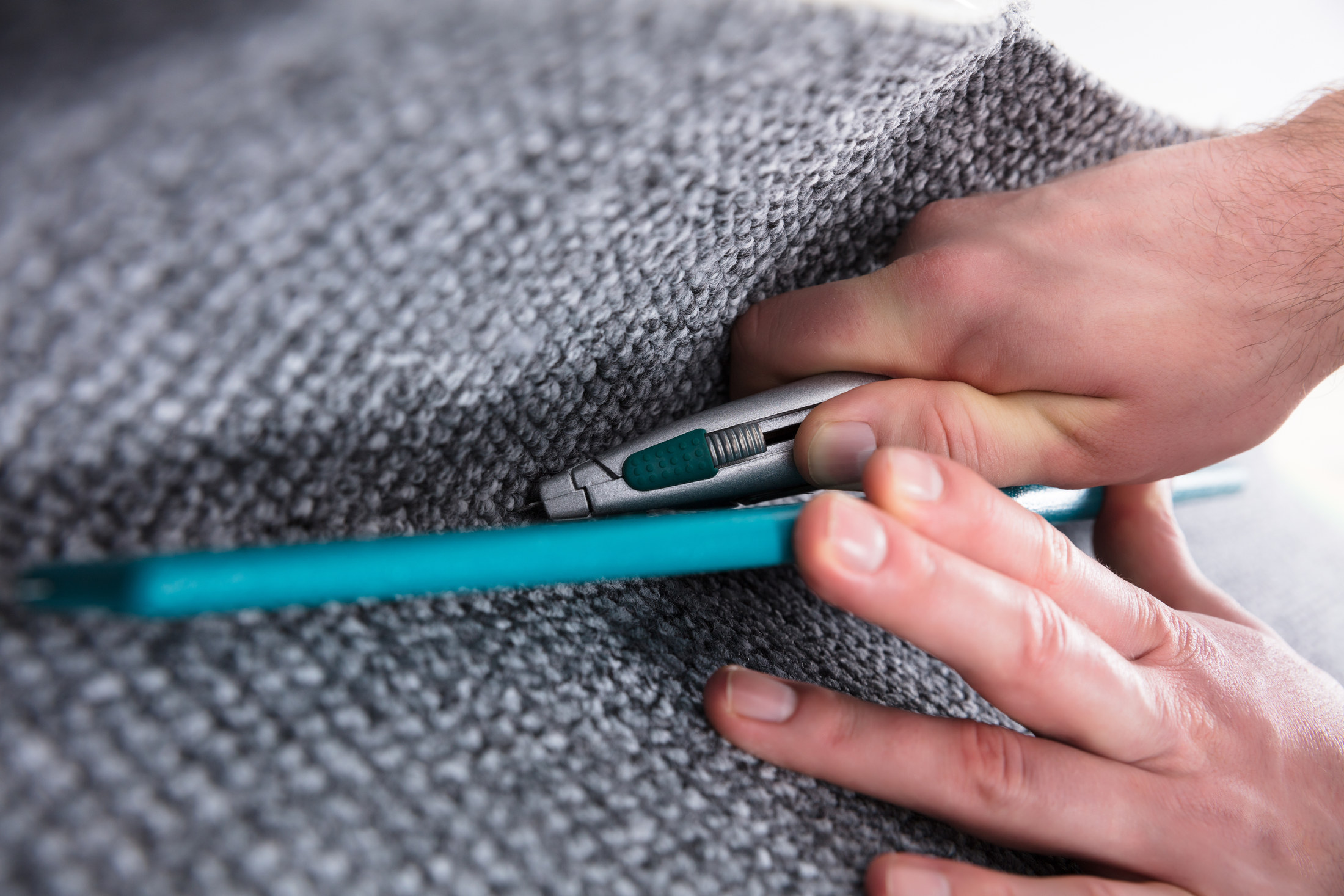
1 hourOnce every wall is hooked and the carpet is tight and flat, trim the excess. Run the knife along the angle between the floor and the skirting, or use a wall trimmer, leaving a little extra to tuck. Push the edge down into the gap between the gripper and the skirting with a tucking tool, as the maker we read recommends, rather than a bolster, which can damage the gripper or the skirting.
- Change the blade every few metres
- Trim a little long; you can always take more off
- Tuck as you go so the carpet does not spring off
Mistake to avoid: Trimming before the carpet is fully stretched. The maker we read is clear: cut nothing until it is properly stretched, or it ends short.
Fit the door bar
20 minutesAt the doorway, mark the line under the closed door, cut the carpet straight along it with a straight edge, and fit the door bar. Seal the cut edge with a little latex or adhesive to stop fraying, as the maker we read suggests for door bars and seams. Press the carpet into the bar's teeth and close the bar's lip over it with a rubber mallet and a block.
- Position the bar under the middle of the closed door
- Use screws suited to the floor below
- Tap the lip down gradually along its length
Mistake to avoid: A ragged cut at the doorway. It frays within weeks and is the part everyone sees.
Rehang doors and finish
30 minutesRehang the doors and check they clear the carpet; if they rub, trim the bottom of the door, not the carpet. Vacuum the new carpet to lift loose fibres; shedding is normal for the first few weeks. Bring the furniture back in carefully, lifting rather than dragging.
- Use furniture cups under heavy legs to spread the load
- Snip any sprouting tufts level with the pile; never pull them
- Keep the offcut for repairs
Mistake to avoid: Dragging a sofa back in. It rucks the carpet off the gripper along one wall.
The mistakes that show
- Gripper fitted tight to the skirting so the edge has nowhere to go
- Reusing old gripper or old underlay
- Overlapping underlay joins into ridges
- Stretching across before along, so ripples set in
- Trimming before the carpet is fully stretched
- A ragged, unsealed edge at the door bar
Stop here and get a carpet fitter
- The job includes stairs, a seam, or a room longer than the maker allows for kicker-only fitting
- It is a woven carpet, which the maker we read says needs an experienced fitter
- There are old tiles or adhesive under the carpet that could contain asbestos
- The subfloor is damp or has damaged boards you cannot fix
| WHAT YOU SEE | WHY, AND THE FIX |
|---|---|
| Ripples or bubbles across the carpet | The carpet was not stretched enough, or was stretched across before along. Unhook one wall, re-stretch with the knee kicker along the length, then the width, and re-hook. Big rooms may need a power stretcher. |
| The carpet has come off the gripper at the skirting | The gripper is too close to the wall, the pins point the wrong way, or the gripper is loose. Lift the edge, refix or reposition the gripper, re-stretch and tuck. |
| A visible gap at the skirting | Trimmed too short. Small gaps can be hidden with a re-stretch from the opposite wall; a big gap needs a new piece or a strip of beading. |
| Frayed edge at the doorway | The cut edge was not sealed or the door bar is not gripping it. Trim it straight, seal it with latex adhesive and refit the bar. |
| Lumps under the carpet | Debris left on the floor, an overlapped underlay join or a staple standing up. Lift the carpet back to that point, fix the cause, re-lay and re-stretch. |
| Shading patches that look darker or lighter | The pile is lying in different directions, which is normal on cut-pile carpets. It is not a fault if all pieces were laid the same way; vacuuming in one direction evens it out. |
| The door will not close over the new carpet | Thicker carpet and underlay than before. Take the door off and trim the bottom with a saw or plane. |
| Dark lines along the skirting after a few months | Draughts blowing up through gaps in a suspended floor carry dust into the carpet. Lining paper under the underlay, as the maker we read advises, prevents it. |
WHAT YOU SAVE
What it costs to do it yourself
| Underlay, one 15 m² roll | €64.99 |
|---|---|
| Gripper, ten lengths | €11 |
| Knee kicker | €42.10 |
| Carpet knife | €17.29 |
| Stair tool or bolster | €16.14 |
| Door bar | €12.29–€16.98 |
| Total, before VAT and the carpet | €164–€169 |
| DIY total | €164–€169 |
Guide prices compiled by the Locufy team from published Irish and UK provider price lists and 2026/27 cost guides. Updated 2026.
Prices before VAT from an Irish flooring supplier's published list, October 2026; VAT at the standard rate is added at the till. The carpet itself is extra. The professional fitting price per square metre, from the price guide, is shown alongside.
RATHER NOT?
Carpet fitters near you, with prices shown
The ones who cover your area, nearest first, with one score from every review. No account needed to look.
Or post the job free and let them come to you.
Old carpet cannot currently be recycled. A small amount can go in the general waste bin; a room's worth should go to a civic amenity or recycling centre, or in a hired skip, as mywaste.ie advises. Old gripper strips are wood waste for the civic amenity site; wrap the pins first.
Vacuum often in the first weeks to lift shedding fibres, and do not worry about tufts: snip them level with scissors.
A new carpet can relax in its first months, especially in a warm room. A ripple can be worked out with the knee kicker by unhooking one wall and re-stretching.
Snap off and safely dispose of used blades, store the kicker dry, and keep a note of the carpet range, colour and batch with the offcut.
Fitting a carpet: questions people ask
Yes, in a single room with no seam, on a sound floor. You need new gripper set back from the wall, taped underlay, a knee kicker to stretch the carpet and a sharp knife. Stairs, seams and woven carpets are better left to a fitter.
Yes. The carpet maker we read recommends new gripper for a new carpet, because old gripper is often damaged, loose or wrongly spaced.
About two-thirds of the carpet's thickness, as the maker we read sets it, with the pins pointing towards the wall.
Better not. Old underlay has flattened and often crumbles; new underlay supports the carpet and helps the pile recover.
For a long room, yes. The carpet maker we read recommends one for any carpet over 5m long. For a smaller room a knee kicker is enough.
The Locufy price guide for Ireland puts carpet fitting at €8–€35 per m², with €18 typical, usually on top of the carpet and underlay.
MORE GUIDES
More DIY guides
Sources — checked October 2026
- Ulster Carpets — retailer fitting guide: new grippers; gap to the wall two-thirds of the carpet's thickness; stairs twice the thickness, 1.5 times where pieces meet; felt and crumb rubber underlay; tape underlay joins; lining paper on suspended floors; start furthest from the door; kicker at 10 degrees; length before width; seal cut edges; power stretcher over 5m; do not cut until stretched; tucking tool
- HSA — Guidance on the Management of Manual Handling in the Workplace (awkward postures, twisting, load held away from the trunk)
- HSA — asbestos information sheet: asbestos can be hidden in any building built or refurbished before 2000
- MyWaste — carpets: currently unrecyclable; small amounts in general waste, larger amounts by skip or to a civic amenity or recycling centre
- MyWaste — wood and timber: to a civic amenity site
- Irish Flooring Products — carpet underlay price check, October 2026: 10mm underlay, 15 sq m, €64.99 before VAT
- Irish Flooring Products — carpet gripper price check, October 2026: €1.10 a 5ft length before VAT
- Irish Flooring Products — carpet stretchers price check, October 2026: knee kicker €42.10 before VAT
- Irish Flooring Products — flooring knives price check, October 2026: €17.29–€19.50 before VAT
- Irish Flooring Products — carpet tucking tools price check, October 2026: stair tool €16.14 before VAT
- Irish Flooring Products — carpet door bars price check, October 2026: €12.29–€16.98 before VAT