HOW TO HIRE · ELECTRICAL · CHECKED OCTOBER 2026
How to hire an electrician to add a socket in the UK
The checks, the questions and the paperwork.
An extra socket usually needs no notification in England. When it does, how to check the electrician, and the certificate it should come with.
- Search and compare — no account needed
- Nearest to you first
- One score from Google, Trustpilot and Locufy reviews
THE 60-SECOND VERSION
Hiring an electrician to add a socket in five steps
- Say where and whyThe room, the wall, what will plug in. A kitchen, bathroom or outdoor socket changes the rules.
- Search the registerBefore you book the new socket in England or Wales, find the business on the Registered Competent Person Electrical register.
- Ask about the circuitWill the new socket go on the existing circuit, or does it need a new one?
- Agree making goodChasing a solid wall leaves a channel; who fills it, and who paints it?
- Get a Minor Works CertificateEven a non-notifiable socket should be tested and certified.
BEFORE YOU BOOK
Check before you book
Registered Competent Person Electrical
In England and Wales, adding a socket to an existing circuit is not notifiable unless it is near a bath or shower — and in Wales, in a kitchen or outdoors; a new circuit is notifiable in both. Where the new socket is notifiable, an electrician on a government-authorised competent person scheme, such as NICEIC or NAPIT, self-certifies it under the Building Regulations; anyone else must notify building control before starting, and you pay for that inspection.
Look up the business name on the register; it takes a minute and should come before the new socket. electricalcompetentperson.co.uk →
Electrical Installation Certificate
When the new socket is added to an existing circuit, it is tested to BS 7671 and recorded on a Minor Works Certificate; a new circuit gets an Electrical Installation Certificate. Notifiable work such as the new socket can bring a compliance certificate from the scheme, which gov.uk expects within 8 weeks in England and the Welsh Government within 30 days in Wales.
Ask for the certificate, with the test results filled in, on the day the new socket is finished. gov.wales →
Building warrant (Scotland) and Northern Ireland
Scottish building standard 4.5 requires the new socket to be wired to BS 7671; there is no competent person register in Scotland, and some jobs, such as a flat rewire, need a building warrant that falls to the owner. In Northern Ireland, the new socket comes under building regulations with no Part P-style notification scheme for home wiring.
In Scotland, check with the electrician or the council whether the new socket needs a warrant, and whether the electrician can certify it as an approved certifier. gov.scot →
Insurance and trader status
For the new socket, a trader should hold public liability insurance; check the insurer and the cover. Trader status matters: it brings the Consumer Rights Act 2015 into play, and under the Consumer Contracts Regulations 2013 an off-premises or online booking usually has 14 days' cancellation, with any work you asked to start early charged for and personalised goods outside the right.
See the insurance certificate before you confirm the new socket; the Locufy profile shows the trader and ID-checked badges.
VAT
Expect 20% VAT, the standard rate, on adding sockets: a business above the £90,000 registration threshold is required to charge it and to show it separately from the labour and materials.
Ask for the VAT number, and look for VAT as its own line on the price per socket. gov.uk →
A good answer: Yes or no, with a reason: a ring or radial with spare capacity, or a new circuit for a heavy load such as a workshop or home office.
A good answer: In England, not unless it is near a bath or shower or on a new circuit; in Wales, add kitchens and outdoors. A good electrician knows which.
A good answer: Yes — the existing circuit is tested before it is extended, so a fault is not passed on to the new socket.
A good answer: A weatherproof socket with RCD protection and suitable cable; in Wales, notifiable work.
A good answer: Yes, with the test results, on the day.
A good answer: A list. USB or metal faceplates cost more; filling a chase is usually included, painting rarely is.
Getting the quote right
- The price per socket, and whether a double counts as one
- Faceplate type — white, metal, USB — named
- Chasing and making good stated
- Minor Works Certificate included
- Who actually attends — the electrician who chases in and wires the sockets, employed or subcontracted — and the business's VAT number, with VAT at 20% shown as its own line
Walk away if
- A spur run off a spur to save a cable run
- No testing of the circuit being extended
- No certificate, 'because it's only a socket'
- An outdoor socket fitted without RCD protection
- Won't say whether the work is notifiable in Wales
What an electrician to add a socket costs: £65–£250 per socket
Extra sockets are priced per socket, with the wall type, the distance from the circuit and the faceplate setting the figure; making good and a certificate should be included. Extra Sockets price guide →
Guide prices compiled by the Locufy team from published Irish and UK provider price lists and 2026/27 cost guides. Updated 2026.
KNOW WHAT TO LOOK FOR? NOW FIND ONE
Electricians near you, with the badges that matter shown
ID checked, trader status and one score from every review — on the card, before you message anyone. Nearest first. No account needed to look.
Or post the job free and let them come to you.
- Plan the routeThe electrician picks the circuit to extend and the cable route to the new socket.
- Isolate and testThe circuit is switched off, proved dead and tested before it is altered.
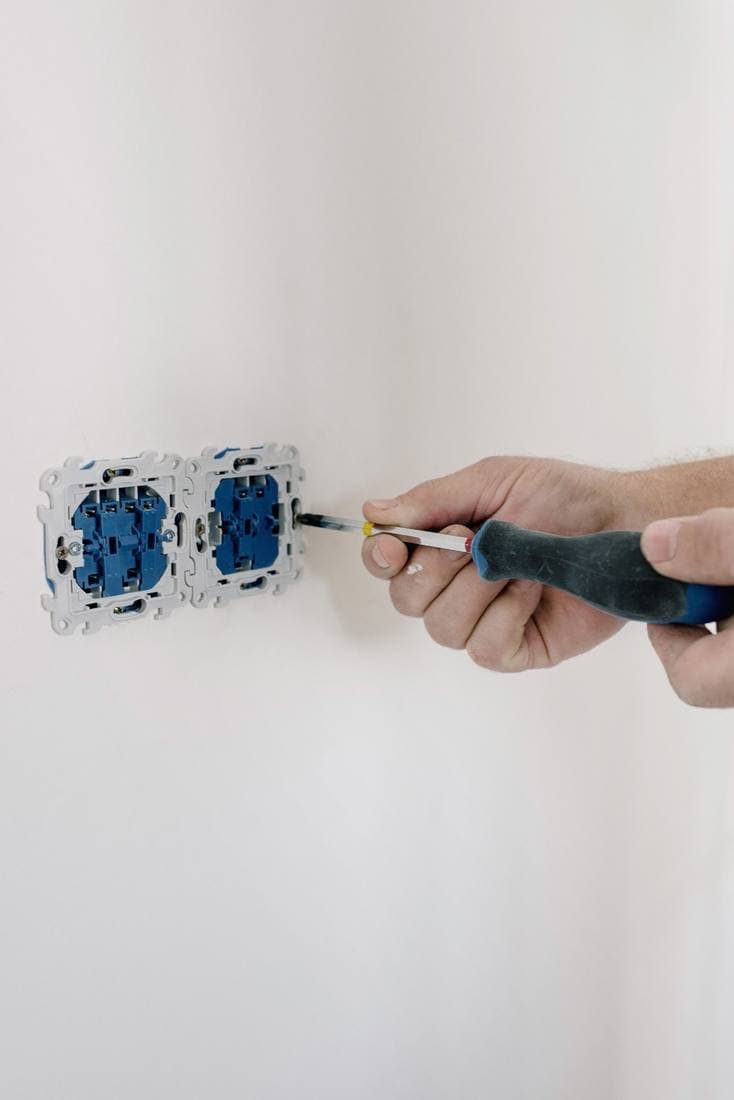
- FitBack box set in the wall, cable run and connected, faceplate fitted.
- TestContinuity, insulation resistance, polarity and earth fault loop impedance, and RCD operation where fitted.
- Certify and tidyMinor Works Certificate handed over, chase filled, dust cleaned up.
- Spur
- A single socket fed off an existing circuit.
- Ring circuit
- A socket circuit wired in a loop.
- Back box
- The box in the wall the socket screws into.
- Fused spur
- A switched, fused outlet for a fixed appliance.
- Minor Works Certificate
- The certificate for an addition to an existing circuit.
- IP rating
- How well an outdoor socket keeps out water and dust.
AFTER
When the job is done
Hiring an electrician to add a socket: questions people ask
Not by law in England for a socket on an existing circuit away from a bath or shower. A new circuit, or in Wales a socket in a kitchen or outdoors, is notifiable and must be self-certified by a scheme electrician or notified to building control.
A Minor Works Certificate with test results, or an Electrical Installation Certificate if a new circuit was installed.
£65–£250 a socket, typically around £120. A swap or a double is the cheap end; new positions, solid walls and outdoor sockets cost more. Use the Extra Sockets price guide to see what pushes a job up or down, and the search above to find electricians in your postcode.
Only outside the zones the wiring regulations set; work near a bath or shower is notifiable in England and Wales.
For occasional use. A permanently overloaded extension is a sign you need another socket.
It is a convenience, priced as a premium faceplate; ask for it on the quote as its own line.
MORE GUIDES
More hiring guides in electrical
Electricians near you
Sources — checked October 2026
- gov.uk — Approved Document P: electrical safety in dwellings (England)
- Registered Competent Person Electrical register
- gov.uk — building work, replacements and repairs to your home (England)
- gov.wales — building regulations: electrics
- gov.scot — Building Standards Technical Handbook 2022 (domestic), standard 4.5 electrical safety
- gov.uk — building regulations: when you do not need approval
- Consumer Rights Act 2015, section 49 — reasonable care and skill
- Consumer Rights Act 2015, section 54 — what you can ask for when a service falls short
- Consumer Contracts Regulations 2013, regulation 30 — the 14-day cancellation period
- Consumer Contracts Regulations 2013, regulation 28 — contracts the cancellation right does not cover
- Consumer Contracts Regulations 2013, regulation 36 — services started within the cancellation period
- Civil Procedure Rules Part 26 — the small claims track limit (England and Wales)
- Scottish Courts and Tribunals — making a claim under simple procedure
- nidirect — the small claims process (Northern Ireland)
- Buildings and construction (VAT Notice 708) — 2.1 Construction services: work to an existing building is normally standard-rated
- GOV.UK — VAT rates
- GOV.UK — Register for VAT: when to register