HOW TO HIRE · VEHICLES & TRANSPORT · CHECKED OCTOBER 2026
How to hire a brake mechanic in the UK
The checks, the questions and the paperwork.
There is no register of mechanics, so a written price, named parts and a road test are what protect you. Here is what to ask and what to keep.
- Search and compare — no account needed
- Nearest to you first
- One score from Google, Trustpilot and Locufy reviews
THE 60-SECOND VERSION
Hiring a brake mechanic in five steps
- Describe the symptomSqueal, grinding, a pull to one side, a soft pedal or a warning light — and when it happens. It tells the mechanic where to look.
- Ask for an inspection firstA proper quote follows a look at pads, discs, calipers and hoses on both axles, not a guess over the phone.
- Get the quote in writingPads or pads and discs, which axle, the parts brand, labour and VAT at 20% — each on its own line.
- Agree a call before extrasSeized calipers or a perished hose may turn up. Ask to be phoned before anything is added to the bill.
- Road test and keep the invoiceThe car should be road-tested before it is handed back, and the invoice should list every part fitted.
BEFORE YOU BOOK
Check before you book
No register applies
There is no licence for brake mechanics, and no register, anywhere in the UK: anyone may work on brakes for a living. The Consumer Rights Act 2015 still requires the job to be done with reasonable care and skill, and that is the standard a court would hold them to.
Agree the work and the price in writing before the car goes on the ramp. citizensadvice.org.uk →
Brakes and the MOT standard
DVSA's MOT inspection manual covers the pads, discs, hoses, calipers and how evenly the car brakes, so a repair should leave the brakes fit to pass. The mechanic needs no licence, but the result is tested at every MOT.
Ask how the brakes would fare at the next MOT; for a test in England, Scotland or Wales, the MOT history shows which parts failed or had minor problems before. gov.uk →
The Motor Ombudsman accreditation
Accreditation to The Motor Ombudsman is a voluntary code, not a licence. Its value for a brake mechanic is the dispute route: the Ombudsman steps in once the accredited business has had eight weeks to put things right, and a final decision you accept is binding on it.
Search the business name on The Motor Ombudsman's Garage Finder. businesses.themotorombudsman.org →
Price and extra work in writing
With no fixed price, the Consumer Rights Act 2015 entitles you to pay only a reasonable amount for the brake mechanic. Citizens Advice notes that a garage can hold on to the vehicle during a dispute over the bill, but has no right to sell it.
Ask for the quote in writing and a phone call before anything is added. citizensadvice.org.uk →
VAT
Brake parts and labour are standard-rated at 20%. Brake mechanics over the £90,000 registration threshold have to charge VAT and list it separately from the price.
Ask the garage for its VAT number and check the 20% under parts and labour. gov.uk →
A good answer: A clear answer per axle, ideally with the disc thickness measured or a photo. "Everything needs doing" with no detail is a sales pitch.
A good answer: A named brand and whether it is original equipment or an equivalent. The cheapest quote is often the cheapest pad.
A good answer: Fluid has a change interval in the service schedule. A good mechanic tells you if it is due and prices it separately.
A good answer: Yes — a sticking caliper or a perished hose is why new pads wear unevenly. They should say what they find before fixing it.
A good answer: Yes, always. New pads and discs need a careful bedding-in, and the mechanic should explain how to drive for the first miles.
A good answer: A period or mileage in writing on the invoice, for both the parts and the fitting.
A good answer: "Of course." Worn pads and scored discs are the proof the work was needed.
Getting the quote right
- Which axle — front, rear or both — and what is replaced on each
- The parts named: pad and disc brand, and whether sensors or fitting kits are included
- Labour shown separately from parts
- The garage's VAT number, with VAT on its own line under parts and labour
- Brake fluid change, if recommended, as its own line
- What happens if a caliper or hose is found seized or perished, and a promise to call first
- The guarantee on parts and workmanship
- Who actually attends to the brakes — the garage's technician, employed or subcontracted
Walk away if
- A price for "brakes" with no mention of which axle or which parts
- Pressure to replace discs that measure within limits
- No road test, or the car handed back with the warning light still on
- Refusing to show you the old pads and discs
- Cash only, with no invoice listing the parts
What a brake mechanic costs: £100–£500 per job
Brake work is quoted by the job and by the axle — pads alone, or pads and discs — with parts and labour on separate lines. Brake Repair price guide →
Guide prices compiled by the Locufy team from published Irish and UK provider price lists and 2026/27 cost guides. Updated 2026.
KNOW WHAT TO LOOK FOR? NOW FIND ONE
Brake mechanics near you, with the badges that matter shown
ID checked, trader status and one score from every review — on the card, before you message anyone. Nearest first. No account needed to look.
Or post the job free and let them come to you.
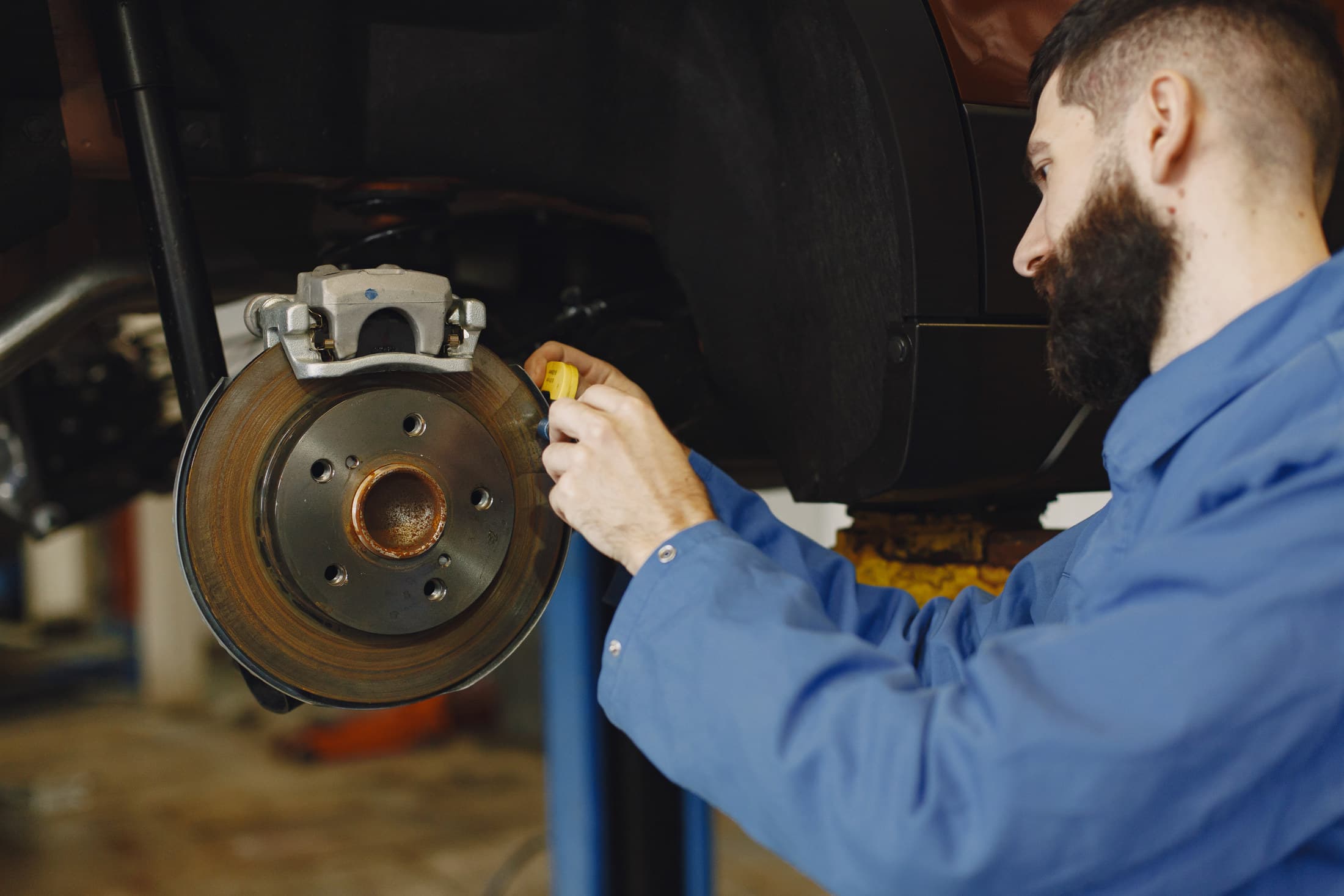
- InspectWheels off, pads and discs measured, calipers, hoses and fluid checked on both axles. You get the findings before the price is final.
- AgreeThe quote is confirmed in writing — which parts, which axle, what it costs — and any extra work waits for your yes.
- ReplaceOld pads and discs removed, hubs cleaned of rust, sliders cleaned and lubricated, new parts fitted to the maker's torque settings.
- CheckPedal pressure, fluid level and the handbrake checked; the warning light cleared if a sensor was replaced.
- Road test and handoverThe car is driven to confirm even braking, and you are told how to bed in the new pads.
- Pads
- The friction blocks that press on the disc; they wear first and are the most common replacement.
- Discs (rotors)
- The metal plates the pads grip; replaced when worn below the minimum thickness or badly scored.
- Caliper
- The clamp that pushes the pads on to the disc; a sticking one causes uneven wear and a pull.
- Bedding in
- The first gentle miles that let new pads and discs mate properly.
- Brake fluid
- The hydraulic fluid that transfers pedal pressure; it absorbs water and is changed on a schedule.
- Advisory
- An MOT note that something is wearing but not yet a fail — often the first sign brakes are due.
AFTER
When the job is done
Hiring a brake mechanic: questions people ask
No. There is no licence or register for mechanics anywhere in the UK, so anyone may repair brakes. What protects you is the Consumer Rights Act 2015, which requires the work to be done with reasonable care and skill, plus a written quote and invoice.
An itemised invoice naming the pads, discs and any other parts, the labour, the mileage and the guarantee. There is no certificate for brake work; the next MOT is where the brakes are formally tested.
It depends on the disc thickness and condition. Discs worn below the maker's minimum or badly scored are replaced with the pads; healthy discs are not. Ask for the measurement.
Usually £100–£500 per job, with £200 as a typical figure. See the brake repair price guide for what pushes a price up or down, and search above for brake mechanics in your area.
A squeal can be a wear indicator, and grinding usually means metal on metal. Book an inspection soon; if the pedal is soft or the car pulls hard, do not drive it.
Go back to the mechanic in writing first. Under the Consumer Rights Act 2015 you can ask for the work to be redone at their cost or for a price reduction if it was not done with reasonable care and skill.
MORE GUIDES
More hiring guides in vehicles & transport
Brake mechanics near you
Sources — checked October 2026
- Citizens Advice — problems with a car repair
- The Motor Ombudsman — Garage Finder
- Consumer Rights Act 2015, section 49 — reasonable care and skill
- gov.uk — MOT inspection manual: brakes
- gov.uk — check the MOT history of a vehicle
- gov.uk — make a court claim for money: court fees
- mygov.scot — make a court claim for money
- nidirect — small claims process
- VAT rates — VAT rates for goods and services: standard rate 20% on most goods and services
- GOV.UK — Register for VAT: when to register