DIY GUIDE · GARDEN & OUTDOOR · CHECKED OCTOBER 2026
How to prune a small tree yourself
An afternoon per small tree. £67–£91 in hand tools you keep.
Protection checks, timing, the right cut, and where pruning from the ground stops.
- Every step, start to finish
- Checked October 2026 — sources at the end
- Honest about when to call a pro
FIRST, THE HONEST ANSWER
Do it yourself, or get a gardener?
Do it yourself if…
- You can reach every branch you want to cut with your feet on the ground, using hand tools or a pole pruner
- The branches are thin enough for secateurs, loppers or a hand pruning saw
- You have checked the tree has no tree preservation order and is not in a conservation area, or have given notice
- The tree is healthy, and the aim is shape, light and fruit rather than making it safe
Get a pro if…
- Any cut is above your reach from the ground, or you would need a ladder against the tree
- A branch is thicker than your pruning saw can handle comfortably, or anything suggests a chainsaw
- The tree is near a power line, a building, a road or a neighbour's property where a falling branch matters
- The tree looks diseased, cracked, hollow or unstable, or is leaning more than it did
Safety first
- Stay on the ground. HSE does not allow chainsaw use off the ground by anyone without training in safe working techniques in safe working techniques, and that aerial tree work needs at least two people with one ready to rescue; a garden ladder and a saw is the worst version of that job.
- Do not use a chainsaw for pruning unless you are trained and wearing the protective clothing HSE says the law requires of operators.
- Wear safety glasses and gloves, and a hard hat if you are cutting with a pole pruner; offcuts fall straight down onto the person cutting.
- Keep everyone, children and pets especially, out of the drop zone under the branch you are cutting.
- Look up before every cut for power lines, phone lines and other branches the falling piece could catch and swing.
- Never stand directly under a branch you are cutting with a pole pruner; stand to one side and cut at an angle.
Stop here: Ladders, chainsaws, climbing and protected trees
Pruning from a ladder or in the crown is work at height, and HSE does not allow chainsaw use off the ground by anyone without training in safe working techniques, with a minimum of two people present for aerial work. A tree with a tree preservation order needs the council's consent before it is pruned, and a tree in a conservation area needs six weeks' notice to the council first, in England, Wales, Scotland and Northern Ireland, though the small-tree exemptions differ by nation. Nests are protected under the Wildlife and Countryside Act 1981 in Great Britain and the Wildlife (Northern Ireland) Order 1985. How to hire a tree pruning specialist →
| MATERIAL | COVERAGE | FOR THIS JOB |
|---|---|---|
| Garden waste sacks | Reusable heavy-duty bags | Two or three for a small tree |
| Mulch | Compost or bark | A ring round the base after pruning helps a stressed tree |
| Tree ties and a stake | Only for a young tree that needs support | Check ties are not cutting into the bark |
How much to take off
Remove no more than about a quarter of the leafy crown in one year. Count the main branches, decide which to remove whole, and shorten the rest. A small apple tree with twelve main shoots worth shortening needs about three removed or reduced this year and the rest left until next winter.
This is a rule of thumb, not a law: a young tree in formative pruning may take more, an old one less. If the plan needs more than a quarter, spread it over two or three years.
Bypass blades pass each other like scissors and leave a clean cut on live stems up to about finger thickness. Anvil secateurs crush; keep them for dead wood. Sharp blades matter more than brand.
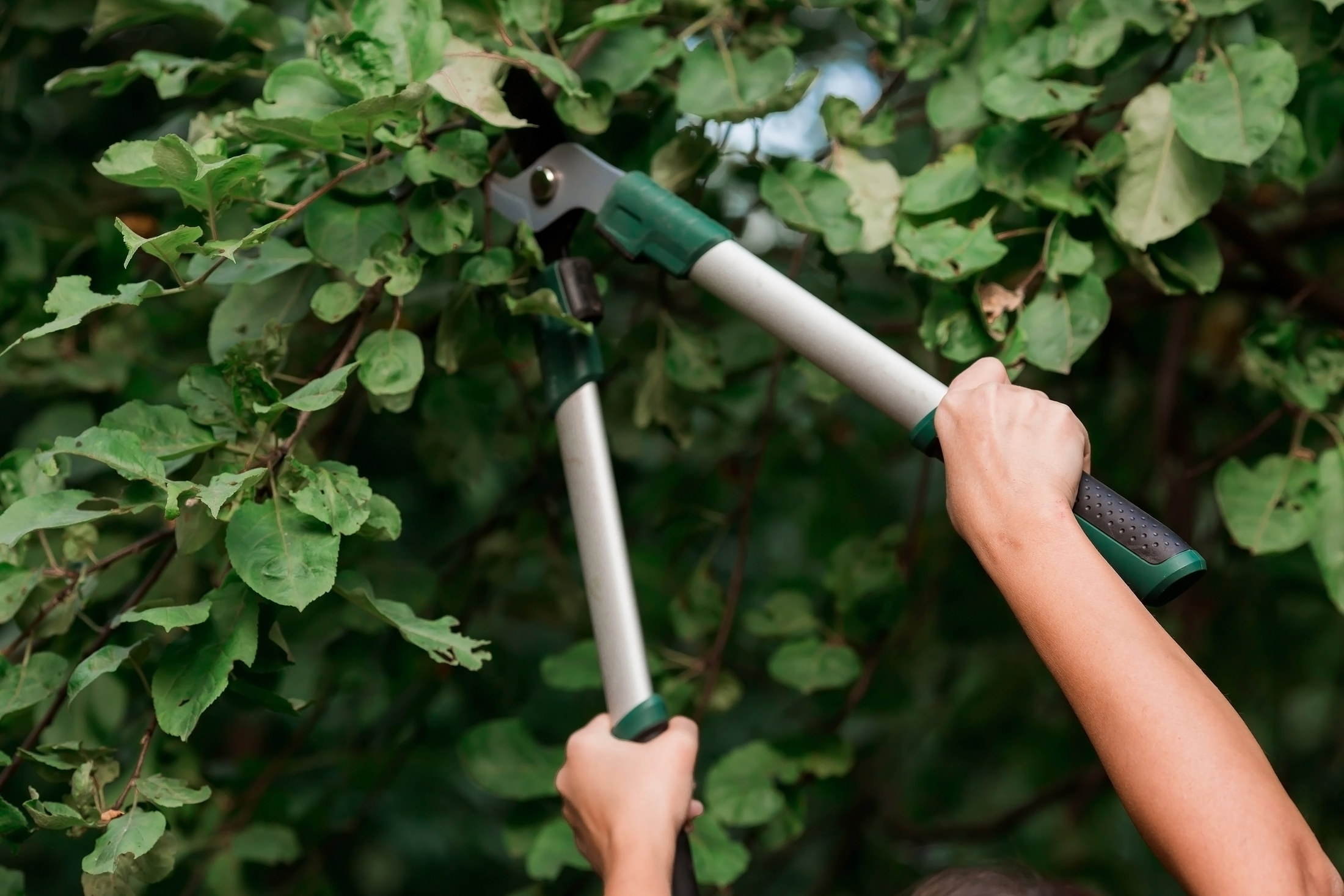
Long-handled loppers give the leverage for stems a little thicker than secateurs can take. If you have to strain or twist them to finish the cut, the branch is a job for the saw.
A curved, pull-cut pruning saw cuts on the draw stroke and gives a clean face. It is the right tool for anything thicker than loppers, and the key to the three-cut method below.
A telescopic pole pruner, with a hook blade or a small saw head, cuts a little above head height from the ground. It is slower than a ladder and that is the point: it keeps your feet on the ground.
Apples and pears are pruned in the dormant season, roughly November to April. Stone fruit such as cherries and plums are pruned in summer, after fruiting, which lowers the risk of the silver leaf and canker diseases they suffer. Avoid any hard pruning in the nesting season.
THE PART THAT DECIDES THE FINISH
Before you cut — by the tree you have
The tree decides the timing and the cut. Find yours, and do the checks before the first branch comes off.
Apple or pear tree
Pruned in winter for shape and fruit.
- Prune between late autumn and early spring, while the tree is dormant
- Take out dead, diseased and crossing branches first
- Aim for an open centre or a central leader with three or four main branches
- Shorten the year's long shoots by up to a third, cutting just beyond an outward-facing bud
Cherry, plum or other stone fruit
Pruned in summer, not winter.
- Wait until after fruiting, in dry weather
- Keep cuts to the minimum; these trees resent heavy pruning
- Remove crossing and damaged branches and any vigorous upright shoots
- Never prune in winter, when the wounds stay open longest to disease
A young tree, first few years
Formative pruning sets the shape for life.
- Choose the leader and three or four main branches spread well round the trunk
- Remove competing leaders and shoots growing straight into the centre
- Prune lightly each year rather than heavily once
- Remove suckers from the base and the rootstock as soon as they appear
An ornamental tree
Cherry, birch, rowan, maple and similar.
- Most need little more than dead, damaged and crossing wood removed
- Prune maples and birches in late summer or autumn to avoid heavy sap bleeding
- Lift the crown by removing a low branch at the collar rather than shortening many
- Leave the natural shape; topping a tree ruins it and creates weak regrowth
A protected tree, or one in a conservation area
Check before any work at all.
- Ask your council whether the tree has a tree preservation order
- If it has, you need the council's consent before pruning, in every nation
- In a conservation area, give the council six weeks' notice unless the tree is below the small-tree size
- Dead or dangerous branches still need notice in most cases; ask first
THE JOB
How to prune a small tree, in order
Check protection, nests and timing
20 minDo the checks above for your tree. Ask the council about any tree preservation order or conservation area, look through the crown for nests, and confirm this is the right season for your tree. If any answer is wrong, wait; a tree is pruned once a year and a month makes no difference.
- A council answers protected-tree questions by phone or online, usually quickly
- Watch the tree for birds before you start, especially from March to September
- Write down which tree is which species if you are unsure; the timing depends on it
Mistake to avoid: Pruning a cherry in winter or a protected tree without consent. One invites disease, the other a prosecution.
Stand back and plan the cuts
15 minWalk round the tree twice and look at it from a distance. Mark, mentally or with a twist of string, the dead, diseased and damaged branches, then any that cross and rub, then any growing into the centre. Those are the first cuts. Only after that decide what to shorten for shape.
- Dead wood first is always right, in any season
- Crossing branches rub bark off each other and let disease in; keep the better-placed one
- Leave a branch if you are not sure; you can take it next year
Mistake to avoid: Starting at one side and cutting your way round. You end up with a lopsided tree and no plan.
Make small cuts to a bud
30 minFor shoots you are shortening, cut with secateurs just beyond a bud that faces outwards, about 1–3 cm above it, sloping away from the bud. The bud becomes the new tip and grows in the direction it faces, so an outward bud opens the tree up. Position the thin blade on the side of the stem you keep.
- An outward-facing bud steers growth away from the crowded centre
- A sloping cut sheds rain away from the bud
- Too far above the bud leaves a stub that dies back; too close damages the bud
Mistake to avoid: Cutting midway between buds. The stub above the bud dies, and rot starts there.
Remove whole branches at the collar
30 minWhen a branch is coming off entirely, cut it back to where it joins the trunk or a larger branch, just outside the slightly swollen collar at its base. Do not cut flush with the trunk, and do not leave a stub. The collar holds the tissue that closes the wound, and cutting into it or beyond it stops that happening.
- Look for the raised ring or ridge of bark where the branch meets the trunk
- Angle the saw so the cut follows the outside edge of the collar
- Make the final cut with the saw, not loppers, on anything thick
Mistake to avoid: A flush cut into the trunk. It leaves a wound the tree cannot close, and rot gets into the heartwood.
Use three cuts for any heavy branch
20 minFor a branch heavy enough to tear as it falls, cut it in stages. First, a short undercut from below about a hand's width out from where you want the final cut. Second, a top cut a little further out, which drops the branch cleanly. Third, the final cut at the collar on the short stub that remains.
- The undercut is what stops the bark tearing down the trunk
- Keep the undercut shallow, about a quarter of the way through
- Hold the stub with your free hand for the last cut so it does not drop and tear
Mistake to avoid: One cut from the top at the collar. The branch's weight snaps it before you finish and peels a strip of bark down the trunk.
Reach higher with the pole pruner
30 minFor branches a little above head height, use the pole pruner from the ground. Stand to the side of the branch rather than under it, hook the blade over the stem or start the saw head on the underside, and cut with steady strokes. Let the piece fall clear and look up before the next cut.
- Extend the pole only as far as you need; it gets heavy and harder to control
- Cut small pieces from the end first rather than a large branch in one
- Wear the hard hat and glasses for every overhead cut
Mistake to avoid: Standing directly under the branch to get a straight pull. The offcut lands on you.
Remove suckers and water shoots
15 minPull or cut off suckers from the base and the roots, and the thin vertical water shoots that sprout on the trunk and main branches after pruning. On a grafted fruit tree, suckers from the rootstock steal energy from the fruiting part. Cut them as close to their origin as you can.
- Pull young suckers off with a downward tug when they are soft; it removes the buds at the base
- Thin water shoots rather than removing every one on an old tree
- Do this in summer too; that is when they grow
Mistake to avoid: Leaving rootstock suckers to grow. In a few years they take over and the tree fruits poorly.
Stand back and stop
10 minWalk away from the tree and look again before making any more cuts. Pruning is easy to overdo: once the dead, damaged, crossing and inward branches are gone, the tree may need very little else. Stop when the crown looks open and balanced, even if you planned more.
- Compare the tree to how it looked in your planning walk
- Leave anything you are unsure about until next season
- Photograph it to compare next year
Mistake to avoid: Taking off more than a quarter of the crown. The tree answers with a thicket of weak, upright shoots next summer.
Clear up and clean the tools
20 minGather offcuts, especially any diseased wood, and bag them separately. Wipe the blades with a cloth and disinfectant before moving to another tree, then clean off sap, dry and lightly oil them. Keep secateurs sharp; a clean cut is half the job.
- Diseased wood should not go on your own compost heap
- Fold the saw blade away and store tools dry
- Sharpen secateurs at the end of each season
Mistake to avoid: Moving from a cankered tree to a healthy one with dirty blades. You carry the disease with you.
The cuts that damage a tree
- Leaving stubs, which die back and rot
- Cutting flush with the trunk, into the collar
- One heavy cut that tears the bark down the trunk
- Pruning stone fruit in winter, or any tree too hard in one go
Stop here and get a tree pruning specialist
- Any cut needs a ladder, a climb or a mobile platform
- A branch is too thick for a hand saw, or the job needs a chainsaw
- The tree is close to a power line, a house, a road or a neighbour's property
- The tree is cracked, hollow, leaning, or shows fungus at the base
| WHAT YOU SEE | WHY, AND THE FIX |
|---|---|
| Lots of thin vertical shoots after pruning | Water shoots, the tree's reply to too much pruning. Thin them out in summer rather than cutting them all, and prune more lightly next year. |
| Torn bark below a cut | The branch fell before the cut was finished. Trim the torn bark back to firm edges with a sharp knife; next time use the three-cut method. |
| Dead stub where you cut | The cut was too far above a bud or outside the collar. Cut the stub back to the next live bud or to the collar in the right season. |
| Sap pouring from the cuts | Some trees, maples and birches especially, bleed heavily in late winter and spring. It rarely harms them; prune these in late summer or autumn instead. |
| Fruit tree not fruiting after pruning | Fruiting spurs or tips were cut off. Many apples fruit on short spurs; prune long shoots and leave the spurs. |
| Oozing, sunken patches on the bark | Often canker, which enters through wounds. Cut out affected wood back to healthy tissue in dry weather and clean your tools; on stone fruit, prune only in summer. |
| Silvery sheen on plum or cherry leaves | A sign of silver leaf, which enters through winter pruning wounds. Prune stone fruit only in summer, and cut out affected branches. |
| Tree looks lopsided | Too much off one side. Leave that side alone next year and shape the other; trees rebalance over a few seasons. |
WHAT YOU SAVE
What it costs to do it yourself
| Bypass secateurs | £14–£17 |
|---|---|
| Loppers | £19–£37 |
| Folding pruning saw | £9 |
| Long-reach pruner | £21 |
| Safety glasses | £2 |
| Gloves | £2–£5 |
| Total, first time | £67–£91 |
| DIY total | £67–£91 |
Guide prices compiled by the Locufy team from published Irish and UK provider price lists and 2026/27 cost guides. Updated 2026.
These are tools you keep for years. A specialist's price is per tree and climbs quickly with height and access, which is exactly the part this guide hands over.
RATHER NOT?
Tree pruning specialists near you, with prices shown
The ones who cover your area, nearest first, with one score from every review. No account needed to look.
Or post the job free and let them come to you.
A ring of mulch round the base, clear of the trunk, and a deep watering in a dry spell help a pruned tree recover.
Shred or compost healthy wood; put diseased wood in the council's garden waste collection or take it to the household waste recycling centre rather than your own compost heap.
A good cut grows a ring of callus from the edges within a season or two; anything oozing or sinking is worth a second look.
Clean off sap, dry, oil, and sharpen once a season; store secateurs closed and the saw folded.
Pruning a small garden tree: questions people ask
It depends on the tree. Apples and pears are pruned while dormant, roughly November to April; cherries and plums after fruiting in summer; maples and birches in late summer or autumn. Avoid hard pruning in the nesting season.
Only if it is protected. A tree with a tree preservation order needs the council's consent, and a tree in a conservation area needs six weeks' notice to the council, in every UK nation. Ask the council if you are not sure.
Generally not. A clean cut just outside the branch collar is what lets the tree close the wound; sealants can trap moisture.
As a rule of thumb, no more than about a quarter of the crown in a year. More than that and the tree responds with a mass of weak, upright shoots.
It is the job this guide stops at. A ladder against a tree and a saw in your hand leaves no hand for the ladder, and HSE treats aerial tree work as a trained, two-person job. Use a pole pruner from the ground, or get it done.
The Locufy UK price guide puts tree pruning at £120–£750 per tree, typically £300. Height, access and waste removal move the price most.
MORE GUIDES
More DIY guides
Sources — checked October 2026
- HSE — aerial tree work: no chainsaw off the ground without training; two people minimum
- HSE — working with chainsaws
- STIHL — how to prune fruit trees: timing, buds, branch removal in stages
- GOV.UK — tree preservation orders and trees in conservation areas (England)
- nidirect — tree preservation (Northern Ireland)
- Wildlife and Countryside Act 1981, section 1
- Wildlife (Northern Ireland) Order 1985, article 4
- GOV.UK — dispose of garden waste
- Wickes — price check: secateurs
- Wickes — price check: loppers and long-reach pruners
- Wickes — price check: pruning saws
- Wickes — price check: safety glasses
- Wickes — price check: gardening gloves