DIY GUIDE · CLEANING · CHECKED OCTOBER 2026
How to clean solar panels from the ground yourself
An hour or two. £20–£90 in kit, depending on how far the pole has to reach.
Soft water, a soft brush, a cool hour and both feet on the ground — the makers' cleaning rules for panels you can reach.
- Every step, start to finish
- Checked October 2026 — sources at the end
- Honest about when to call a pro
FIRST, THE HONEST ANSWER
Do it yourself, or get a cleaner?
Do it yourself if…
- The panels are ground-mounted, or on a shed, carport, garden room or porch roof you can reach with a pole while standing on the ground
- The glass and frames are undamaged, and every cable you can see is intact and clipped up
- You have a soft brush that will reach the far edge of the array without stretching or climbing
- You can work in the cool of the morning or evening, not in full midday sun
Get a pro if…
- The panels are on the house roof — reaching them is roof work at height, whatever the pole length
- Any panel is cracked, scorched, delaminating or has loose or damaged cabling
- Output has dropped sharply even after rain, which points to a fault rather than dirt
- The dirt is bird mess or lichen that a soft brush and water will not shift without scrubbing
Safety first
- Keep both feet on the ground. Do not climb onto an outbuilding roof or stand a ladder against a panel or its frame to reach it.
- Module makers warn that a cracked or damaged panel is a shock hazard, and that the risk rises when it is wet. Look first; if anything is broken, do not wet it.
- Never touch the cables, connectors, junction boxes or the isolator during cleaning, and never open anything electrical. Faults are for the installer.
- Do not use a pressure washer. One maker caps water pressure at 40 bar and another at 35 bar at the nozzle, and a domestic jet can exceed both.
- Clean in the cool part of the day with water near the air temperature; cold water on sun-heated glass risks thermal shock and cracking.
- Use a non-conductive pole and brush, and keep the pole well clear of any overhead power line.
Stop here: Roof-mounted panels, damaged panels and anything electrical
Panels on a house roof can only be reached by working at height on or beside the roof. HSE's work at height guidance expects that kind of work to be planned with the right equipment and done by competent people — it is not a ladder-and-pole job for a householder, and a fall from a roof edge is often fatal. The second danger is electrical: module makers warn that panels generate a lethal voltage in daylight and that cracked or damaged modules carry a shock risk, worse when wet. Never touch cables, connectors or isolators, and leave any fault to an installer. How to hire a solar panel cleaner →
| MATERIAL | COVERAGE | FOR THIS JOB |
|---|---|---|
| Clean water | Low-mineral, near neutral; rainwater or purified water is ideal | A few buckets for a small array |
| Mild non-abrasive detergent (optional) | Only for greasy film; rinse completely | A few drops per bucket |
| Purified water (optional) | From a filter unit or bought in | Avoids spotting in hard-water areas |
How much pole you need
Pole length = the distance from where you stand to the top edge of the array, plus a margin so the pole is not at full stretch. For a carport array whose top edge is 3 m up and 2 m back from where you can stand, the reach is about √(3² + 2²) = 3.6 m, so choose a pole that extends to at least 4.5 m.
If the sum says you would need to lean, stand on something or go higher, the panels are outside this guide.
One maker's manual says that panels tilted at 15° or more generally may not need cleaning, because rain does it. Clean when you can see a film, a crust or bird mess, or when output on bright days has dropped compared with the same weeks last year. Do not clean on a schedule for its own sake — every clean is a chance to scratch.
The makers ask for low-mineral water with a pH close to neutral, about 6 to 8. Tap water in a soft-water area is fine. In a hard-water area, tap water leaves white spots as it dries, so either rinse with purified water from a water-fed pole system or squeegee the glass dry.
A soft-bristled brush, a soft sponge or a microfibre cloth. The makers are specific that dirt must never be scraped or rubbed away dry, because it leaves micro-scratches in the coating. Check that the brush is non-abrasive to glass, rubber seals and aluminium frames, and non-conductive.
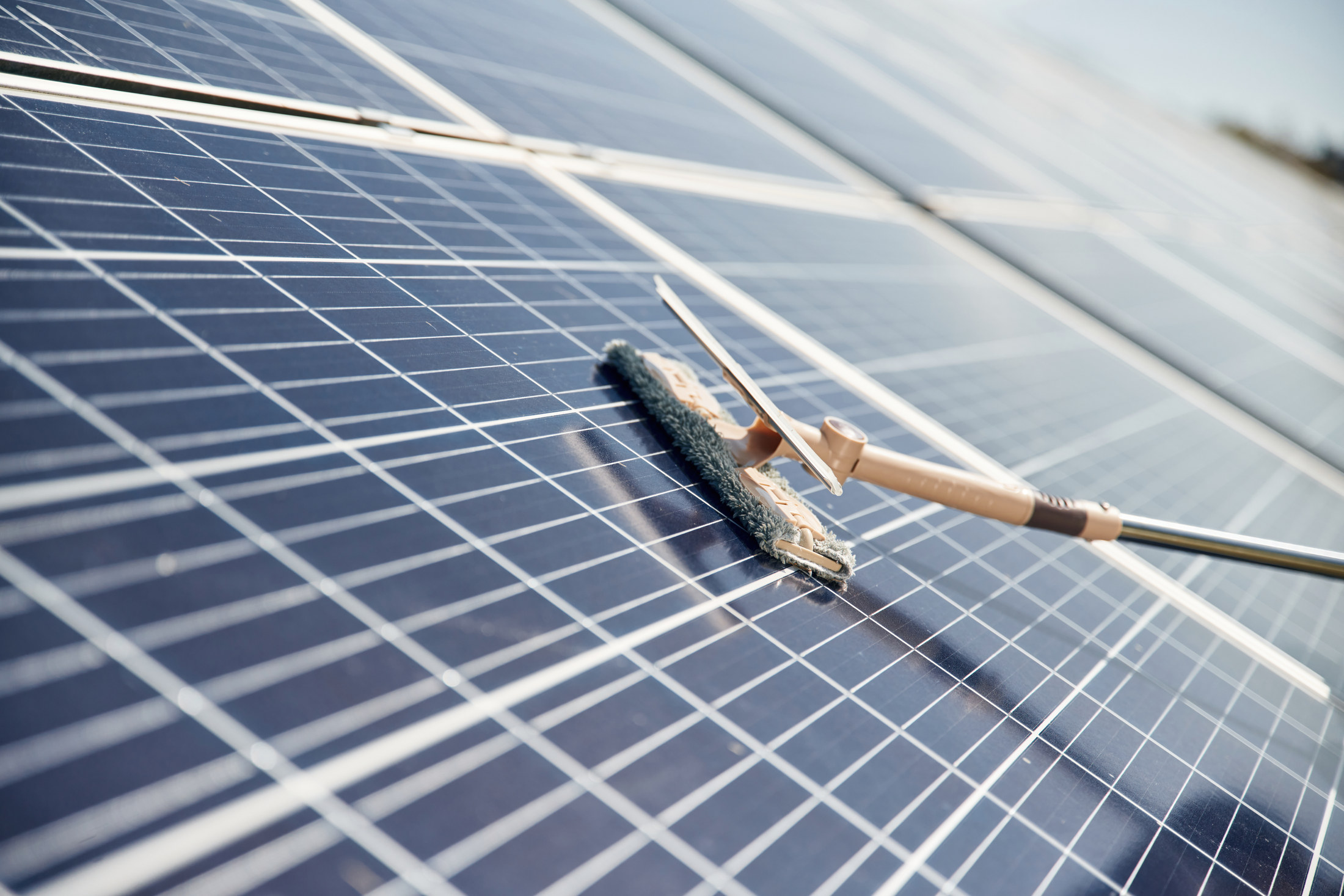
An extending pole lets you reach across the panel without leaning on it. Measure from where you will stand to the far top edge of the array and add a little; a pole at full stretch flexes and is hard to control. A water-fed pole kit pumps water through the brush head, so you wash and rinse in one.
Water and a soft brush shift most dirt. For greasy film, one maker allows a mild, non-abrasive, non-caustic detergent; both prohibit abrasive cleaners, degreasers and acid or alkali products. Washing-up liquid can leave a film if it is not rinsed away completely, so if you use any, use very little and rinse well.
Early morning, evening or an overcast day, when the panels are cool and producing least. Cleaning in the hottest hours stresses the glass and dries water into spots before you can rinse it.
THE PART THAT DECIDES THE FINISH
Before you start — the array and the ground
Find your array below. If it is not one of the ground-reachable cases, this guide is not for it.
Ground-mounted array in the garden
The easiest case.
- Walk round it and look at every panel for cracks, chips, scorch marks or lifting edges
- Look underneath for cables hanging loose or chewed by animals; if you find any, stop
- Clear long grass and plants from the front edge so water drains away
- Note where you will stand for each panel so the pole never has to be at full stretch
Panels on a shed, carport or garden room roof
Reachable from the ground on most single-storey outbuildings.
- Check you can reach the top edge with the pole from the ground without leaning on the building
- Do not use the roof, the gutter or the panel frame as a support for anything
- Look at the roof covering at the same time — the panels are only as sound as what holds them
- If the top row is out of reach, clean what you can and leave the rest
Light dust and pollen
The usual film in spring and summer.
- Try a soft brush on a pole with no water first; one maker allows dry brushing for dust and sand
- Brush gently from top to bottom in one direction
- If it smears, stop and switch to wet cleaning — dry rubbing on a film scratches
- Leave it if it rinses off in the next rain
Bird droppings, insects or sap
Under trees, wires and roosts.
- Soak the marks with plenty of water and let them soften before touching them
- Lift them with a soft sponge or microfibre; do not scrape
- Rinse straight away with plenty of water, as the makers advise
- Repeat the soak rather than pressing harder
Lichen, moss or a hard crust at the frame edge
Usually on shallow, shaded arrays.
- Do not pick at it with a blade or a scraper — the edge seal and the frame coating are easily damaged
- Soak it, brush gently, and accept what will not come off
- A heavy growth that covers the cells is a job for a specialist cleaner
- Check whether the panel's bottom edge sits in standing water; that is where growth starts
Panels on the house roof
Stop here.
- Do not use a ladder against the house or a roof ladder to reach them
- A long pole from the ground at two storeys is hard to control and cannot be pressed lightly enough
- Look at them from a window or with binoculars to decide whether they need cleaning at all
- If they do, hire a cleaner who works from the ground with purified water or with proper roof access
THE JOB
How to clean ground-reachable panels, in order
Check the panels and choose the hour
15 minInspect every panel and every visible cable from the ground, using a phone camera on zoom for the upper row. Look for cracks, chips, burn marks, bubbles under the glass and loose wiring. If anything is damaged, stop: makers warn that wet damaged panels are a shock hazard. If all is sound, plan to clean early in the morning or in the evening, when the glass is cool.
- Feel the frame edge with the back of your hand; if it is hot, wait
- Photograph the panels before you start so you can compare
- Note your inverter's output reading for the day, for a later comparison
Mistake to avoid: Cleaning a panel with a hairline crack. Water gets into the crack and the panel becomes a shock risk.
Set up where you will stand
10 minClear the ground in front of the array and check it is firm and level where you will stand. Extend the pole to the length you worked out and lock each section. Fill the bucket with clean water at air temperature, or connect the water-fed pole. Keep the hose on a gentle flow.
- Stand on paving or firm grass, never on a step, a wall or a box
- Lock every pole section and test it before it goes near the glass
- Water from a hose that has been sitting in the sun is hot — run it until it is cool
Mistake to avoid: Standing on something to gain reach. That turns a ground job into a fall.
Dry-brush the loose dust
10 minWith no water, brush lightly from the top edge of each panel downwards in one direction to lift loose dust, leaves and pollen. Use the weight of the brush, not pressure. If the dust smears instead of lifting, stop and go on to wet cleaning.
- One direction only — scrubbing back and forth drags grit
- Knock the brush head out away from the panels between passes
- Leaves lodged at the bottom edge can be lifted off by hand on low panels
Mistake to avoid: Dry-scrubbing a stuck film. Every maker warns this causes micro-scratches in the coating.
Wet the glass thoroughly
5 minWet each panel generously from the top so water runs down the whole surface. Give the water a minute or two to soften dried dirt and droppings. On a water-fed pole, let water flow through the brush and hold it on the glass without moving it.
- Plenty of water does the work so the brush does not have to
- Wet the next panel while you wash this one
- Keep water off the junction box and cable entries on the back
Mistake to avoid: Using a jet or a pressure washer to save time. High pressure can push water past the seals and damage the module.
Wash with the soft brush
15 minMove the wet brush gently down the panel from top to bottom in overlapping strips, letting the bristles carry the dirt down to the bottom edge. Keep the pole angle low so you are stroking, not pressing. Rinse the brush in the bucket after each panel.
- Light strokes — if the pole bends, you are pressing
- Change the bucket water when it turns cloudy
- Work panel by panel, top row first
Mistake to avoid: Leaning on the pole for extra pressure. It loads the glass in one spot and can cause micro-cracks in the cells beneath.
Treat the stubborn marks
10 minFor droppings, sap or insects that are still there, soak them again and lift them with a soft sponge or microfibre, by hand on the low panels or on a pole pad on the higher ones. For a greasy film, use a few drops of a mild non-abrasive detergent in the bucket. Rinse immediately with plenty of clean water.
- Soak twice before you press once
- Never use a scraper, a blade or a scouring pad
- Accept a faint mark rather than scratching the glass to remove it
Mistake to avoid: Leaving detergent to dry on the glass. The film it leaves catches dust faster than the dirt you removed.
Rinse from the top
10 minRinse each panel from the top edge down with clean water until it runs clear and no suds are left. With purified water, let it dry on its own — it dries without spots. With hard tap water, follow the rinse with a squeegee.
- Rinse the frame edges, where suds collect
- Rinse the brush and the bucket before the last pass
- Watch the water run off the bottom edge; it should leave no streaks
Mistake to avoid: Rinsing only the middle. Detergent left at the frame edge dries into a white tide line.
Squeegee in hard-water areas
10 minDraw a rubber squeegee on a pole down each panel from top to bottom in overlapping strokes, wiping the blade on a cloth between strokes. This removes the water before minerals dry onto the glass. Use a soft rubber blade in a plastic frame so nothing metal touches the glass.
- Top to bottom only
- A clean blade every stroke
- Skip this step if you used purified water
Mistake to avoid: Letting hard water air-dry in a breeze. The spots it leaves are the same minerals you were trying to remove.
Check the result and the output
10 minLook at the panels from a distance and from an angle; streaks and missed patches show up against the sky. Compare a photo with the one from before. Over the next bright days, compare the generation reading with what it was before cleaning.
- A small gain is normal; a large one means they were badly soiled
- No change after cleaning on a bright day suggests a fault, not dirt
- Write down the date and what you found
Mistake to avoid: Cleaning again straight away to chase a faint mark. Each extra pass is another chance to scratch the coating.
Put the kit away clean
10 minRinse the brush head and squeegee in clean water and store them where they will not pick up grit — a brush used on the patio is not the panel brush any more. Retract the pole and store it dry. Empty the bucket onto the lawn or down an outside drain if you used only water.
- Keep a separate brush just for the panels
- Wash microfibre cloths without fabric conditioner
- Dispose of any detergent water down an indoor sink
Mistake to avoid: Reusing a brush that has swept a path. It is loaded with grit and will scratch the next clean.
The mistakes that damage panels or hurt people
- Climbing onto a roof or a ladder to reach panels instead of stopping
- Pressure washing — high pressure can damage modules and drive water past the seals
- Dry scrubbing or scraping, which leaves permanent micro-scratches
- Cold water on hot glass in the middle of a sunny day
Stop here and get a solar panel cleaner
- The panels are on the house roof or anywhere you cannot reach with both feet on the ground
- A panel is cracked, scorched or delaminating, or a cable or connector is loose or damaged
- Output stays low after cleaning and rain, which needs the installer to check the system
- Heavy lichen, moss or a crust covers the cells and will not soften
| WHAT YOU SEE | WHY, AND THE FIX |
|---|---|
| White spots on the glass after cleaning | Hard tap water dried on the panels. Re-rinse with purified water or squeegee each panel dry from top to bottom. |
| Streaks or a cloudy film | Detergent left on the glass. Rinse thoroughly with clean water; next time use none or only a few drops. |
| Fine scratches visible in low sun | Dry rubbing, grit in the brush or an abrasive pad. They cannot be polished out; use a soft, clean brush and plenty of water from now on. |
| Bird droppings come back within days | Birds are perching or roosting above or under the array. A bird-proofing installer can fit mesh; do not climb up to do it yourself. |
| Output has not improved after cleaning | Dirt was not the problem. Check the inverter display for faults and call the installer if output is well below the same season last year. |
| Green growth along the bottom edge of each panel | Water and silt sit against the frame on a shallow tilt. Soak and brush gently; a heavy growth needs a specialist. |
| A crack or a brown patch appears on a panel | Stop cleaning it and keep it dry. Damaged modules are a shock risk and need the installer. |
| Water drips from the back of the panel | Water has run round the frame. Use a gentle flow, not a jet, and keep the hose off the back of the array and its junction boxes. |
WHAT YOU SAVE
What it costs to do it yourself
| Soft wash brush with a telescopic handle | £18–£30 |
|---|---|
| Squeegee on a pole | £10–£19 |
| Microfibre cloths | £4–£7 |
| Total, hand kit | £20–£56 |
| Water-fed pole kit instead (optional) | £41–£90 |
| DIY total | £20–£90 |
Guide prices compiled by the Locufy team from published Irish and UK provider price lists and 2026/27 cost guides. Updated 2026.
The kit is a one-off and the water is nearly free. If your panels are on the house roof, the right comparison is the professional price, not this kit.
RATHER NOT?
Solar panel cleaners near you, with prices shown
The ones who cover your area, nearest first, with one score from every review. No account needed to look.
Or post the job free and let them come to you.
Compare the generation reading with the same week before cleaning. A big jump means they were dirty; no change means look elsewhere.
Rinse it, let it dry and keep it apart from yard brushes so it stays grit-free.
Plain rinse water can go on the lawn. Detergent water goes down an indoor sink. Empty detergent bottles go in your council recycling collection, and any old or damaged panel is electrical waste for the installer or the household waste recycling centre, never the general bin.
Check the panels from the ground in spring and autumn, and clean only when you can see dirt or the output says so.
Cleaning solar panels from the ground: questions people ask
Often not. One maker says panels tilted at 15° or more generally may not need it because rain does the job. Clean when you can see a film or bird mess, or when output has dropped compared with the same time last year.
No. Makers cap water pressure — one at 40 bar, another at 35 bar at the nozzle — and warn that high-pressure hoses can damage modules. Use a gentle flow and a soft brush.
Low-mineral water close to neutral pH, which the makers put at about 6 to 8. Rainwater or purified water dries without spots; hard tap water needs a squeegee.
Not safely. Reaching a house roof is work at height that needs proper access equipment and a competent person. Check them from the ground and hire a cleaner if they need it.
The Locufy UK price guide puts solar panel cleaning at £80–£250 per job, typically £150. Bigger arrays, steep roofs and poor access raise it.
Early morning, evening or an overcast day, when the glass is cool. Cleaning in the hottest hours risks thermal stress and leaves water spots.
MORE GUIDES
More DIY guides
Sources — checked October 2026
- Canadian Solar — PV module installation manual v2.7: module cleaning guidelines
- Goldi Solar — solar PV module cleaning instructions
- HSE — work at height: the law
- HSE — working at height whilst window cleaning: water-fed poles from the ground
- GOV.UK — recycling collections: find your council
- B&Q — price check: soft wash brushes, October 2026
- B&Q — price check: squeegees on poles, October 2026
- B&Q — price check: microfibre cloths, October 2026
- B&Q — price check: water-fed poles, October 2026