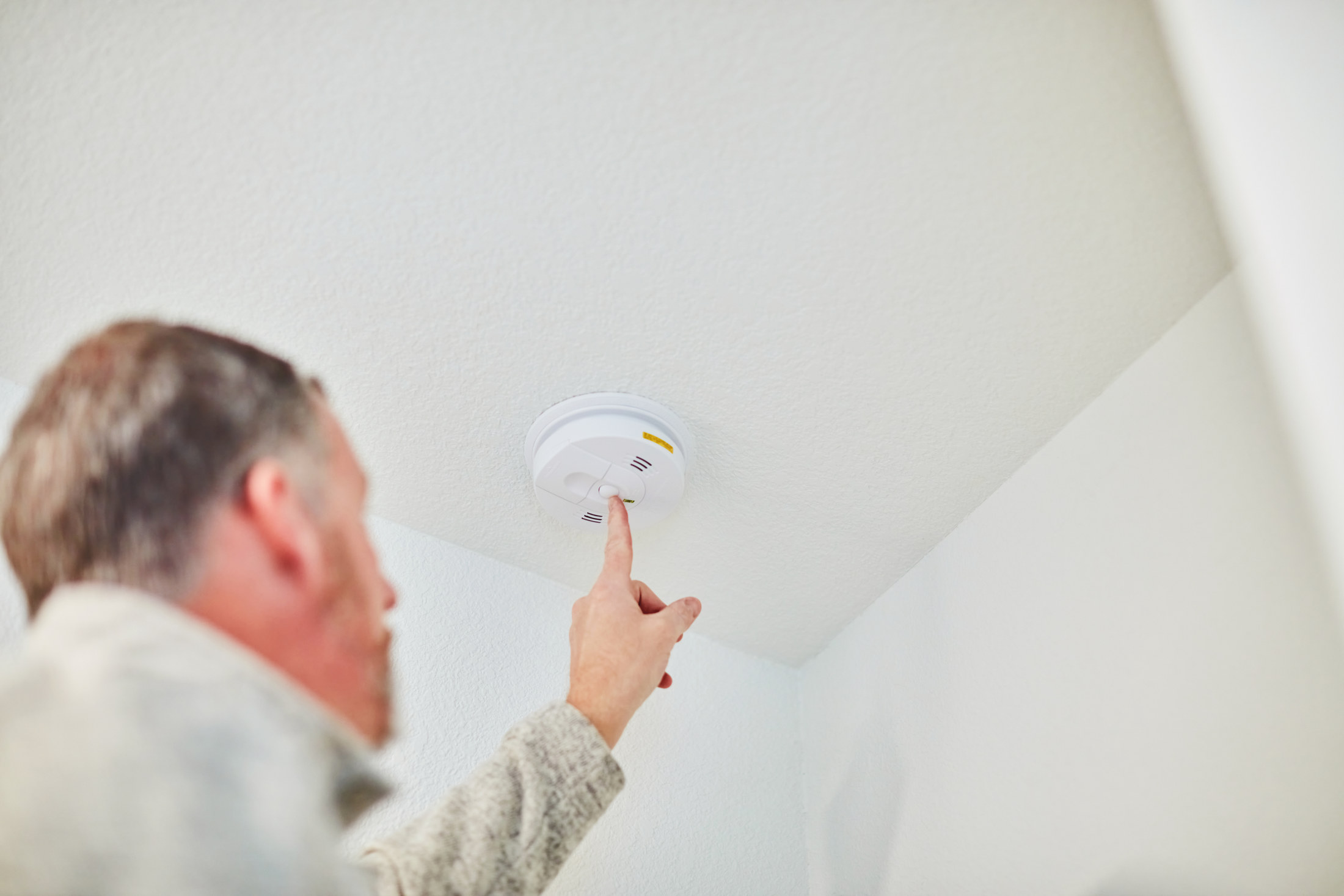
DIY GUIDE · ELECTRICAL · CHECKED OCTOBER 2026
How to fit a carbon monoxide alarm yourself
Twenty minutes an alarm. £15–£23 for a sealed-battery alarm certified to BS EN 50291.
Right room, 1 to 3 m from the appliance, high on the wall, tested weekly. Two screws — and never touch the appliance.
- Every step, start to finish
- Checked October 2026 — sources at the end
- Honest about when to call a pro
FIRST, THE HONEST ANSWER
Do it yourself, or get a electrician?
Do it yourself if…
- You are fitting a battery or plug-in alarm, not wiring one into the mains
- You have a gas, oil or solid fuel boiler, fire, stove or cooker, or a flue passing through a room
- You can follow the alarm's siting instructions and drill a wall or ceiling
- You are replacing an alarm that has reached its end of life with a new battery one
Get a pro if…
- You want mains-powered or interlinked alarms on new wiring, or a fused spur for them
- The alarm has sounded and you need the appliance checked — that is a gas or heating engineer
- You are a landlord and need a system that meets your nation's rules across a whole property
- The appliance shows warning signs: yellow flames, soot, staining, or a pilot that keeps going out
Safety first
- If the alarm sounds, open doors and windows, turn off fuel-burning appliances if you can, get everyone out into fresh air and ring the gas emergency line on 0800 111 999 for gas, or a heating engineer for other fuels. Do not go back in until the source has been found.
- Headaches, dizziness, breathlessness, nausea or tiredness that ease when you leave the house are possible signs of carbon monoxide poisoning, as HSE describes. Seek medical help.
- An alarm is a warning, not a fix. The alarm maker's own manual says it is no substitute for proper installation, ventilation and servicing of appliances and sweeping of chimneys.
- Before drilling, check the wall for cables and pipes with a detector; cables often run vertically above and below switches and sockets.
- Never open, repair or paint an alarm, and keep it away from aerosols, polishes and solvents, which the maker warns can affect the sensor.
Stop here: Stop here: new wiring, the appliance, and the landlord rules in your nation
Fitting a battery alarm is the householder's part. A mains-powered or interlinked alarm on new wiring is electrical installation work: a new circuit is notifiable in England under Part P of the Building Regulations; Wales has its own Approved Document P; Scotland works to building standard 4.5; Northern Ireland has no Part P-style scheme but the work still needs a competent electrician. Any work on a gas appliance or its flue is restricted to Gas Safe registered engineers under regulation 3 of the 1998 Gas Safety (Installation and Use) Regulations in Great Britain and the 2004 Regulations in Northern Ireland. Landlords: in England, the Smoke and Carbon Monoxide Alarm Regulations, as amended from 1 October 2022, require a carbon monoxide alarm wherever a living room, bedroom or other lived-in room has a fixed combustion appliance, gas cookers excepted; in Wales, a landlord must have one in each room with a gas, oil or solid fuel appliance; in Scotland, every home with a carbon-fuelled appliance must have one in the same room; in Northern Ireland, private landlords must fit one in any room or circulation space with a fixed combustion appliance or a flue, and replace it before its expiry date. Follow the alarm maker's instructions and use alarms to BS EN 50291. How to hire a carbon monoxide alarm fitter →
| MATERIAL | COVERAGE | FOR THIS JOB |
|---|---|---|
| Carbon monoxide alarm | Certified to BS EN 50291, sealed long-life battery | One per room with an appliance, plus bedrooms |
| Wall plugs and screws | Supplied with the alarm; use those | Two per alarm |
| Plasterboard fixings | Only if fixing to a hollow wall or ceiling | Two per alarm |
| Marker pen | For the fitting date | One |
How many alarms
Alarms = rooms with a fuel-burning appliance or a flue + bedrooms + rooms out of earshot. A house with a boiler in the kitchen, a gas fire in the lounge and two bedrooms needs four.
If the boiler is in a cupboard or a room nobody uses, the alarm goes just outside it, where it will be heard.
Look for BS EN 50291 on the box and the alarm itself, ideally with a Kitemark or other independent certification. It is the standard for carbon monoxide alarms in homes. The manual for the alarm we checked states certification to EN 50291 parts 1 and 2 and tells users to install only alarms that meet it.
A sealed battery alarm runs for its whole life without a battery change and cannot be borrowed for the remote control. The one we checked has a power pack that lasts its 7-year life, with an end-of-life signal; many now last 10 years. Write the fitting date on it; it is replaced as a whole when its life ends.
The alarm maker's guidance is an alarm in every room containing a fuel-burning appliance, and extras in bedrooms and rooms where people spend a long time, out of earshot of the others. If you can only fit a few, put them in rooms with open-flued or flueless appliances first, and where people spend most time.
A digital alarm shows the carbon monoxide level and sometimes the peak reading. It is useful for spotting a low level that is not yet high enough to sound, but a simple alarm meeting the standard protects you just as well. Choose by what you will look at.
A carbon monoxide alarm does not detect smoke, and a smoke alarm does not detect carbon monoxide. Combined units exist, but their siting is a compromise: smoke rises to the ceiling, while carbon monoxide alarms have their own distance and height rules. Separate alarms are easier to site well.
THE PART THAT DECIDES THE FINISH
Before you start — where it goes
The alarm's siting instructions are the authority; these are the cases the manual we checked describes. Find the room and the mounting you have.
Wall-mounted in the room with the appliance
The usual case, and the maker's recommended mounting.
- Measure 1 to 3 metres horizontally from the edge of the appliance
- Mount high on the wall, above the top of any door or window
- Keep at least 150 mm below the ceiling
- On the same side of any partition as the appliance
Ceiling-mounted
Where there is no suitable wall.
- Measure 1 to 3 metres horizontally from the appliance
- Keep at least 300 mm from any wall
- Keep at least 300 mm from light fittings and other ceiling obstructions
- In a room with a sloping ceiling, go on the high side
Bedrooms and rooms away from the appliance
To wake sleepers and warn people in distant rooms.
- Place it relatively close to the breathing zone of the people in the room, as the maker describes
- A bedside wall or a shelf at head height suits a bedroom
- In a bedsit, put it as far from the cooker as possible but near where the person sleeps
- For a boiler in a cupboard or room not normally used, put the alarm just outside so it can be heard
Places to avoid
Where alarms give false readings or miss carbon monoxide.
- Not directly above a source of heat or steam, such as a cooker or kettle
- Not in dusty, dirty or greasy areas, which can affect the sensor
- Not in a draught next to an extractor fan, vent, open window or door
- Not behind curtains or furniture, or anywhere the alarm cannot be heard
THE JOB
How to fit and test the alarm
Set up: decide the rooms and read the manual
10 minList every room with a fuel-burning appliance or a flue, then bedrooms, then rooms where people spend time away from the others. Read the alarm's siting section; the cards above follow the manual we checked, but your model's instructions win. Unpack the alarm and find the template, screws and plugs.
- Include rooms with a flue passing through, not just the appliance
- A gas hob or cooker alone may not need one under some nations' landlord rules, but an alarm in the kitchen is still sensible
- Write the date on the alarm now
Mistake to avoid: Putting a single alarm in the hall. Carbon monoxide builds in the room with the appliance first, and a hall alarm may sound too late or not at all.
Measure the position
10 minThis is the prep from your card above. With a tape, measure 1 to 3 metres horizontally from the edge of the appliance. On a wall, go high, above the top of any door or window, and at least 150 mm below the ceiling. On a ceiling, at least 300 mm from walls and light fittings. Check the spot is not above a heat or steam source or in a draught. Mark it.
- Measure from the appliance's nearest edge, not its middle
- Above a door means above the top of the frame
- Check you will hear it from where people sleep
Mistake to avoid: Mounting it low on the wall like a thermostat. Most alarms are sited high, and the maker's instructions say so for a reason.
Check for cables and pipes
5 minRun a cable and pipe detector over the marked spot and a hand's width around it. Avoid the zones directly above and below switches and sockets, where cables run vertically. If the detector reacts, move the position a little along the wall while keeping it within the distance and height rules.
- Detectors are less reliable on foil-backed plasterboard; go slowly
- Kitchen walls near boilers carry pipes as well as cables
- A ceiling between joists may carry cables to the light
Mistake to avoid: Drilling into a cable behind the plaster. A small hole in a live cable is a shock and a fire risk you cannot see.
Drill and fix
10 minHold the template level on the mark and mark the two holes through it. Drill to the depth of the plugs, push the plugs in, and drive the screws, leaving them standing slightly proud — the manual we checked says 3 mm — so the alarm can slide onto them. On plasterboard, use plasterboard fixings.
- Use the supplied screws; the alarm's slots are sized for them
- A level line keeps the alarm sitting straight on the screw heads
- Vacuum the dust; it gets into the sensor if you hang the alarm straight away
Mistake to avoid: Driving the screws fully home. The alarm then will not slide onto them, and forcing it cracks the case.
Activate and hang
5 minActivate the battery as the instructions show — on the model we checked, by pulling out a disabling tab, which you keep. A power light starts to flash. Slide the alarm onto the screws until it locks. Check it sits firmly and cannot be knocked off.
- Keep the disabling tab; the maker uses it to switch the battery off for disposal
- Some alarms will not lock onto their base until the battery is active
- Check the power light is flashing before you walk away
Mistake to avoid: Hanging an alarm whose battery has not been activated. It looks fitted but has no power at all.
Test it
5 minPress and hold the test button until the alarm sounds. It is loud — the one we checked is rated 85 dB at 1 metre — so keep your ear away. The test checks the sounder, the battery and the circuit. Then go to the furthest bedroom with the door closed and have someone press it again, to check it can be heard.
- Warn the household before testing
- Test weekly, as the maker recommends, for the alarm's whole life
- If it cannot be heard from a bedroom, fit another alarm there
Mistake to avoid: Testing once on the day and never again. A weekly press is the only way to know the battery and sounder still work.
Learn its signals
5 minRead the manual's page of signals. A loud continuous alarm means carbon monoxide. A single chirp once a minute usually means a fault or the end of life, not carbon monoxide; the maker we checked says it can chirp for up to 30 days before stopping. Stick a note with the signals and the gas emergency number near the alarm or on the fridge.
- Teach children what the alarm sounds like and what to do
- Know the difference between the alarm and the chirp
- Write the replacement date somewhere you will see it
Mistake to avoid: Pressing the silence button on a real alarm and going back to bed. A silenced alarm still means carbon monoxide; get out and get the appliance checked.
Maintain and replace
5 minTest weekly. Every few months, gently vacuum the case with a soft brush to keep dust out of the sensor, and wipe it only with a slightly damp cloth. Before decorating, take it down and seal it in a plastic bag, then put it back afterwards. Replace the alarm when it signals end of life or reaches the life on its label.
- No cleaning sprays, polish or paint on or near the alarm
- Have every fuel-burning appliance serviced and chimneys swept regularly; the alarm is a backup, not a service
- Landlords: check alarms at the start of each tenancy
Mistake to avoid: Leaving an alarm up past its end of life because it still has a green light. The sensor has aged and may not respond.
The mistakes that show
- Fitting one alarm in the hall instead of the room with the appliance
- Mounting it low, in a draught, or above a cooker
- Not activating the battery, or never testing it again
- Treating the alarm as a substitute for servicing the appliance
- Painting over the alarm or spraying polish near it
Stop here and get an electrician — or a gas engineer
- You want mains-powered or interlinked alarms on new wiring or a new spur
- The alarm has sounded: get out, then get the appliance checked by a Gas Safe registered engineer for gas, or a heating engineer for other fuels
- The appliance shows warning signs — yellow or orange flames, soot, staining, a pilot that keeps blowing out
- You are a landlord and need a compliant system across a whole property
| WHAT YOU SEE | WHY, AND THE FIX |
|---|---|
| Carbon monoxide alarm chirping every minute | Usually a fault or the end of the battery or sensor life, not carbon monoxide. Check the manual's signal page; if it is end of life, replace the alarm. |
| Carbon monoxide alarm going off | Treat it as real. Open windows, turn off appliances, get everyone out and ring the gas emergency line or a heating engineer. Do not go back in until the source is found. |
| Alarm goes off when cooking | It is too close to the cooker or above steam. Move it 1 to 3 metres away from the appliance and out of the steam path. |
| Alarm will not stay on its screws | The screws are too far in or out. Adjust them so they stand out by the amount the manual gives and the alarm locks on. |
| No light flashing after fitting | The battery has not been activated. Pull the disabling tab or follow the activation step in the manual. |
| Can't hear it from the bedroom | Fit another alarm in or near the bedroom, close to where people sleep. |
| Digital alarm shows a low reading but no alarm | A low level is present. Ventilate, stop using fuel-burning appliances, and have them checked; do not ignore a reading because it has not sounded. |
| Alarm past its date but seems fine | Replace it. The sensor ages and may not respond even though the light flashes. |
WHAT YOU SAVE
What it costs to do it yourself
| Sealed-battery carbon monoxide alarm | £15–£23 |
|---|---|
| Plasterboard fixings, if needed | £3–£5 |
| Total, one alarm | £15–£23 |
| DIY total | £15–£23 |
Guide prices compiled by the Locufy team from published Irish and UK provider price lists and 2026/27 cost guides. Updated 2026.
An electrician's guide price for carbon monoxide alarms usually covers mains-wired systems. A battery alarm fitted yourself costs the alarm.
RATHER NOT?
Carbon monoxide alarm fitters near you, with prices shown
The ones who cover your area, nearest first, with one score from every review. No account needed to look.
Or post the job free and let them come to you.
Press the test button weekly, as the maker recommends; put a reminder in your phone.
Vacuum the case gently every few months and keep sprays, polish and paint away from it.
A carbon monoxide alarm is electrical waste with a battery inside. Deactivate the battery as the manual shows, then take it to the electrical or battery recycling at your council's household waste recycling centre, or a retailer that takes them back. Never put it in the household bin. Find your centre on the council website or the recycling pages for your nation.
Have every fuel-burning appliance serviced and every chimney swept as their makers recommend; the alarm only tells you when that has been missed.
Fitting a battery carbon monoxide alarm: questions people ask
In the room with the fuel-burning appliance, 1 to 3 metres from it horizontally. On a wall, high up, above any door or window and at least 150 mm below the ceiling; on a ceiling, at least 300 mm from walls and light fittings. Follow your alarm's own instructions.
It depends on the nation and whether you rent. England, Wales, Scotland and Northern Ireland each have their own rules for landlords, and Scotland requires one in every home with a carbon-fuelled appliance. Every home with a fuel-burning appliance should have one.
It is the standard for carbon monoxide alarms in homes. Look for it on the box and the alarm before you buy.
Weekly, by pressing the test button, as the maker of the alarm we checked recommends, for its whole life.
As long as its label says; many are 7 or 10 years. Write the fitting date on it and replace it when it reaches the end of life or signals it.
Locufy's UK price guide puts carbon monoxide alarm installation at £50–£200 per job, typically £70 — the same three figures as the strip at the top of this page.
MORE GUIDES
More DIY guides
Sources — checked October 2026
- FireAngel — CO-9X carbon monoxide alarm user manual: siting, fixing, testing, signals, disposal
- HSE — carbon monoxide awareness: symptoms and warning signs
- HSE — domestic gas safety: frequently asked questions (the gas emergency number)
- Smoke and Carbon Monoxide Alarm (England) Regulations 2015, regulation 4
- gov.uk — smoke and carbon monoxide alarms: guidance for landlords and tenants (England, from 1 October 2022)
- Renting Homes (Fitness for Human Habitation) (Wales) Regulations 2022, regulation 5
- gov.scot — fire and smoke alarms in Scottish homes
- Smoke, Heat and Carbon Monoxide Alarms for Private Tenancies Regulations (Northern Ireland) 2024, regulation 3
- gov.uk — Approved Document P: electrical safety in dwellings (England)
- gov.wales — building regulations: electrics
- Gas Safety (Installation and Use) Regulations 1998, regulation 3
- gov.uk — recycling collections: find your council (England and Wales)
- mygov.scot — find your council's recycling centre (Scotland)
- nidirect — recycling and reusing (Northern Ireland)
- B&Q — price check: carbon monoxide alarms
- B&Q — price check: wall plugs and plasterboard fixings