DIY GUIDE · GARDEN & OUTDOOR · CHECKED OCTOBER 2026
How to trim a hedge yourself
A morning for a typical garden hedge. €140–€270 in kit you keep.
When to cut, what the Wildlife Act says, a level top, and where a ground-level trim stops.
- Every step, start to finish
- Checked October 2026 — sources at the end
- Honest about when to call a pro
FIRST, THE HONEST ANSWER
Do it yourself, or get a gardener?
Do it yourself if…
- You can reach the top of the hedge standing on firm ground, or from a low, stable platform at most
- It is your own garden hedge and you have watched it for active nests before you start
- The job is a trim of this year's soft growth, not a hard cut into thick, old wood
- You can work the face from your own side, or your neighbour has agreed to let you in
Get a pro if…
- The top is well above head height and the only way up would be a ladder leaning into the hedge
- The hedge runs along a public road or footpath where cuttings and the blade reach traffic and people
- It needs cutting down by a metre or more, or stems as thick as your wrist need removing
- An overhead electricity or phone line, a glasshouse or a conservatory sits within reach of the blade
Safety first
- Plug a corded trimmer into an RCD-protected socket and press the test button before you start; Safe Electric advises testing an RCD by its button twice a year, and a garden tool is a good reason to check it on the day.
- Run the lead over your shoulder and away behind you, and glance at it before each sweep; a severed flex is the classic garden electrical accident.
- Hold a powered trimmer with both hands on its handles at all times, and do not force it into stems that are too thick for its teeth.
- Wear safety glasses, ear protection and gloves; the HSA warns that hand-held power tools cause hand-arm vibration, which with regular, long exposure is linked to vibration white finger, so take a break every so often and keep your hands warm.
- Do not use a leaning ladder for hedge work. The HSA says never to work from the top three rungs of a ladder or the top two steps of a stepladder, and to keep three points of contact, which a two-handed trimmer makes impossible.
- Stop the motor and take the battery out, or unplug it, before you clear a jam or touch the blade.
Stop here: Anything above head height, across the boundary, or holding an active nest
Section 40 of the Wildlife Act 1976, as amended in 2000, makes it an offence to cut, grub, burn or destroy vegetation in any hedge or ditch between 1 March and 31 August. The exemption for agriculture includes horticulture, and the Department's guidance is that routine garden hedge trimming is covered by it. Section 22 still applies all year: wilfully destroying the nest or eggs of a wild bird, or disturbing a bird on a nest with eggs or young, is an offence. Work at the top of a tall hedge from a ladder is a danger the HSA treats as work at height that needs proper access, not a leaning ladder. How to hire a hedge cutter →
| MATERIAL | COVERAGE | FOR THIS JOB |
|---|---|---|
| Garden waste bags | Heavy-duty reusable bags | Two or three for a typical garden hedge |
| Blade cleaner or light oil | For sap and resin on the teeth | A wipe after every use |
| Spare battery, for cordless | Matched to your tool's battery system | Only if one charge will not finish the length |
How long the trim will take
Face to cut = two sides plus the top, so roughly three times the hedge's length. Time yourself on the first two metres of face, then scale up. If two metres takes six minutes, a 12 m hedge is about 36 m of face, so close to two hours of cutting, plus as long again for the clearing up.
Measure your own pace on your own hedge: dense box or yew is far slower per metre than loose privet, and clearing always takes longer than you expect.
A corded trimmer is light, cheap and never runs flat, but the lead is the hazard you manage all morning. Cordless suits most gardens: check the battery will cover your length of hedge, or buy a second one. Petrol is for long country hedges and is heavier, louder and more work to start than a garden needs.
A longer blade covers a wide face faster but tires your arms when you hold it level along the top. The gap between the teeth sets the thickest twig it will cut cleanly; anything fatter is a job for loppers, not for forcing the motor.
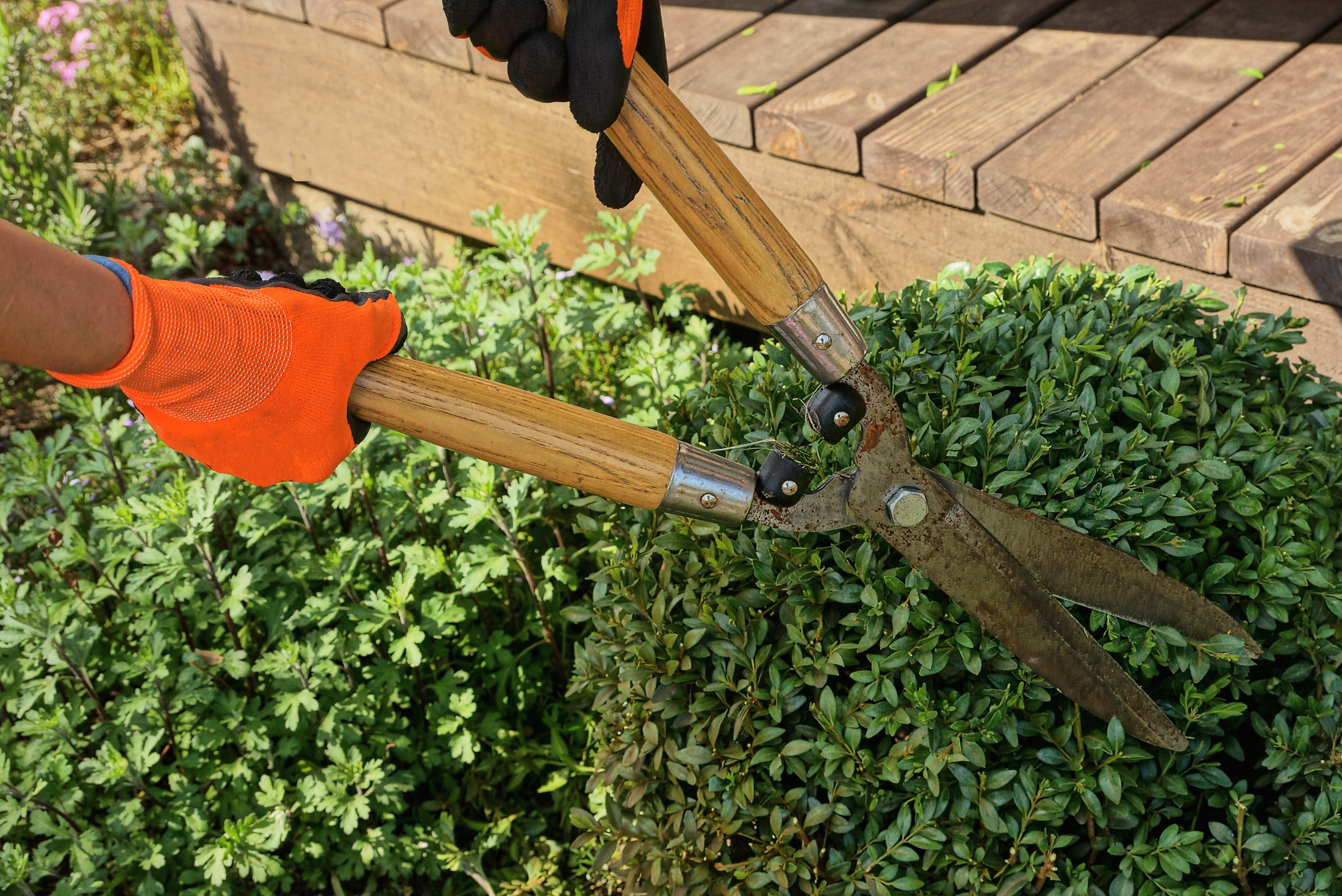
Shears give the neatest finish on small-leaved hedges such as box and lonicera and on the corners of any hedge. They are silent, they cannot cut a flex, and on a short hedge they are often quicker than unwinding a lead.
A long-reach tool lets you take the top of a hedge that is a little above your head while your feet stay on the ground. The weight is all at the far end, so work in short bursts and treat the tool as a reason not to need a ladder, not as a reason to take on a tall hedge.
A chainsaw is the tool for felling and for cutting a hedge down hard, not for trimming the face. If the stems inside are too thick for the trimmer, take them out one at a time with a pruning saw or loppers.
THE PART THAT DECIDES THE FINISH
Before you cut — by the hedge you have
The same trimmer does very different jobs on different hedges. Find yours and do its checks before the motor goes on.
A young hedge in its first few years
Planted in the last two or three seasons and still filling out.
- Trim the top lightly even before it reaches full height; a little off the top makes it branch and thicken lower down
- Shorten the side shoots of deciduous hedging such as beech, hornbeam or hawthorn to make them bush out
- Leave conifers such as thuja and cypress to establish, then trim only the sides at first
- Plan for little and often: the shape a hedge gets in its first few years is the shape it keeps
An established formal hedge
Privet, beech, griselinia, escallonia or similar, already in shape.
- Walk the length and look in for nests, from both ends and the middle
- Pick a dull, dry day; strong sun scorches the inner leaves you are about to uncover
- Set a taut line along the length at the finished height of the top
- Plan two trims a year for fast growers, and keep each one to the new growth
A conifer hedge
Leyland cypress, thuja, lawson cypress or similar evergreens.
- Never cut back into brown, leafless wood; most conifers do not regrow from it and the gap is permanent
- Trim only the green growth, a little at a time, through the growing season
- Stop trimming by late summer so the last new shoots can harden before frost
- Cover your arms; thuja sap irritates many people's skin
A flowering or informal hedge
Fuchsia, forsythia, escallonia or a mixed native hedge.
- Wait until flowering has finished, or you cut off next year's flowers
- Shape loosely with shears rather than squaring it off
- Take one or two of the oldest stems out at the base with loppers if it is getting woody
- Look very carefully for nests; dense shrubby hedges are favourite nesting sites
A hedge on a boundary or a road
A shared line, your neighbour's side, or a road frontage.
- Agree the work with your neighbour before you cut their face, and offer them the clippings
- Do not go onto their land without permission; trim only what you can reach from your side
- Along a road, the landowner has a duty to keep the hedge from becoming a hazard; do that work between September and February where you can
- Never let cuttings land on the road or footpath, and have a second person watch for traffic
THE JOB
The steps, in order
Check for nests and plan the day
15 minStart with the checks above for your type of hedge. Watch the hedge quietly for ten minutes before you touch it, looking for birds flying in and out with food or nesting material. Look into it from both ends and the middle. If you find an active nest, leave that whole section until the young have flown, even if the rest of the hedge gets done. Then decide which faces you can reach from the ground and which you cannot, and accept the second list now rather than halfway along the top.
- Birds give a nest away by their comings and goings far more than by anything you can see in the leaves
- Nests can be active outside the spring and summer months too
- Note any wire, old fence posts or tree ties buried in the hedge before a blade finds them
Mistake to avoid: Starting the trimmer and checking as you go; by the time you see the nest, the blade has been through it.
Set up the line, the sheet and the power
15 minPush a cane into the ground at each end of the hedge and tie a string tight between them at the finished height of the top. Lay a sheet along the base on the side you are cutting. For a corded trimmer, plug into the RCD-protected socket, press the test button, then reset it. Run the lead over your shoulder and back towards the socket so it trails behind you, and start at the end nearest the socket so you are always working away from it.
- Tie the string with a slip knot so you can lower it if you decide to take more off
- Charge every battery the night before
- Keep children and pets indoors while the trimmer is running
Mistake to avoid: Leaving the lead coiled at your feet in front of you, where the next downward sweep finds it.
Trim the sides first on a chest-high hedge
30–60 minStand square to the hedge with your feet apart and the trimmer held in both hands, blade flat against the face. Start low and sweep upwards in long, smooth arcs, letting the teeth do the work. An upward stroke is the safe one: if the blade snags, it comes towards you rather than down towards your leg. Keep the blade moving and take off a little with each pass; it is easy to take more off and impossible to put it back. Work along the face a blade's width at a time, overlapping each pass.
- Cut a gentle taper so the hedge is a little narrower at the top than at the base, which lets light reach the bottom
- Take off no more than a fifth of the hedge in one session as a rule of thumb
- Step back every few metres and look along the face
Mistake to avoid: Holding the blade at an angle into the hedge and gouging hollows that take a season to grow out.
Cut the top to the string
20–40 minHold the blade flat and level just above the string and walk it along the top, keeping your elbows in and the trimmer below chest height. For a top wider than your blade, cut the near half, then reach across for the far half only if you can do it without stretching. If you cannot reach the far edge, cut it from the other side or leave it. Stop at every few steps, put the trimmer down and sight along the string to check you are on line.
- On a hedge taller than your chest, do the top first and then the sides, as clippings fall onto cut faces otherwise
- A slight downward slope from the centre to each edge sheds rain and snow
- Use shears for the last few centimetres at the ends
Mistake to avoid: Lifting the trimmer above your shoulders to reach the far edge; that is when the blade wanders and your arms give out.
Square the corners and edges
15 minOnce the faces and the top are cut, take a small chamfer off each top edge and each corner with the shears. A slightly softened edge grows back squarer than a sharp arris, which tends to splay. Check the ends of the hedge from the side and trim them plumb. On a hedge that meets a wall or fence, finish the last stretch with shears so the blade does not catch the post.
- Shears give you the control a trimmer cannot at a corner
- Look at the hedge from the house as well as from the garden
- Trim in short snips rather than long cuts at the edges
Mistake to avoid: Running the trimmer flat along a fence or wall and blunting the blade on a nail or a post in one stroke.
Thin out stems that are too thick for the blade
15–30 minIf the trimmer stalls or chews instead of cutting, the stem is wider than its tooth gap. Stop, take the battery out or unplug, and cut that stem with loppers or a pruning saw just inside the face of the hedge, so the cut is hidden by leaf. On an old hedge, take out no more than one or two of the thickest stems in a year, spread along the length.
- Cut thick stems at a slight angle so water runs off
- Make the cut just above a side shoot where you can
- Keep the loppers' hook on the side of the stem you are leaving
Mistake to avoid: Pushing the trimmer through thick wood and bending the blade or burning out the motor.
Do the far face if you can reach it
30–60 minRepeat the side cut on the far face only if you can reach it from your own ground or your neighbour has agreed. Move the sheet across first. If the hedge is too wide to reach the middle of the top from either side, leave the middle slightly higher than the edges rather than overreaching. A little crown in the middle sheds water and nobody sees it.
- Ask your neighbour whether they want the clippings left or taken
- Agree a date so their washing and car are not in the way
- If you cannot reach the far face, ask them to trim it to your line
Mistake to avoid: Cutting your neighbour's side without asking and starting a row that outlives the hedge.
Clear up the clippings
30–60 minGather the sheet up by its corners and empty it into bags. Rake the lawn and beds under the hedge and pick clippings out of the hedge base by hand, because a mat of clippings left lying kills grass and harbours slugs. Shake out the inside of the hedge with a rake if a lot of clippings have lodged in it. Sort the soft green clippings from any thick stems as you bag them.
- Small soft clippings can go in the brown bin or the compost; thick stems cannot
- Run the mower over the lawn edge on a high setting to collect the last of them
- Clear the footpath outside before anyone else does it for you
Mistake to avoid: Leaving the clippings on the lawn for a week and finding brown stripes under them.
Clean and store the trimmer
10 minWith the battery out or the plug pulled, brush the leaves and sap off the blade and the vents. Wipe the blade with a cloth and a little light oil or blade cleaner along its whole length, then fit the blade guard. Check the lead from plug to tool for nicks before you coil it. Store batteries indoors, at room temperature, not in a cold shed.
- A blade dried and oiled after each use will not rust between trims
- Sharpen gently and not often; the tool maker suggests about once every fifty hours of use
- Fit the guard before you put the trimmer down anywhere
Mistake to avoid: Hanging the trimmer up wet and sticky, and finding the blade seized with resin next spring.
The mistakes that show
- Cutting into the bare brown wood of a conifer and leaving a hole that never fills
- Letting the top grow wider than the base, so the bottom of the hedge goes bare
- Trimming in hot sun and scorching the inner leaves
- Cutting through a nest that ten minutes of watching would have found
Stop here and get a gardener
- The top is out of reach from the ground and the only way up is a ladder; a two-handed trimmer and three points of contact cannot happen together
- The hedge needs a hard reduction in height or a cut back into old wood, which is a different job from a trim
- It runs beside a public road, near an overhead line or over a neighbour's glasshouse
- There is an active nest and something about the hedge must be dealt with now
| WHAT YOU SEE | WHY, AND THE FIX |
|---|---|
| Hedge turning brown after trimming | Usually cut too far into a conifer, or trimmed in hot sun. Scorched tips recover; patches cut back to brown conifer wood do not, so let the neighbouring growth cover them over the next season. |
| Hedge bare at the bottom | The top is wider than the base and is shading it. Trim the faces to a gentle taper over the next two trims and the lower branches will green up on most broadleaved hedges. |
| Ragged, torn leaf edges | A blunt or sap-clogged blade. Clean the teeth, then sharpen or replace the blade; torn leaves also let disease in. |
| Top not level | Cut by eye rather than to a line. Set a string next time and take the high spots down with shears rather than another pass with the trimmer. |
| Gaps or holes in the hedge | Shade, a dead plant, or old wood cut back. Clear anything shading the gap, and tie a nearby shoot across it to a cane so it grows in. |
| Trimmer keeps stalling | Stems thicker than the tooth gap, or a flat battery. Lop the thick stems first and swap the battery before it fades mid-sweep. |
| RCD keeps tripping | A damaged lead, a wet connection or a fault in the trimmer. Stop, check the lead along its length, and have the tool repaired; Safe Electric's advice is that an RCD tripping for no clear reason needs a Registered Electrical Contractor to check the circuit. |
| Yellow, sickly patches after the cut | Often dryness or hunger showing once the outer leaves are gone. Water deeply in a dry spell and mulch the base; patches that persist on box or privet may be disease. |
WHAT YOU SAVE
What it costs to do it yourself
| Hedge trimmer, corded or cordless | €79.95–€179.95 |
|---|---|
| Hand hedge shears | €24.99–€43.99 |
| Safety glasses and ear defenders | €24.98 |
| Gardening gloves | €3.99–€9.99 |
| Bamboo canes for the line | €8.99 |
| Total, first time | €143–€268 |
| DIY total | €140–€270 |
Guide prices compiled by the Locufy team from published Irish and UK provider price lists and 2026/27 cost guides. Updated 2026.
Almost all of it is kit you keep, so the second and every later trim costs only your time. Against an hourly rate for a hedge cutter, a twice-yearly trim pays for a trimmer within a year on most garden hedges.
RATHER NOT?
Hedge cutters near you, with prices shown
The ones who cover your area, nearest first, with one score from every review. No account needed to look.
Or post the job free and let them come to you.
After a heavy trim in a dry spell, water deeply at the base and spread a mulch of compost or bark along the roots; a freshly cut hedge loses moisture faster.
Light clippings and twigs go in your brown bin or on the compost heap, which mywaste.ie lists as the routes for light garden waste. Thicker branches do not belong in the brown bin; take them to a civic amenity site that accepts garden waste. Never dump them on a verge or in a ditch.
Clean and oil the blade, check the lead, and keep batteries indoors. When a trimmer finally dies, it is electrical waste: bring it to a WEEE drop-off point or a civic amenity site, not the general bin.
Fast growers such as privet and griselinia want two trims a year; slower hedges are fine with one. A light trim in late winter, outside the nesting season, and another in late summer suits most garden hedges.
Trimming a hedge: questions people ask
Section 40 of the Wildlife Act restricts cutting hedges from 1 March to 31 August, mainly aimed at field and roadside hedgerows. The Department's guidance is that routine trimming of a garden hedge is covered by the horticulture exemption. Destroying an active nest is an offence all year under section 22, so check before you cut.
Twice a year suits most fast-growing garden hedges, such as privet, griselinia and beech; slower ones need only one. Light, regular trims make a denser hedge than one heavy cut every few years.
Not into the brown wood. Most conifers, including Leyland cypress, will not regrow from bare wood, so a hard cut leaves a permanent gap. Yew is the exception and tolerates hard pruning.
Talk to your neighbour first. Trimming what overhangs your side back to the boundary is the usual courtesy, but do not go onto their land or cut their face without agreement, and offer them the clippings.
Not a ladder leaning into the hedge. The HSA's ladder guidance is to keep three points of contact and never to work from the top three rungs, which a two-handed trimmer rules out. Use a long-reach tool from the ground, or have it done.
The Locufy Irish price guide puts hedge trimming at €30–€70 per hour, typically €45. Ask whether the price includes taking the clippings away, since green waste removal is often extra.
MORE GUIDES
More DIY guides
Sources — checked October 2026
- Husqvarna — how to trim a hedge: timing, sweep direction, how much per session
- Husqvarna — hedge trimmer maintenance guide
- HSA — using ladders safely information sheet
- HSA — control of vibration at work toolkit
- Wildlife (Amendment) Act 2000, section 46 — section 40 as amended, 1 March to 31 August
- Wildlife Act 1976, section 22 — nests and eggs of wild birds
- gov.ie — reminder on hedge cutting and the law
- Safe Electric — home safety: RCDs and testing
- mywaste.ie — garden waste
- mywaste.ie — hedge trimmers are electrical waste
- Woodie's — price check: hedge trimmers
- Woodie's — price check: shears and loppers
- Woodie's — price check: safety glasses and ear defenders
- Woodie's — price check: gardening gloves
- Woodie's — price check: canes and stakes