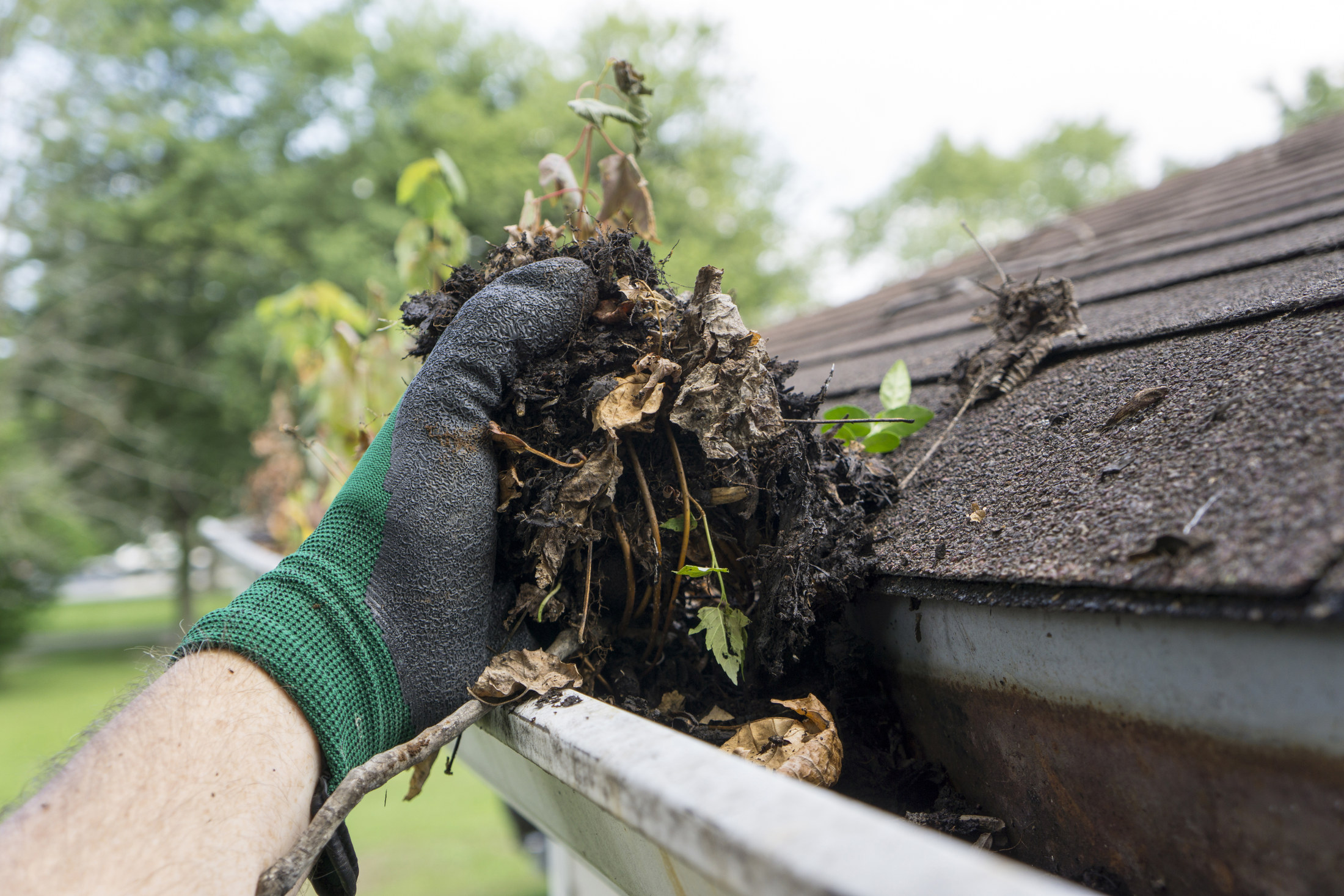
DIY GUIDE · CLEANING · CHECKED 2026-10
How to clear your gutters safely
An hour for a single-storey run. €105–185 in kit you keep.
Easy at single-storey height from a ladder set correctly. Above that, stop.
- Every step, start to finish
- Checked 2026-10 — sources at the end
- Honest about when to call a pro
FIRST, THE HONEST ANSWER
Do it yourself, or get a cleaner?
Do it yourself if…
- The gutter is at single-storey height and you can reach it with your feet below the top two rungs
- The ground at the foot of the ladder is firm and level
- Someone else is in the house and knows you are up there
- You are steady on a ladder and not working alone on a windy day
Get a pro if…
- The gutter is above a single storey — this is the line, and it is not a judgement call
- The ladder would have to stand on a slope, a flower bed, decking or a flat roof
- There is a conservatory, a lean-to or a bay in the way of a straight ladder set
- The gutter is sagging, leaking at the joints, or the fascia behind it is soft — that is a repair, not a clean
Safety first
- Set the ladder one out for every four up, about 75°, on firm level ground, and maintain three points of contact while climbing and at the work position — that is HSA guidance and it is the whole of the safety case for this job.
- HSA treats working from a ladder as short-duration work of no more than about 30 minutes in one position. Move the ladder rather than stretch; three metres of gutter per set-up is the realistic reach.
- Keep your hips between the stiles. If you have to lean out beyond that, come down and move it.
- Never stand a ladder on a pallet, a plank, a flat roof or a lean-to to gain height, and never lean it on a conservatory.
- Do not do this in wind, rain or ice, and do not do it with nobody else in the house.
- Wear gloves and eye protection: gutter silt is sharp and holds bird droppings.
Stop here: the gutter is above a single storey
A step-ladder on firm level ground is a householder's limit. Above a single storey the safety authority expects the work to be planned, with the right platform and somebody competent on it — and a long ladder with a scoop on the end is neither. The same applies the moment there is nowhere flat and solid to stand the feet. How to hire a gutter cleaner →
| MATERIAL | COVERAGE | FOR THIS JOB |
|---|---|---|
| Gutter guard or leaf mesh | Optional, by the metre | Worth it under trees; it halves the frequency, it does not end it |
| Replacement gutter clips and union seals | Only as needed | A sagging run usually wants a clip, not a whole gutter |
| Heavy-duty refuse sacks | A couple | Wet gutter silt is heavy and splits ordinary bags |
How many ladder set-ups
4 set-ups, about 80 minutes — nothing — this one is about planning the moves, not the materials
The reach figure is deliberately short. Stretching sideways from a ladder is how people fall, and HSA caps a single position at about 30 minutes anyway.
HSA guidance is one unit out for every four units up — about 75° — with three points of contact maintained while climbing and, wherever possible, at the work position. A ladder at too shallow an angle slides out; too steep and it tips back.
HSA treats working from a ladder as short-duration work of no more than about 30 minutes in one position. the Health and Safety Authority in Ireland frames the same limit in its own words. That is why this job is mostly moving the ladder: three metres of gutter per set-up, then down and across.
A stand-off holds the ladder off the wall and spans the gutter, so you are not leaning the stiles on the gutter itself — which both damages it and makes the ladder unstable. It costs little and changes the job.
A plastic scoop and a bucket hooked to the ladder is the simple way. A gutter vacuum with a camera clears from the ground and removes the ladder from the job entirely — the right answer for anyone who is not confident, and for anything above a single storey.
You need one hand for the ladder, which means the bucket hangs from a hook and the scoop is in the other hand. If a task needs both hands, it needs a tower, not a ladder.
THE PART THAT DECIDES THE FINISH
What you are standing on, case by case
This job is decided at the foot of the ladder, not at the top of it. Find your case before you climb.
Firm, level ground
The only case that is straightforwardly fine.
- Set the ladder one out for every four up and check it does not rock
- Clear the base of hose reels, plant pots and anything you might step back onto
- Open the stand-off so the stiles sit off the wall and span the gutter
- Climb and descend facing the ladder, with three points of contact
Soft ground, lawn or a flower bed
Fixable, with care.
- Use a proper ladder mat or a wide board under both feet — not a single plank on edge
- Push the feet in and test with your weight on the bottom rung before climbing
- Re-check after every move; a foot that sank on one side changes the angle
- If it still moves, stop; this is where a ladder goes sideways
A slope, steps or a driveway crossfall
Usually a stop.
- A ladder on a slope is standing on two different heights, and levelling it with packing is not safe
- Ladder levellers exist, but if you do not already own and understand them, this is not the day
- Consider working that run with a gutter vacuum from the ground instead
- Do not compensate by leaning — the reach limit gets shorter on a slope, not longer
In front of a conservatory, lean-to or bay
The commonest reason to stop.
- There is no safe ladder set that clears the obstruction — leaning the ladder on a conservatory roof is not one
- Do not stand on a flat or lean-to roof to gain height unless it is designed and guarded for it
- Clear what you can safely reach and leave the rest
- This is the typical case for a gutter vacuum or a professional with a tower
A two-storey gutter
Not a DIY ladder job.
- Both safety authorities treat work at height as something to be planned, with the right equipment and a competent person
- An extension ladder at two storeys is at the edge of its stability and well past most people's
- A gutter vacuum with extension poles clears a two-storey gutter from the ground
- Otherwise this is a tower or a professional, and the price guide has the band
Windy, wet or icy conditions
Reschedule.
- Wind catches a ladder and catches you more; a gust while you have one hand on a scoop is the scenario
- Wet rungs and wet soles are how feet slip off
- Cold hands grip badly and you will not notice until you need the grip
- Gutters are not urgent enough to do in bad weather — a week will not matter
THE JOB
How to clear a gutter
Plan the job from the ground
15 minWalk the whole run. Note where the downpipes are, where the ground is firm, and where a conservatory or bay blocks a ladder set. Decide what you will NOT be reaching before you start, rather than deciding it while up there.
- Count the set-ups you will need; three metres per set-up is the realistic figure
- Note where the water should discharge, so you can check it does afterwards
- Tell someone in the house that you are going up
Mistake to avoid: Deciding the plan from the top of the ladder. That is how people stretch sideways to avoid one more move.
Set the ladder properly
5 min per set-upOne unit out for every four up — about 75°. Both feet on firm, level ground, a mat or board on soft ground, the stand-off open so the stiles clear the gutter. Push down on the bottom rung and make sure nothing rocks or sinks.
- Four up, one out. It is the only ladder rule most people remember, and it is the one that matters
- Never lean the stiles on the gutter itself — it crushes plastic and lets the ladder slide
- Test with your weight before you commit to the climb
Mistake to avoid: Setting the ladder too upright to reach higher. A steep ladder tips backwards, and it does it when you lean out at the top.
Hook the bucket and climb
2 minHang the bucket from an S-hook on a rung at a comfortable height. Climb facing the ladder with three points of contact, and keep your hips between the stiles throughout.
- Hips between the stiles is the simple test for whether you are over-reaching
- One hand for the ladder at all times — that is what three points of contact means here
- Carry nothing in your hands while climbing; the bucket goes up on the hook
Mistake to avoid: Carrying the scoop and the bucket up by hand. You then have no hand for the ladder on the most dangerous part of the job.
Scoop out the bulk
15 min per set-upWork from the end nearest the downpipe backwards, so you are not pushing debris into it. Scoop into the bucket rather than dropping it. Clear about 1.5 m either side of the ladder, then stop.
- Away from the downpipe, always — pushing silt into a pipe turns a clean into a rodding job
- Into the bucket, not onto the ground, unless you want to clear the border afterwards
- Stop at the limit of comfortable reach, every time
Mistake to avoid: Stretching to get the last half metre instead of moving the ladder. This is the single action that causes falls in this job.
Come down and move the ladder
5 min per set-upDown, bucket off, ladder moved, ladder re-set and re-tested. HSA caps one ladder position at about 30 minutes; most of this job is this step, and that is correct rather than inefficient.
- Empty the bucket each time; a full bucket of wet silt is heavy and unbalances you
- Re-test the footing after every single move
- If you find yourself resenting the moves, that is the signal to get a gutter vacuum
Mistake to avoid: Shuffling the ladder sideways while standing on it. People do it to save a climb, and it is how a ladder goes over.
Brush out the silt
10 minOnce the bulk is out, brush the remaining silt towards the bucket with a stiff hand brush. Silt is what holds water and feeds moss, so the brush-out is not cosmetic.
- A stiff brush, not a wire one — wire scores plastic gutters
- Check the fall as you go: standing water means the gutter has dropped between clips
- Look at the fascia behind the gutter while you are there
Mistake to avoid: Leaving the silt because the leaves are gone. Silt is the part that holds the water against the fascia.
Flush and prove the downpipes
15 minPour water in at the far end of each run and watch it discharge at the bottom. If it backs up, the downpipe is blocked — try a snake or drain rods from the bottom.
- Watch the OUTLET, not the gutter; a gutter can look clear while the pipe is blocked
- Check where it discharges — a gully that is itself blocked gives the same symptom
- A hose is easier than a watering can if you can get one up there safely
Mistake to avoid: Declaring the job done without flushing it. A clear gutter above a blocked downpipe overflows in exactly the same way.
Check the gutter itself
10 minFrom the ladder, look at the joints, the clips and the fascia. Note anything sagging, dripping or soft, and photograph it from the ground.
- Photograph anything you are unsure about and look at it properly later
- A gutter holding water in the middle of a run needs a clip, which is a small job
- Soft or dark fascia behind the gutter is a repair and a different trade
Mistake to avoid: Fixing a sagging gutter from a ladder while you are up there. Clip work needs both hands, and both hands means a tower.
Clean up and put the kit away
15 minBag the silt — it is heavy, so use strong sacks and do not overfill them. Rinse the tools. Note the date.
- Gutter silt is mostly organic and can usually go in a garden-waste collection; grit and moss may not
- Write the date somewhere — under trees, this is twice a year
- Store the stand-off with the ladder so you actually use it next time
Mistake to avoid: Leaving wet silt in bags against the wall. It stains render and it is heavier than it looks a week later.
The mistakes that actually hurt people
- Stretching sideways instead of moving the ladder
- Leaning the ladder stiles on the gutter instead of using a stand-off
- Standing a ladder on something to gain height, or on a lean-to roof
- Doing it alone, in the wind, with nobody in the house
Stop here and get a professional
- The gutter is above a single storey — both authorities expect work at height to be planned with the right equipment and a competent person, and an extension ladder with a scoop is neither
- There is no safe place to stand the ladder: a slope, a bed, decking, a conservatory or a bay in the way
- The gutter is sagging, dripping at the joints, or the fascia behind it is soft — those need both hands and a stable platform
- A downpipe will not clear from the top or the bottom, which may mean a blockage below ground
| WHAT YOU SEE | WHY, AND THE FIX |
|---|---|
| Water still overflows after cleaning | The downpipe or the gully below it is blocked, not the gutter. Flush from the top and watch the outlet; rod the pipe from the bottom. |
| Water stands in the middle of a run | The gutter has dropped between clips, so it no longer falls to the outlet. It needs a clip refitting — both hands, so not from a ladder. |
| It drips at a joint | The union seal has perished or the joint has been forced. A new seal is cheap; getting to it safely is the hard part. |
| Water runs down the wall behind the gutter | Either the gutter has pulled away from the fascia or the roof felt is not dressed into it. The second one is a roofer's job. |
| The gutter fills again within weeks | Trees. A leaf guard will halve the frequency but not end it; plan on clearing it twice a year rather than hoping. |
| The downpipe will not clear with rods | It may be blocked at a bend or below ground. Stop before you force it apart — a cracked underground pipe is a far bigger job. |
| The fascia behind the gutter is soft or dark | Water has been getting in for a while. This is a repair, and painting or re-clipping over it only delays it. |
| There is a nest in the gutter or the downpipe | Stop and check before clearing it. Nesting birds are protected during the season in both markets, and the timing matters. |
WHAT YOU SAVE
What it costs to do it yourself
| Ladder stand-off | €45–80 |
|---|---|
| Gutter scoop, brush, bucket and hook | €20–35 |
| Gloves, eye protection, heavy sacks | €15–25 |
| Ladder mat or board for soft ground | €25–45 |
| Total, first time | €105–185 |
| DIY total | €105–185 |
Guide prices compiled by the Locufy team from published Irish and UK provider price lists and 2026/27 cost guides. Updated 2026.
Nearly all of this is kit you keep, so the second clear-out costs nothing. A gutter vacuum is a bigger purchase and the right one if a ladder is not for you.
RATHER NOT?
Gutter cleaners near you, with prices shown
The ones who cover your area, nearest first, with one score from every review. No account needed to look.
Or post the job free and let them come to you.
From a window. It is the only test that counts, and it takes two minutes.
Twice a year under trees, once otherwise — late autumn is the one that matters.
It halves the work. It does not remove it, and a blocked guard is worse than no guard.
A photo and a date. Small gutter faults get expensive slowly.
Clearing gutters from a ladder: questions people ask
At single-storey height, with the ladder set one out for every four up on firm level ground, a stand-off spanning the gutter and three points of contact — yes. HSA treats it as short-duration work of no more than about 30 minutes in one position, which is why the job is mostly moving the ladder.
About 1.5 m either side, so roughly 3 m of gutter per set-up. Keep your hips between the stiles; if you have to lean out past that, come down and move it. Over-reaching is the action that causes the falls.
Not from a ladder with a scoop. Above a single storey this is work at height that needs planning and the right equipment. A gutter vacuum with extension poles clears it from the ground, which is the DIY answer.
Twice a year under trees and once otherwise, with the late-autumn clear being the one that matters. If it blocks within weeks, a leaf guard will halve the frequency.
Almost always the downpipe or the gully below it rather than the gutter. Pour water in at the top and watch the outlet; if it backs up, rod the pipe from the bottom.
Bag it in strong sacks — wet silt is heavy. Mostly organic silt can usually go with garden waste, but grit and moss may not; your local civic amenity site (mywaste.ie lists them) will say.
MORE GUIDES